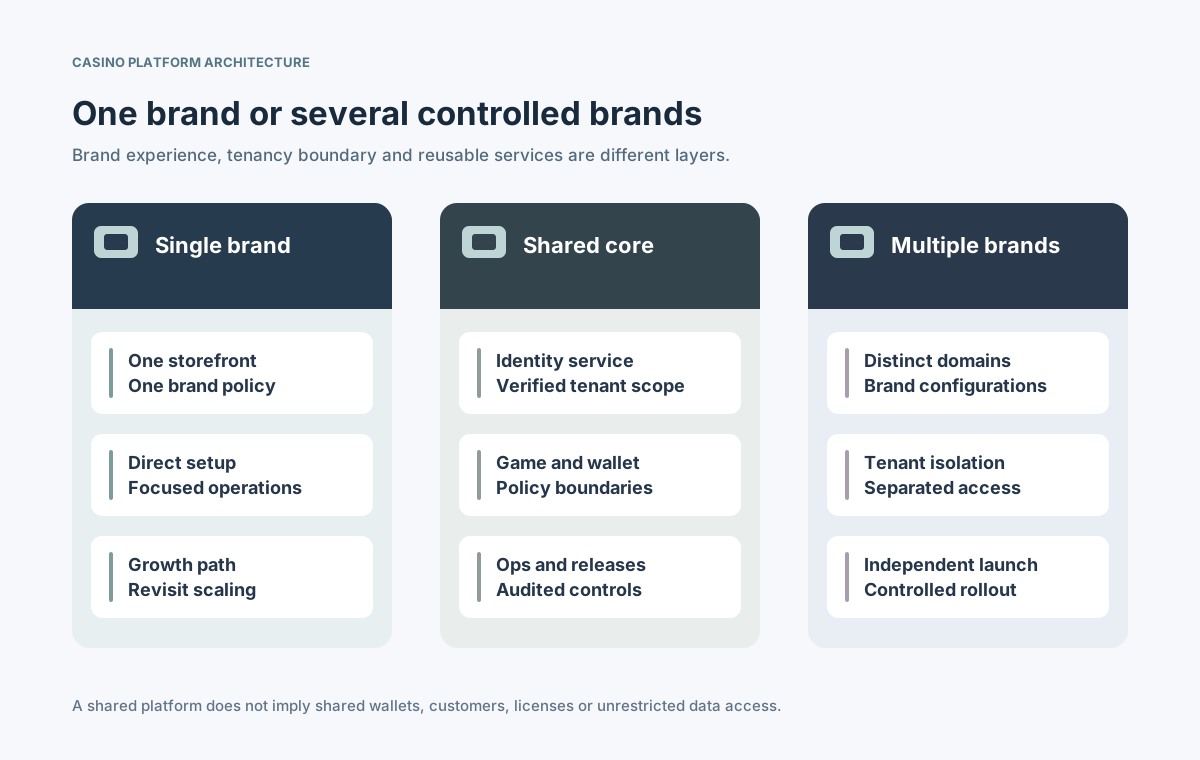
An operator planning one casino website faces a different architecture decision from a business preparing several brands, domains or markets. A single-brand platform concentrates configuration and operations around one brand; a multi-brand platform adds controlled reuse across distinct branded experiences. However, sharing code does not automatically permit sharing player accounts, funds, licenses or personal data. The important choice is how brand, operator and technical tenant boundaries map to services, storage and governance. This guide compares deployment models, isolation controls, release processes and practical decision criteria without treating either pattern as universally superior.
Published
Several frontends can reuse a platform while preserving separate brand configuration and access boundaries.
On this page
What separates a single-brand from a multi-brand casino platform?
A single-brand platform is designed and operated for one branded casino experience. It may still use multiple services, environments and markets. A multi-brand platform serves several distinct brands using some shared technology, such as account services, a game integration layer, content tooling or deployment automation. Neither label alone reveals the strength of data isolation.
The contrast is an operating model, not merely the number of domain names. Two websites may be skins of one brand, while one operator can run legally and commercially distinct brands. Start with ownership, contract, regulatory and player-data boundaries before deciding what technology to share. [1] [2]
How do brand, tenant, operator and domain differ?
A brand describes a customer-facing identity; a legal operator is the entity responsible for relevant operations and obligations; a tenant is the isolation and administration unit chosen by the software design; a domain is an address. These can map one-to-one, one-to-many or many-to-one. Record the mapping explicitly instead of inferring access rights from a URL.
Boundary
Typical responsibility
Do not assume
Brand
Visual identity and product proposition
One brand equals one legal entity
Tenant
Administrative and data isolation scope
Tenant equals domain
Operator
Contracts and regulated accountability
One license covers every market
Domain
Routing, SEO and certificates
Hostname proves authorization
Market
Eligibility, currency and rules
Same settings apply everywhere
Environment
Test, staging or production boundary
A staging brand is live
Use immutable internal IDs for each dimension and an approved mapping table for active relationships. A request that includes brand_id must still be authorized against the authenticated tenant and requested resource; client-supplied identifiers cannot grant cross-brand access. [3] [4]
Which frontend and domain settings belong to each brand?
Brand-specific frontends commonly need their own domain, languages, theme, navigation, promotional copy, legal pages, country targeting and content. Centralize these differences as typed, versioned configuration rather than copying application logic into dozens of forks. Preserve canonical and hreflang decisions per real page and market, not merely per brand color palette.
Resolve domains to an approved brand and tenant on the server before reading private data.
Version themes, content and configuration with review and rollback controls.
Keep brand-specific assets and secrets in scoped storage with deliberate cache keys.
Test localizations, redirects, consent and responsible-gambling links for each storefront.
A shared frontend component library can coexist with different content and customer journeys. The tradeoff is that one accidental global setting may affect several brands; treat configuration promotion as a production deployment with an accountable owner.
How should common services and tenant boundaries be organized?
A multi-brand design can share an API gateway, provider adapter, content engine, payment orchestration and observability while isolating brand-specific records. Choose a pool, bridge or silo arrangement service by service: shared infrastructure with scoped records, a hybrid, or separately deployed stacks. Microsoft and AWS describe isolation as a design spectrum, not one universal architecture. [1] [2]
Define the brand-to-tenant mapping and its source of truth before onboarding.
Classify every service as shared, tenant-scoped or fully dedicated.
Require a verified tenant context in APIs, queues, jobs and storage access.
Document failure domains, data ownership and recovery responsibilities.
⊕View largerThe shared technology layer needs authorization and isolation controls even when storefronts look independent.
Sharing code does not force shared databases or shared player identities. A dedicated ledger and payment environment may coexist with a shared game catalog. Evaluate each component's security and latency needs instead of forcing every service into the same tenancy model.
Can wallets, games and payments be shared across brands?
Common adapters can connect several brands to game suppliers or payment partners, but entitlements, currencies, limits, transactions and reporting must be resolved in the correct scope. A single game integration does not mean every brand may show every title. A shared wallet is a separate legal and financial product decision, not an automatic consequence of shared login.
Component
Reusable layer
Required brand control
Game API
Provider adapter and monitoring
Catalog, market and contract rights
Wallet
Ledger implementation and idempotency
Player/brand funds and transaction scope
Payments
Gateway orchestration
Merchant, region, currencies and risk
Bonuses
Rule engine and event bus
Eligibility, budget and exclusions
Player account
Identity technology
Consent, ownership and visibility
Test for cross-brand leakage through searches, exports, callbacks and cache entries as well as normal gameplay. An account or payout endpoint must reject requests whose verified player, operator or tenant scope does not match the target resource. [3] [4]
How do brand onboarding and releases change?
For one brand, deployments and configuration changes normally have a concentrated blast radius. For several brands, onboarding is a repeatable product capability: domain verification, certificate provisioning, tenant IDs, configuration, supplier entitlements, payment credentials, observability and acceptance testing must all be recorded. AWS SaaS Lens treats repeatable tenant onboarding as a design concern. [6]
Create the brand and tenant record with owners, markets, permitted products and isolation mode.
Provision scoped domains, secrets, storage, suppliers and monitoring without manual copying.
Validate configuration in staging, then roll out by brand or cohort with a rollback route.
Run cross-tenant regression tests and confirm the new brand cannot access other records.
A shared code release can cause a shared incident. Feature flags, canary cohorts and per-brand maintenance windows reduce risk only when their configuration is tested and auditable. Avoid permanent code forks that silently diverge across brands.
Which data-isolation controls prevent cross-brand access?
Tenant isolation has to apply throughout the request path: authentication, object authorization, database queries, caches, storage, exports, event consumers and internal admin tools. Resolve tenant context from trusted server identity and membership; do not trust a brand parameter in the browser or a queue event as standalone proof. OWASP recommends explicit tenant-scoped enforcement. [3] [4]
Deny by default and authorize every resource/action with validated tenant membership.
Use tenant-aware database policies or deliberate schema/database separation for sensitive data.
Include tenant scope in cache and object-storage keys, logs, rate limits and background jobs.
Test cross-tenant IDs, replayed requests, exports, queues and privileged support functions.
Infrastructure namespaces can help isolate workloads when Kubernetes is used, but they are not a complete end-user authorization system. Shared clusters require security policies, quotas and networking controls; dedicated resources may be more appropriate for some regulated or high-risk tenants. [5]
How do reliability, observability and recovery differ?
A single-brand incident usually affects one storefront, while a shared-core failure can affect many brands at once. Monitor the platform overall and by verified tenant without exposing sensitive player data. Limit noisy-neighbor effects with queue quotas, workload controls, capacity planning and isolation for high-demand brands. [1] [5]
Risk
Single-brand concern
Multi-brand safeguard
Shared outage
One storefront unavailable
Isolate service blast radius
Traffic surge
Scale one demand profile
Per-tenant quotas and capacity
Bad configuration
One setup may break
Version and scoped rollback
Data recovery
Restore one environment
Tenant-safe backup/restore tests
Observability
Single operational context
Segment metrics and audit scope
Backups and restore procedures are especially important: restoring a full shared database to recover one brand can overwrite another brand's newer transactions. Practice tenant-safe recovery, financial reconciliation and incident communication before promising independent recovery targets.
When do governance, licensing and economics favor each model?
A single-brand setup usually offers simpler initial governance and fewer configuration paths. Multi-brand reuse may spread core engineering and supplier integration costs over several products, but adds isolation testing, tenant-aware support, configuration management and cross-brand incident exposure. Compare total operational cost, not only the expense of launching the second frontend.
Map each brand, domain, operator, merchant account and relevant market to approved ownership.
Check supplier and payment agreements before reusing credentials or game content.
Estimate onboarding effort, tenant operations, on-call coverage, data separation and migration costs.
Decide whether a shared release schedule fits different brands' risk and compliance needs.
Do not assume that multiple sites require multiple licenses everywhere, or that one license authorizes all brands and regions. The licensing and commercial model must be evaluated by qualified local specialists alongside the technical design.
What should teams check before choosing single or multi-brand?
Build a decision matrix using the expected number of brands, operators, markets, product differences, data isolation requirements and operational maturity over the next two years. A single-brand architecture can be the right fit even for a large business; a multi-brand platform is useful only when shared services deliver value without compromising isolation or agility.
List proposed brands, domains, legal owners, player relationships and regulatory markets.
Draw the tenancy model for identity, wallet, providers, payments, data, support and reporting.
Prototype second-brand onboarding, cross-brand attacks, rollout rollback and recovery.
Compare total cost, support load and failure impact before approving architecture.
The key question is not simply how many casino frontends can run on one codebase. It is whether the organization can operate every brand with a clear owner, independently enforced policy and evidence that shared technology has not blurred customer or financial boundaries.