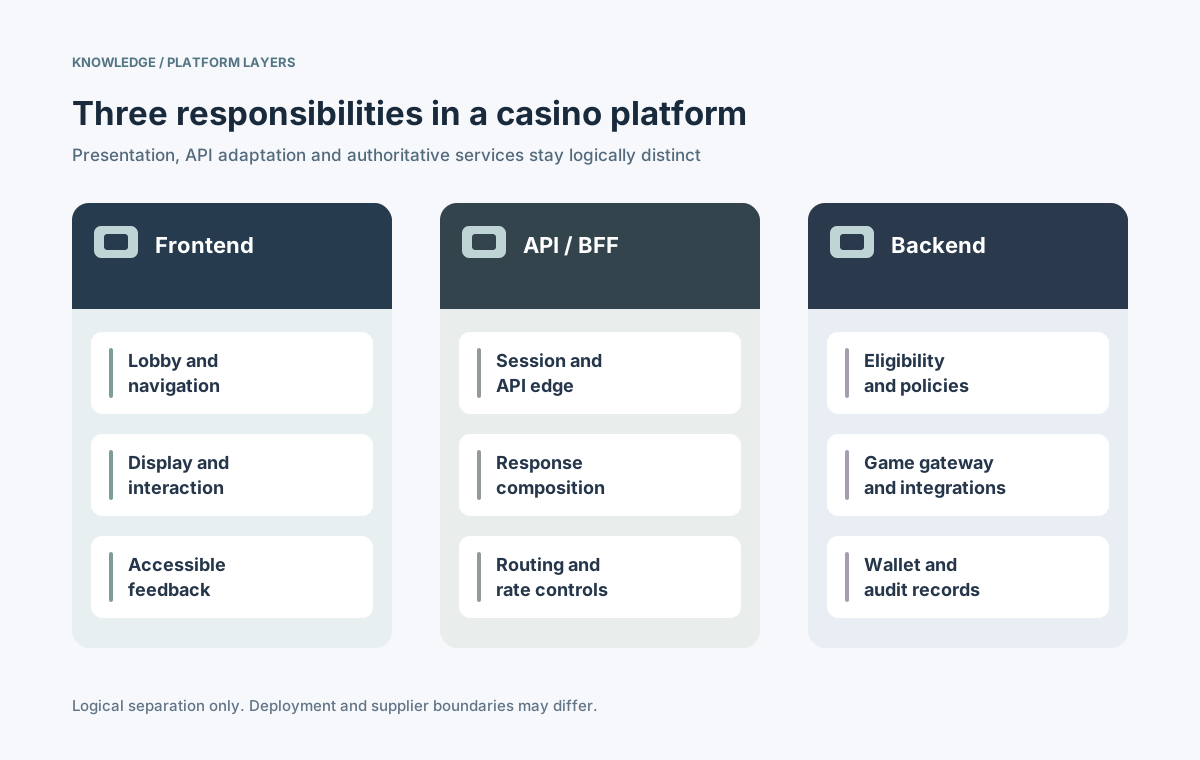
An online casino frontend is the player-facing experience: the lobby, navigation, account views, game entry points and feedback on actions. The backend is the controlled system that checks identity and eligibility, coordinates integrations, records authoritative transactions and returns decisions to that experience. The boundary is not simply a choice of programming language or where HTML is rendered. This guide maps each layer's responsibilities, follows a game launch across the API boundary and explains how teams can design secure contracts without confusing an attractive interface with a working casino platform.
Published
Conceptual frontend, API boundary and backend. Visual presentation is separate from authoritative decisions.
On this page
What is the difference between a casino frontend and backend?
The frontend is what a player interacts with: web pages, responsive layouts, menus, buttons, accessibility features and status messages. The backend processes requests behind those screens and returns data or a decision. In web systems the browser and server communicate through requests and responses, but server-side rendering may also produce part of the visible page. That does not move authoritative business logic into the browser. [1]
The useful distinction is responsibility and trust. A frontend may ask to open a game or display a balance; it should not decide which account may wager, settle a round or modify the ledger. A backend can be a modular monolith or several services. Neither architecture is automatically safer or more scalable without appropriate contracts and operations.
Which capabilities belong to the casino frontend?
The frontend turns platform capabilities into understandable journeys. It renders the game lobby, categories, filters, promotions, account information and support entry points. It handles local interaction state, input hints, loading states and accessible feedback. Content and permissions still arrive from the platform; a hidden button or disabled field is not an authorization control. [5]
Frontend area
Player-facing job
Required backend contract
Lobby and search
Display eligible titles and filters
Catalog response with available content and restrictions
Game entry
Show launch and recovery states
Authorized launch request and session reference
Account area
Present profile, limits and preferences
Authenticated profile data and permitted updates
Balance display
Show server-confirmed figures and pending states
Authoritative balance and transaction-status endpoints
Messages
Explain errors and next steps
Stable error codes and support references
Accessibility
Provide keyboard, focus and readable interactions
Consistent content labels and predictable state responses
Good frontend engineering includes small-screen layouts, localization, graceful loading, keyboard access and clear empty or error states. Web Vitals such as LCP, INP and CLS can help assess loading, responsiveness and visual stability; they do not measure whether platform transactions are correct. [5][6]
What must the casino backend control?
The backend is responsible for the checks and records that cannot be trusted to a player-controlled device. It authenticates the relevant session, authorizes access to account-specific data, applies eligibility and limit rules, coordinates providers and payment services, and records results that can be reconciled. Individual systems may be supplied by different vendors, but the operator still needs a clear ownership map.
Account identity, access rights, market eligibility and restrictions are checked on the server for each protected operation.
Game catalog and launch gateways resolve approved providers, products, configuration and short-lived launch context.
Wallet, payment and settlement components maintain authoritative transaction references, status transitions and audit history.
Backoffice and support services can inspect platform state without treating the browser as a trusted record.
Monitoring, incident controls and integration adapters handle unreliable dependencies and trace failures.
OWASP's API security guidance highlights broken object-level authorization as a major risk. Every account, game and transaction API must enforce access to the requested resource, regardless of what the frontend hides or displays. [3]
How does a game launch move through the layers?
A game launch illustrates the separation without requiring the frontend to know provider credentials or settlement details. The player selects a title; the interface sends a request containing an approved reference, not a self-declared permission. The platform establishes whether that account and game can be used and produces a bounded launch response.
Frontend shows a catalog item using the current platform-supplied availability and receives the player's launch intent.
API edge validates the application session and passes the request to the appropriate platform service.
Backend verifies account status, product, market, limits and the relevant game-provider integration.
Backend returns a scoped launch context or a structured refusal; frontend renders the result without inventing success.
Subsequent round and wallet events are processed and recorded by the contracted services; the interface reads confirmed state.
⊕View largerA launch request crosses controlled boundaries; each service retains its own responsibility.
A launcher URL or embedded game frame is not proof that an account or transaction is valid. If the browser closes, the API times out or a provider callback arrives late, the platform must still know the actual session status. Detailed game aggregation and wallet design are covered by separate Knowledge Hub topics.
Where do API gateways and backends-for-frontends fit?
An API gateway can provide routing, rate controls and common entry-point protections. A backend-for-frontend (BFF) can assemble responses specifically for a web lobby, native application or another channel. These are design options, not mandatory boxes. A BFF should adapt the presentation contract without becoming an alternative wallet or bypassing the underlying authorization service. [2]
Layer
Useful responsibility
Boundary to protect
Browser or app
Render views and gather user intent
No secret provider credentials or authoritative balances
API gateway
Route, authenticate at the edge, limit traffic
A gateway check does not replace object authorization
BFF if needed
Combine channel-specific view data
Do not duplicate business rules across channels
Domain services
Enforce eligibility and coordinate actions
Keep decisions consistent for all clients
Systems of record
Persist wallet, rounds and audit evidence
No direct writable access from player clients
A small platform may use one well-defined API layer. Multiple channels may justify a BFF, but adding services solely to make an architecture diagram look sophisticated can increase operational complexity. Choose boundaries by ownership, traffic, coupling and failure isolation. [2]
How should identity, sessions and authorization work?
Frontend state is not the same as an authenticated session. A browser can lose storage, repeat requests or be modified by its user. Session credentials must be issued and validated under server-controlled rules; the platform must authorize each protected operation against the authenticated account and relevant resource. OWASP's session guidance describes protecting session identifiers, expiry and lifecycle. [3][4]
Authenticate or link the user through the approved flow and establish a server-recognized session.
Protect session tokens against disclosure; use suitable cookie and transport controls for the web channel.
Validate permissions, account status and object ownership inside the backend, not only at the gateway or UI.
Expire, revoke or step up authentication when risk or account status changes; tell the frontend how to recover safely.
The client should receive the minimum data required for its current view. Keep service secrets, provider keys, administrative actions and sensitive internal identifiers outside delivered HTML and JavaScript. A frontend permission flag may improve UX but must never be the final security decision.
Why must balance and game outcomes remain authoritative?
The frontend may format amounts, show a pending operation or animate a successful response. It cannot be the accounting engine. The backend and contracted systems must decide how a request is accepted, identify its transaction, handle provider callbacks and reconcile the final result. An animation, a delayed browser response or an iframe event is not a reliable settlement record.
Use stable transaction and game-session references so support and reconciliation can identify an operation across services.
Make sensitive commands idempotent or otherwise safe against duplicated taps, webhook retries and network resends.
Model pending, completed, rejected and uncertain outcomes explicitly; the UI should query confirmed status after a timeout.
Retain operator-visible audit and correction workflows independently of the player's browser session.
The exact wallet model, provider settlement protocol and payment arrangement depend on contracts and market obligations. Those are separate architectural decisions. The boundary principle remains constant: the client displays a value, while trusted systems determine and record it.
What changes between desktop, mobile and embedded channels?
A desktop browser, mobile web view and native application can use related platform APIs but have different input methods, lifecycle events, network conditions and navigation needs. A Mini App or other embedded surface may add another hosting environment. This changes interface design and sometimes response composition; it does not justify separate eligibility or wallet rules. [2][5]
Channel concern
Frontend decision
Platform contract
Small screens
Prioritize critical actions and readable state
Compact responses and pagination where useful
App interrupted
Restore the view after suspension
Recoverable session and operation status
Slow connection
Use skeletons, retries and honest error states
Bounded requests, timeouts and idempotent commands
Localization
Translate labels, amounts and help content
Locale-aware metadata and consistent canonical IDs
Assistive technology
Support focus, contrast and semantic controls
Reliable labels, errors and accessible task completion
The right adaptation is measured with real client devices and journeys. A visually identical screen can behave quite differently with touch, keyboard navigation, constrained webviews or intermittent networks. Accessibility requirements are design inputs, not a final polishing task. [5]
How should both layers be measured and debugged?
A page can load quickly while the game-launch API repeatedly fails. Conversely, a correct backend can still feel unusable if the interface blocks input or jumps during rendering. Measure browser experience and server operations separately, then connect them through request and correlation IDs. Core Web Vitals describe visible loading and interaction; traces, metrics and logs help locate service failures. [6][7]
Frontend: track task completion, LCP, INP, CLS, JavaScript errors, accessibility and recovery from interrupted journeys.
API edge: observe authentication failures, response status, latency distributions, rate limits and abnormal traffic.
Operations: keep one correlation reference through the user action, API, domain service and support record when permitted.
Use graceful degradation for nonessential lobby widgets but fail safely on protected operations. Test duplicate commands, expired sessions, unavailable providers and late responses. The user interface should explain what is known and offer recovery without promising an outcome that the backend cannot confirm.
What should a frontend and backend contract specify?
A procurement or implementation brief should make the boundary reviewable. Naming a supplier as the 'frontend vendor' or 'platform vendor' does not define who owns authentication, API evolution, data, incident response or audit evidence. Document those responsibilities and test the complete journeys before accepting a delivery.
List player journeys and map each screen to an API contract, authoritative owner and permitted action.
Specify authentication, authorization, data exposure, rate controls and session recovery at every boundary.
Agree on game-launch and wallet status models, error codes, retries, reconciliation references and provider responsibilities.
Set measurable UX and backend reliability targets, instrumentation, accessibility checks and localization acceptance criteria.
Test negative paths on actual channels: rejected eligibility, duplicated requests, stale data, provider outage and interrupted sessions.
The practical distinction is not design versus code. It is an interface that communicates with people versus trusted systems that make and preserve business decisions. A successful casino platform needs both layers connected by clear, testable contracts.