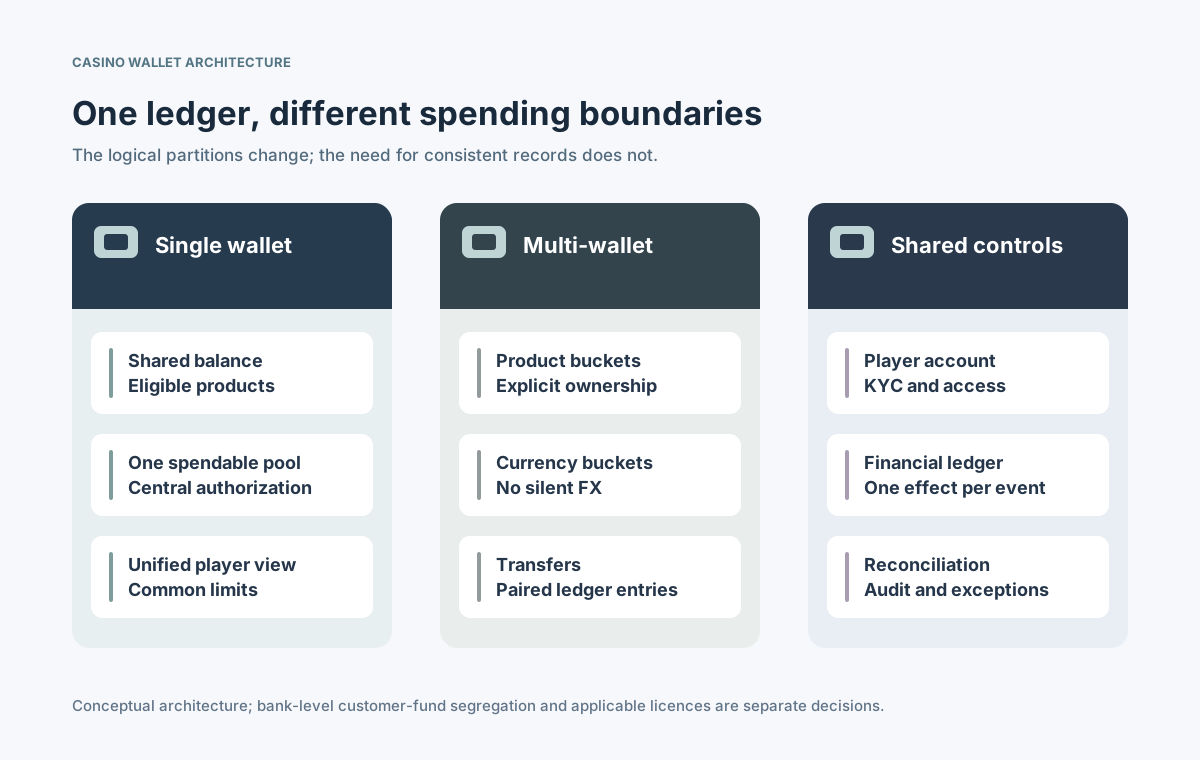
A casino wallet is more than the number shown beside a player's name. It is a controlled view of funds available for eligible transactions, backed by recorded debits, credits, reservations and settlements. A single-wallet design exposes one spendable pool across permitted products; a multi-wallet design deliberately separates balances by product, brand, currency or another justified boundary. Neither option removes the need for an authoritative ledger, payment reconciliation or player protection. This guide compares those models from the viewpoint of a platform buyer, architect and operations team, including the cases where separation is required and the cases where it merely adds friction.
Published
One pooled balance or several controlled balances: the accounting record remains authoritative.
On this page
What is a casino wallet, and what is it not?
In casino software, a wallet is the platform's way of authorizing and displaying monetary value a player may use. It can expose cash, bonus and reserved amounts, but the visible balance is a derived view, not a substitute for the underlying transaction journal. The wallet service should answer what can be spent now, by whom, in which currency and under which restrictions.
A software wallet is also not the same thing as a bank account, payment institution or legal safeguard for customer funds. In Great Britain, UK Gambling Commission guidance distinguishes the segregation of customer funds from the user-facing account display; requirements depend on licence type and the operator's role. Never assume that creating two database wallets fulfils a fund-segregation obligation. [1] [2]
How do single-wallet and multi-wallet models differ?
A single-wallet platform lets an eligible player spend from one available pool across supported games or products without an internal balance transfer. A multi-wallet platform holds separate spendable partitions, such as casino versus sportsbook, individual brands or currencies. Both can share one player identity and one accounting engine.
Design question
Single wallet
Multi-wallet
Player experience
One visible eligible spending pool
Several clearly labelled balances
Product switching
Usually no internal transfer
Transfer or separate funding may be needed
Currency handling
One wallet currency or explicit sub-balances
Separate currency wallets and FX rules
Brand boundaries
Common pool only where permitted
Explicit brand-level separation
Bonus allocation
Rules applied within the shared pool
Bonus eligibility may be wallet-specific
Operations
Fewer transfers, shared exposure
More transfer and reconciliation events
Multi-wallet does not automatically mean better security, and single-wallet does not mean every product can legally share funds. A partition only works when authorization, transfer policy, ledger entries and reporting consistently enforce it. The right design begins with the operator's actual product and market boundaries.
Why must the ledger be separate from the displayed balance?
The ledger is the durable record of economic events: deposits, withdrawals, bets, wins, refunds, reversals and internal transfers. A wallet balance is calculated or materialized from those events with rules for pending and reserved funds. An append-only journal with compensating entries is a useful design pattern; silently rewriting past balances destroys the explanation for a discrepancy.
Record a unique business event ID, player ID, wallet ID, currency, amount, type and reason for every financial change.
Separate available, reserved, pending and bonus-restricted values; do not present their sum as universally withdrawable.
Use atomic accounting entries for a transfer: debit the source and credit the destination under one controlled operation.
Give support and finance an auditable transaction history rather than only before-and-after snapshots.
For a regulated GB example, UKGC RTS 1 requires relevant balance visibility and access to account and gambling history, including movements between products when those occur. That is a jurisdiction-specific customer-information requirement, not a specification that every platform must use one database wallet. [1]
What happens to the wallet during a game round?
A wager typically starts with an authenticated player and an allowed product. The platform checks limits and available funds, reserves or debits an amount once, then processes the provider's round result. A settlement, cancellation or correction must refer back to the same provider round and financial operation, even if the player closes the browser.
Authorize the player, wallet, product, market, currency and current limits before accepting the bet.
Create a unique wager operation and atomically reserve or debit the approved amount.
Track provider round IDs and apply the eventual win, loss or rollback only once.
Release stale reservations through documented recovery rules and reconcile with provider evidence.
⊕View largerOne logical financial journal can serve either model, provided transfers and round settlements are explicit.
Do not treat a timeout as proof that a bet failed. The result may have committed upstream while the response was lost. Recover status using the original operation ID and evidence; avoid issuing a fresh debit merely because a callback is delayed. GLI's interactive gaming standards provide industry test guidance, while the actual binding requirements come from the relevant jurisdiction. [3]
How should currencies and transfers be modelled?
A wallet has a defined unit of account. If a platform supports several currencies, an amount must always carry an explicit currency and precision policy. Moving value between USD and EUR is not the same operation as moving an unchanged EUR balance between casino and sportsbook subwallets: the former may involve a quoted exchange rate, fees and settlement timing.
Movement
Accounting treatment
User-facing requirement
Same-currency transfer
Matched debit and credit journal entries
Both wallets and timestamp shown
Cross-currency exchange
Quote, rate, source and target amounts
Explain FX rate and any fee
Casino to sportsbook
Check product/market transfer eligibility
Show funds movement in history
Pending payout
Place authorized amount on hold
Show pending versus withdrawable
Failed transfer
Rollback or compensating event with reason
No unexplained vanished funds
Use exact decimal or integer minor-unit arithmetic with currency-specific rules; floating-point rounding is inappropriate for financial postings. Cross-brand or cross-jurisdiction transfers may be prohibited or require separate checks. The existence of a transfer API is not permission to make the transfer.
Where do bonuses, player limits and restrictions belong?
Cash and promotional value often have different rules. A bonus may apply only to eligible games, require wagering conditions or be unavailable for withdrawal. In a single wallet, those restrictions still need separate attribution and spend-order logic; in a multi-wallet design, merely placing value in another bucket is insufficient without enforcement at the transaction boundary.
Define whether cash, bonus, winnings, holds and wagering requirements are distinct ledger dimensions or controlled wallet partitions.
Evaluate product and market eligibility on every wager; do not rely on a frontend label or cached switch.
Apply responsible-gambling limits, exclusions and risk blocks across all balances and channels according to the applicable rules.
Document what happens to pending rounds and locked funds when a limit, block or withdrawal request changes account status.
Operationally, it is safer to model a clearly governed policy engine than to encode eligibility only through wallet names. For UKGC-regulated operations, the RTS describes customer-facing transaction information and product rules, but a separate legal assessment is needed for each market. [1] [4]
How do provider and payment callbacks affect the ledger?
Game aggregators, individual studios and payment gateways can deliver the same business event more than once or after a network timeout. An internal wallet cannot assume an exactly-once network delivery contract. An idempotency key must identify the business action, not each HTTP attempt, and repeated messages must not repeat the monetary side effect.
Use distinct namespaces for payment events, game rounds, transfers and reversals; check event ownership and amount.
Persist deduplication outcomes with the ledger transaction so a retry cannot bypass them after a restart.
Treat an unknown provider outcome as pending investigation, not an automatic win, loss or refund.
Use an outbox or equivalent durable event publication method to avoid a committed ledger entry without a downstream notification.
Stripe documents idempotent API design, and AWS describes the transactional outbox pattern and duplicate-delivery risks. These are engineering references, not claims that either company supplies a casino wallet or that a particular gambling payment route is approved. [5] [6]
What are the operational and compliance tradeoffs?
A pooled wallet simplifies a player's authorized journey but concentrates product exposure and demands consistent central limits. Separate wallets can clarify legal-entity, brand or currency boundaries yet introduce transfer failures, idle balances and more reporting work. The number of visible wallets should follow actual accounting and policy requirements.
Control
Typical risk
Required evidence
Balance availability
Spendable amount exceeds eligible funds
Ledger and reservation invariants
Transfer rules
Unauthorized cross-product movement
Policy decision and paired postings
Financial reporting
Orphaned or duplicated provider events
Daily reconciliation and exception queue
Player protections
Limits bypassed through another wallet
Shared enforcement and denial tests
Fund safeguarding
Software balances mistaken for held funds
Operator-level safeguarding evidence
UKGC customer-fund guidance provides an example of an operator-level segregation obligation with licence-specific scope, and OWASP's API guidance highlights authorization failures that can expose another player's financial objects. A wallet design should document both legal responsibility and API ownership checks. [2] [7]
How can teams migrate and test wallet architectures?
Changing wallet topology after launch is a financial migration, not a simple UI release. A multi-wallet conversion must map existing balances, unpaid rounds, restricted promotions, withdrawal holds and currencies without changing the total economic position. Reversing the process must not silently merge funds that cannot be pooled by policy.
Freeze a signed opening-balance snapshot and compare it with a replayable journal before cutting over.
Build a mapping from every old balance dimension to a new wallet ID with an explicit conservation rule.
Test duplicate callbacks, out-of-order settlements, retries, transfer races and rollback after partial failure.
Run parallel reconciliation by player, wallet, currency, provider and reporting period; investigate every unexplained delta.
Rehearse controlled rollback with exact transaction and product restrictions, then obtain business and compliance sign-off.
Monitoring must continue after launch: transfer failures, late settlements and mismatched provider balances can reveal defects that synthetic tests miss. Use explicit owners for exceptions and do not silently patch accounting history.
Which model should a platform team choose?
Choose a single wallet when one operator can lawfully share funds across the intended products and currencies, the rules are consistent and minimizing customer transfers is a priority. Choose multiple wallets when separation by brand, currency, product or legal entity has a real policy or accounting purpose. A hybrid design can expose one aggregate overview while retaining protected subledgers—but the overview must never imply all funds are freely interchangeable.
Inventory brands, legal entities, currencies, products, markets and eligible player groups.
Write the allowed transfer matrix and cash/bonus/hold precedence before designing the interface.
Define the authoritative ledger, financial event IDs, provider contracts and reconciliation ownership.
Prove player-level limits, transaction history, fund safeguarding and permissions in each supported market.
Select the least complicated wallet topology that preserves those invariants, then test its failure paths.
The durable decision is not 'one balance looks simpler'. It is whether every cent or minor unit can be explained and controlled from deposit through wager, settlement and withdrawal. That accounting test should drive both platform architecture and vendor evaluation.