An online casino platform is a set of connected services, not a single piece of software. This guide follows a player session and a game round to explain where identity, balances, games, payments and operational controls fit together.
Published
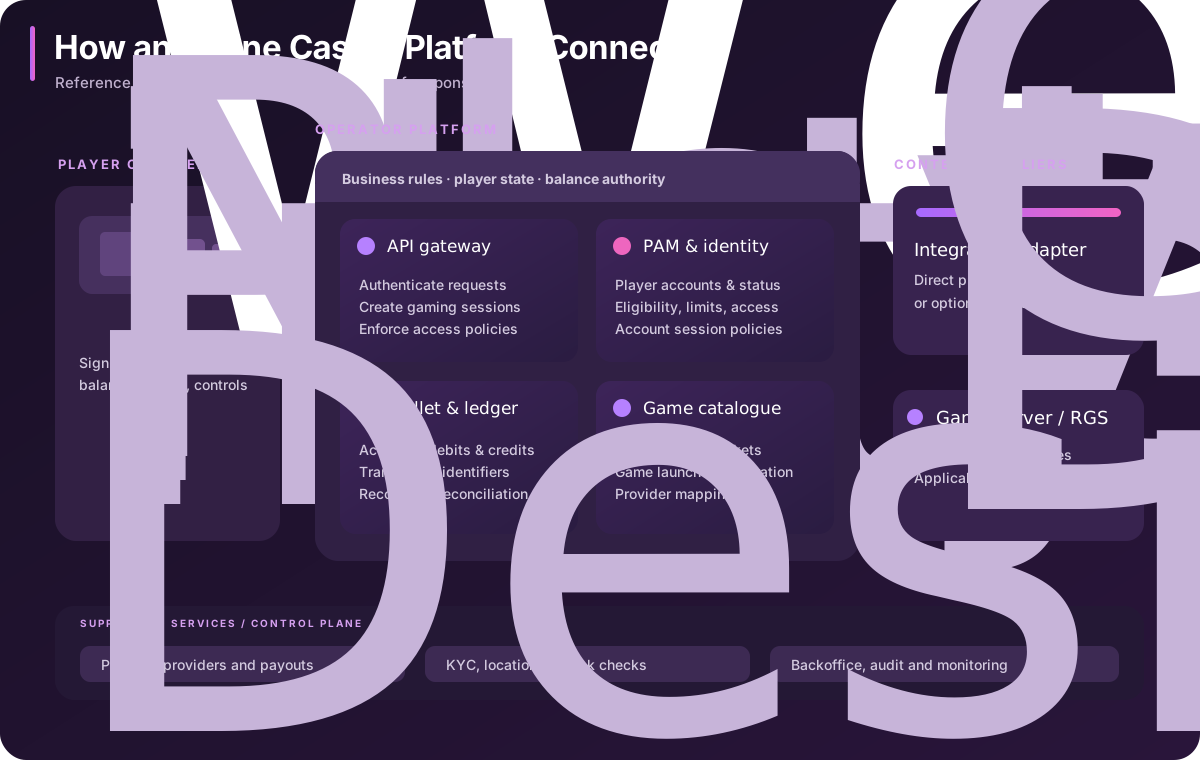
Concept illustration of interconnected platform services; not a diagram of a particular vendor's system.
On this page
What Is an Online Casino Platform?
In practical terms, an online casino platform is the software environment that lets an operator register eligible players, present available games, manage money-related records and run the business behind the interface. A website or mobile app is only the visible entry point. The difficult work happens across identity services, the wallet, game integrations, payments, operational reporting and controls that apply to the operator's markets.
There is no mandatory universal deployment diagram. A turnkey supplier may provide several of these functions as one managed product. Another operator may combine a separate player account management (PAM) system, a wallet, payment partners and multiple game suppliers. A web app and a Telegram Mini App can also share platform services while using different player interfaces. The important questions are which service owns each record, which team is responsible when something fails, and how the systems exchange trusted events.
The Main Architecture Layers
A useful way to understand the system is to follow the direction of requests and records: player channels connect to the operator's service layer, which connects to specialized suppliers and supporting controls. The diagram illustrates one common logical arrangement, not a required network topology.
⊕View largerSimplified logical flow. Direct integrations and aggregators are alternatives; ownership, hosting and data paths vary by supplier and jurisdiction.
Layer
Typical job
Important record or boundary
Player channel
Display sign-in, catalogue, game launch and account controls
Client session; never the authoritative balance
API gateway and session services
Route authenticated requests, apply permissions and limits
Session and service identity
PAM and identity
Maintain player profile, eligibility, access and preferences
Player account and verification status
Wallet and ledger
Record deposits, stakes, winnings, adjustments and reversals
Authoritative balance and transaction history
Game catalogue and integration
Resolve entitled titles, markets, launch parameters and suppliers
Provider mapping and launch authorization
Game server / RGS
Execute game rules and return game-round events
Round identifier, outcome and settlement facts
Payments, risk and operations
Handle external money movement, checks, monitoring and reconciliation
PSP references, audit trails and operator actions
An API is the interface between responsibilities; it is not the responsibility itself. For example, a casino game API can connect the platform to a supplier, but it does not automatically provide player verification, payment processing or a complete operational backoffice.
From Player Login to Game Launch
The steps below describe a representative launch flow. Exact calls, tokens and sequencing depend on the PAM, content supplier and integration contract.
The player enters through a web or mobile interface. The platform authenticates the session; a new account may require additional onboarding and identity checks.
The platform evaluates applicable access rules, such as market availability, player status and configured restrictions. These checks cannot safely be delegated to a browser button alone.
The catalogue lists games the operator is entitled and technically able to offer in that context. Provider availability can differ across markets or channels.
When a game is selected, the platform creates or requests a time-limited launch context that associates the player, session, game and authorized operator environment.
A direct game supplier or an aggregator routes the launch to the appropriate game service. The supplier may host the game client or return an authorized launch URL, according to its integration model.
During play, game-round and wallet interactions pass through the agreed server-side interfaces. The browser must not be trusted as the source of balance or outcome truth.
After the round, the platform records settlement information and refreshes the player's displayed balance. Operations and audit systems retain the evidence needed to investigate exceptions.
How Stakes, Wins and Wallet Balances Stay Consistent
A game can show a result in seconds, but the platform still needs durable records of the associated financial events. Common integrations use a round identifier plus distinct transaction identifiers for a stake, win, cancellation or correction. A ledger records each accepted movement so that the displayed balance can be explained and reconstructed. The exact event vocabulary and wallet ownership vary by supplier.
A simplified round lifecycle
The game service requests or reports a stake against a specific player and round, using the agreed trusted interface.
The wallet checks available funds and applicable restrictions, then records an accepted debit or returns an explicit rejection.
The game service determines the outcome under its game rules and transmits the corresponding settlement event.
The wallet records any win credit and correlates it with the relevant round and transaction identifiers.
Reconciliation compares supplier events, wallet movements and operator reports; unmatched or delayed events follow a defined investigation and recovery process.
Suppose a supplier repeats a win notification because the original response timed out. If the operator treats every retry as new money, the player could receive the win twice. An idempotent settlement design recognizes the same supplier transaction within its agreed scope and returns a consistent outcome without creating a second credit. The same discipline matters for debits, reversals and partial failures.
Two common patterns are a seamless wallet, where the operator's wallet authorizes game transactions directly, and a transfer-based arrangement, where funds move into and out of a supplier-held game balance. The latter introduces additional transfer and reconciliation boundaries. Neither pattern is universally best; contract terms, reporting needs, latency, control ownership and regulatory requirements shape the choice.
Direct Game Providers, Aggregators and Remote Gaming Servers
A game provider supplies content and, depending on its model, the server-side game environment. An RGS is the infrastructure through which game logic, outcomes and game-related events are delivered. An aggregator is an integration and distribution layer that can provide access to multiple supplier catalogues through a shared technical relationship. These terms describe different functions, although one company may perform more than one of them.
Integration route
Potential advantage
What still needs checking
Direct supplier connection
A direct technical and commercial relationship with the content source
Separate mappings, operational processes and maintenance for each supplier
Aggregator connection
A shared interface and consolidated catalogue access to participating suppliers
Underlying game availability, market rights, round semantics and supplier-specific exceptions
Turnkey managed platform
A single vendor may operate more layers and simplify initial coordination
Data portability, control over releases, incident responsibility and contractual exit paths
A single aggregation API does not imply that every game is available in every jurisdiction or that every game behaves identically. A useful supplier evaluation covers supported currencies and locales, game entitlements, maintenance notices, lifecycle events, wallet behavior, reporting formats, production support and how disputes are traced back to a round.
Payments, Player Controls and Backoffice Operations
A payment service provider (PSP) moves money through external payment methods. The casino wallet tracks the player's funds inside the operator's platform. A completed card or bank payment is therefore not the same object as a game win, and a PSP reference is not a substitute for a ledger transaction identifier. Deposits, withdrawals, chargebacks and adjustments need explicit mapping and reconciliation across these boundaries.
Identity and age verification, location controls where applicable, account restrictions, spending or playing limits, safer-gambling workflows and suspicious-activity monitoring should have defined system owners. The exact requirements are jurisdiction-specific, and some checks use specialized external services. A platform architecture can make these controls enforceable and auditable; software structure by itself does not establish legal compliance.
Backoffice: give authorized staff tools for catalogue configuration, account review, provider status and exception handling, with role-based permissions.
Finance and reconciliation: compare payment, wallet and supplier records, and make discrepancies visible instead of silently overwriting them.
Audit: retain traceable reasons for sensitive account actions and manual balance adjustments, under a defined retention policy.
Operations: monitor supplier errors, settlement lag, unclosed rounds and service availability; make escalation ownership explicit.
Security, Game Integrity and Technical Standards
The platform handles sensitive identity data and money-related instructions, so security controls must operate between services as well as at the player login screen. The OWASP API Security Top 10 highlights recurring risks such as broken object-level authorization, broken authentication and unsafe consumption of third-party APIs. In a casino integration, a valid session should never allow one player to access another player's account or transaction by changing an identifier.
Authorize every sensitive action against the player, operator and service role; do not rely only on a gateway having authenticated the request.
Protect machine-to-machine credentials, validate supplier messages and keep credentials out of client code and logs.
Use stable request and round correlation identifiers so an incident can be traced across services; separate operational traces from sensitive personal data.
Define recovery behavior for network loss, duplicate events, unavailable providers and ledger inconsistencies before production release.
Test game outcome integrity and transaction controls against the requirements applicable to the intended market and product.
Gaming Laboratories International's GLI-19 v4.0, released in November 2026, describes a technical framework for interactive gaming systems, including player accounts, game requirements and system controls. The UK Gambling Commission separately publishes Remote Gambling and Software Technical Standards covering topics such as result determination and random outcomes. These are useful reference points, but licensing, certification and implementation duties differ by jurisdiction; no single document automatically approves a platform for every market.
If a deployment stores, processes or transmits cardholder data, the applicable PCI DSS scope must also be assessed. Integrating a PSP does not by itself prove that card-related obligations disappear; the actual data flow determines which systems and responsibilities are in scope.
Architecture Decisions to Make Before Integration
Teams can narrow a large vendor comparison by agreeing on a small set of architectural decisions first. The answers should be documented in contracts, integration specifications and operating procedures—not left as assumptions in a sales diagram.
Decision
Key question
Consequence to evaluate
System of record
Who owns player identity, balances and settled round history?
Consistency, auditability and data export
Wallet model
Seamless authorization or supplier balance transfer?
Failure recovery and reconciliation boundaries
Content route
Direct provider APIs, aggregator or both?
Catalogue coverage versus integration complexity
Market rules
Where are eligibility, game rights and player controls enforced?
Availability, compliance review and release governance
Operational ownership
Who responds when a game settles but a wallet response is lost?
Incident resolution, reports and service-level expectations
Multiple brands or channels
What can be shared and what requires tenant or channel separation?
Access boundaries, configuration and reporting
This is also where the distinction between buying an API and adopting a managed platform becomes concrete. An API may reduce integration effort at a particular boundary. It does not eliminate the need to decide who owns the wallet, security, player controls, operations and supplier relationships.
A Practical Pre-Launch Checklist
A credible go-live rehearsal should include normal player journeys and deliberately broken ones. The aim is not only to show that a game opens, but to prove that balances, rights and records remain understandable when services disagree or fail.
Confirm the authoritative owner of player, wallet and round records and the permitted data flows between them.
Verify that unsupported games, markets and restricted player states are rejected server-side.
Exercise stake rejection, duplicate win notifications, timeout retries, reversals and round recovery without double settlement.
Reconcile test transactions across game supplier, platform ledger, payment partner and operator reports.
Prove that a support user cannot perform a finance-only action or view another tenant's private data.
Test credential rotation, service failures, supplier maintenance and alert escalation with named operational owners.
Confirm the relevant market-specific technical, player-protection, certification and data-security review before publication.
The best architecture is the one whose responsibilities can be explained, whose transactions can be reconciled and whose failures can be recovered. Once those foundations are clear, teams can compare game APIs, PAM services, aggregators and turnkey solutions on the same technical terms.