Casino platform scalability is not just the ability to serve more home-page requests. Traffic may rise during a promotion, while game sessions, payments, identity checks, provider callbacks and wallet reconciliation have different latency and consistency needs. Adding application instances can relieve one bottleneck but create another in the database, a payment gateway or a shared session store. Reliability asks a related question: when a dependency fails, can the platform preserve correct account and financial state, communicate clearly, and recover within documented objectives? This guide connects capacity planning to real online casino journeys, explains where redundancy helps and where it does not, and provides a practical test matrix. Vendor documentation illustrates architectural techniques; it does not establish the capabilities or service levels of any specific casino platform. [1] [2] [3] [6]
Published
Reliable capacity is built from independent services, protected state and rehearsed recovery, not server count alone.
On this page
What do scalability and reliability mean for a casino platform?
Scalability means sustaining acceptable service as demand changes; reliability means performing the intended functions correctly and consistently, including recovery after faults. A platform can scale page views while still failing a balance check or provider game launch. Define success separately for discovery, account access, active games, payments and back-office actions. [1] [2]
Capacity and resilience are linked but not interchangeable. Extra web servers cannot repair a single shared wallet database, and multiple regions do not automatically prevent duplicate callbacks. Identify critical state, dependencies and the maximum acceptable interruption for each customer journey before selecting architecture. [1] [6]
Which platform components become bottlenecks under load?
A single request may pass through the edge, application API, session service, game provider, wallet, database and event pipeline. Each has a separate capacity ceiling. Load tests should trace real end-to-end journeys and report waiting time, errors and saturation at every dependency rather than assuming that a fast landing page proves scalability. [1] [5]
Component
Pressure signal
What to validate
Edge and lobby
Peak arrivals or bursts
Caching, rate control, origin capacity
Login and session
Concurrent sign-ins
Identity store and session continuity
Game launch API
Provider round trips
Timeouts, quotas and launch tokens
Wallet and ledger
Simultaneous balance writes
Lock contention and reconciliation
Payments and KYC
Slow external services
Bounded queues and clear pending state
Events and back office
Callback or report backlog
Consumer lag and replay behavior
Keep peak concurrent sessions, transactions per second and dependency rate limits separate. An operator should ask suppliers for measured capacity at the relevant integration points, not convert a marketing concurrency number into a guaranteed transaction rate. [1] [5]
How should application capacity scale without breaking sessions?
Stateless web and API workers are natural candidates for horizontal scaling behind a health-aware load balancer. Kubernetes documents automated replica adjustment through the HorizontalPodAutoscaler, but the controller relies on selected metrics and does not remove database or vendor bottlenecks. Choose workload indicators that reflect actual queueing and user latency. [3]
Keep account sessions and critical state outside individual disposable application workers.
Set resource requests, safe replica limits, warm-up behavior and rate limits from real tests.
Use backpressure when payment, game or verification partners approach their contractual limits.
Check autoscaling response during sudden bursts, gradual growth and scale-down, not just steady traffic.
A scalable design may use different capacity policies for the lobby, game-launch gateway and asynchronous workers. When a downstream service cannot scale, graceful rejection with a clear response is safer than unlimited retries that amplify an incident. [1] [3]
What redundancy protects an active casino journey?
Redundancy addresses failure domains: a host, a zone, a network route or an external provider can fail independently. Place critical stateless instances across appropriate domains, use health checks that reflect service readiness and specify what happens to an in-flight game or payment during failover. Multi-instance deployment is not a substitute for testing state ownership and replay. [1] [6]
Map each critical user journey to the components and external providers it actually requires.
Separate workloads where a slow provider or reporting task could exhaust shared capacity.
Define health checks, circuit breakers, timeout budgets and safe fallback for each boundary.
Rehearse a node, service and dependency outage and compare observed behavior with the agreed objective.
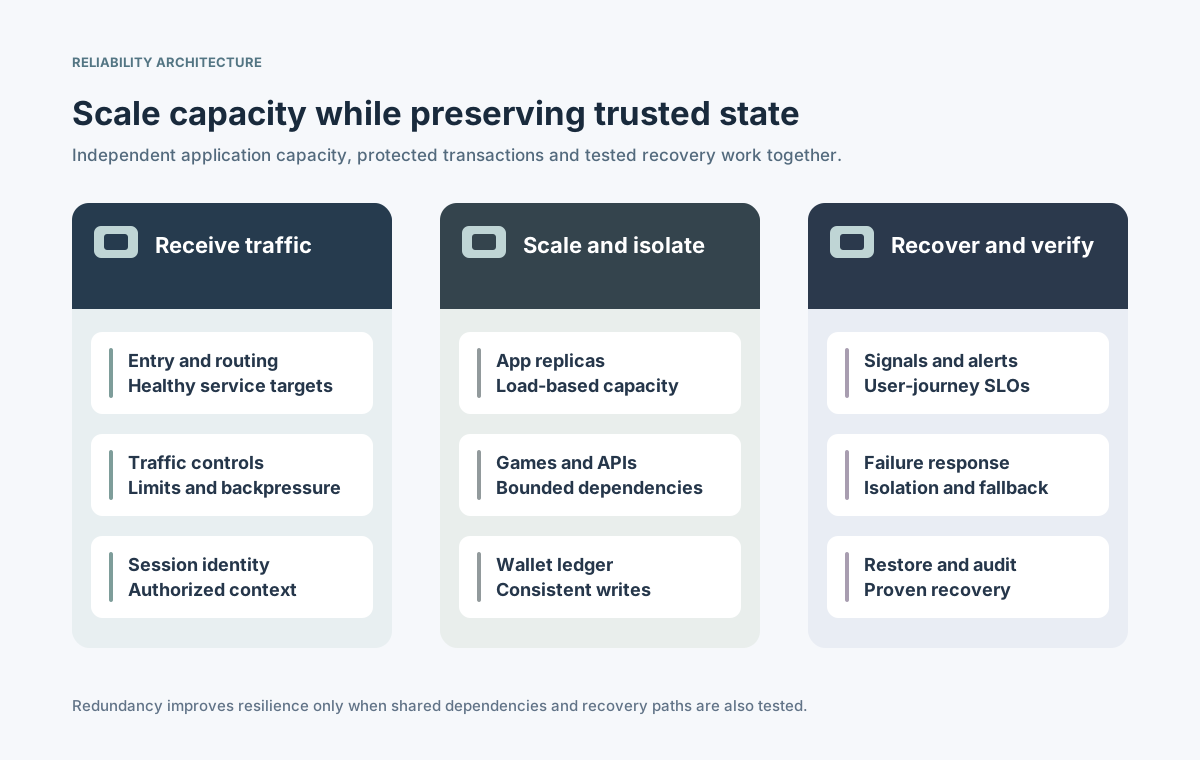
⊕View largerEffective redundancy combines routing, isolated capacity, trusted state and recovery evidence.
Failover may preserve availability while reducing features. Document which operations are read-only, disabled or queued during partial failure; never promise that financial state is safe merely because a second application server responds. [1] [6]
Why must game sessions and wallet operations scale differently?
Game catalog pages often tolerate caching, while a real-money balance and wager outcome require authoritative ordering and consistency. Even when requests arrive on different app replicas, the operator's transaction system must prevent two concurrent actions from spending the same funds or recording the same outcome twice. This is a domain requirement, not a feature of autoscaling. [1] [4]
Operation
Safe scaling pattern
Correctness condition
Game discovery
Cache with controlled expiry
Market and provider eligibility stays current
Game launch
Short-lived authorized token
One valid player and game context
Place or settle wager
Serialized/idempotent ledger change
No double debit or settlement
Read balance
Server-authoritative value
Clear handling of pending writes
Restore session
Revalidate and reconcile
No orphaned game or wallet state
Track a transaction through request ID, provider correlation ID, durable ledger entry and final status. A delayed provider callback must not overwrite a newer confirmed outcome; the integration contract should define whether reconciliation or manual review is required. [4] [5]
How do queues and retries improve resilience without duplicating money movements?
Queues decouple work but do not guarantee perfect ordering. AWS documents at-least-once delivery and possible out-of-order delivery for standard SQS queues. The architectural lesson is broader: design consumers for duplicate messages and retries rather than assuming a callback executes exactly once. [4]
Assign stable idempotency keys to financial operations and retain processed outcomes durably.
Set retry limits, exponential backoff and a dead-letter or investigation path for poison events.
Distinguish delayed, missing and contradictory provider responses before changing ledger state.
Reconcile provider records to internal transaction history and alert on unresolved differences.
Treat asynchronous processing as a state machine with observable pending, complete, failed and disputed outcomes. Idempotency belongs at the authoritative write boundary; a duplicated queue delivery should return the prior result instead of creating another debit. [4] [7]
Which database and storage decisions affect reliability?
Read replicas and caches may help noncritical reads, but they can lag behind authoritative writes. Determine which data requires immediate consistency, which can tolerate staleness and which must survive a zone or regional failure. Partitioning or replication should follow measured transaction patterns and failure tests; copying a database does not automatically make an application safe. [1] [6]
Data area
Typical concern
Evidence to request
Wallet ledger
Concurrent writes and durability
Isolation and recovery test
Player identity
Session invalidation
Cross-instance logout behavior
Game catalog
Cache freshness
Market-change propagation
Event history
Replay and audit trail
Ordering and retention policy
Backups
Usable recovery point
Restore drill and integrity check
Backups, point-in-time restoration and failover plans need separate tests. Recovery point and recovery time objectives are explicit business choices; a backup that has never been restored does not prove that the operator can meet either objective. [6]
How can operators measure reliability with SLOs and telemetry?
Service-level indicators measure what users experience; service-level objectives define the acceptable target. Google SRE recommends tracking meaningful indicators and error budgets rather than relying on an undefined promise of perfect uptime. For casino operations, one global availability number can hide failed wallet or game-launch flows. [2]
Define separate success and latency indicators for login, game launch, wallet writes and payments.
Monitor traffic, error rate, latency and saturation at the edge and downstream services.
Correlate traces, metrics and logs across API calls, queues and providers using safe identifiers.
Alert on user impact, stuck settlements and reconciliation lag, with clear ownership and runbooks.
OpenTelemetry documents telemetry signals, while Google's monitoring guidance explains the four golden signals. Do not export sensitive player or payment fields merely to improve observability; apply retention and access controls to diagnostic data. [5] [7]
What should disaster recovery and safe deployment include?
Availability during a component failure and disaster recovery after a major event are different capabilities. Define recovery time objective (RTO) and recovery point objective (RPO) for critical journeys and data, then select a strategy that can actually meet them. AWS describes these as measurable recovery objectives, not universal figures that every platform achieves. [6]
Keep versioned, restorable backups and verify their integrity in a controlled exercise.
Document infrastructure, secrets, dependencies and personnel needed for recovery.
Use staged releases, health gates, rollback procedures and compatibility checks for active sessions.
Test a lost zone or core dependency while protecting wallet writes from ambiguous replay.
Communicate partial-service states and the expected next step to players and support teams.
A mature runbook records the incident owner, decision to stop new transactions, recovery sequence and post-incident reconciliation. Test the process after major changes; a familiar backup command alone is not a production recovery plan. [1] [6]
What should buyers and teams test before approving a platform?
An acceptance test should combine representative traffic with specific faults and financial consistency checks. Ask for load-test methodology, dependency limits, alerts, the incident escalation path and recovery evidence. Do not interpret benchmark numbers from a different architecture, market or provider mix as a binding guarantee. [1] [2]
Run peak and burst tests with realistic login, lobby, game and wallet mixes rather than one synthetic endpoint.
Force provider timeouts, dropped callbacks, duplicate events and temporary database saturation.
Verify no double debits, lost settlements or unbounded queue growth during retries and failover.
Measure SLOs, RTO, RPO and customer-facing status across staged releases and recovery drills.
Document acceptance thresholds, system owners, vendor dependencies and remaining risks before sign-off.
The goal is not maximum server count or a blanket uptime claim. It is a platform that can grow while demonstrating correct balances, predictable user outcomes and tested recovery for the journeys the operator actually offers. [1] [4] [6]