A player may register on a casino website, sign in again from a phone and open a supplier-hosted game moments later. Those steps should not create interchangeable credentials or unlimited access. Authentication establishes confidence in an identity; a session carries limited proof of that event; authorization decides what the account may do at this moment. A reliable platform keeps those boundaries explicit, including for withdrawals, self-exclusion, account recovery and external game launches. This guide explains the architecture and operational checks behind those controls. It describes security patterns, not a universal legal requirement or a claim about a particular vendor's implementation.
Published
A shared identity service can authenticate multiple clients without giving every client the same credentials or privileges.
On this page
Why are authentication and session management separate?
Authentication confirms that a presented credential belongs to a known player account. Session management allows subsequent requests to use a server-issued secret without repeating the entire login process. Authorization evaluates whether a specific operation is permitted, using the current account state. These are related services, but treating them as one boolean flag creates gaps when an account is restricted after login. [1] [2]
A player who logged in successfully yesterday may be self-excluded, locked or asked to complete a new verification step today. An active cookie must not override those changes. Equally, logging out should end the server-side session rather than just hiding a button or deleting the local cookie. Access rules need to be evaluated at the API boundary, especially for balance changes and withdrawals. [2]
Which identities, credentials and session artifacts exist?
Map the identities and secrets handled by the operator before selecting a login provider. A player profile is a durable business record. Password verifiers and passkey registrations are authentication material; cookies and access tokens represent sessions; supplier launch tokens authorize a narrower technical integration. None should be treated as a substitute for another merely because it is a random-looking string.
Artifact
Authority
Primary control
Player account
Operator identity database
Persistent ID and restrictions
Password or passkey
Authentication service
Secure verifier or key proof
Web session cookie
Operator session service
Opaque secret, expiry, revocation
App access token
Trusted authorization service
Audience, scope, short lifetime
Refresh token
Token issuer
Secure rotation and reuse checks
Game launch credential
Operator and provider contract
One game, player and expiry context
Maintain a separate inventory for support and administrative identities, which should have stricter roles and authentication. An account identifier may appear in logs and APIs, while authentication and session secrets must not. Use data classification and secret-handling rules rather than relying on one shared credential for every channel. [1] [6]
How should registration, login and recovery work?
Registration can create an account record while leaving eligibility and verification incomplete. Login proves control of an enrolled authenticator; it does not by itself establish age, identity verification, deposit permission or the right to play in a particular market. On failure, avoid account-enumerating responses and use risk-aware throttling rather than exposing whether an email address exists. [1] [4]
Use modern password verification and offer stronger authenticators such as passkeys or MFA when suitable.
Protect sign-in and reset endpoints against credential stuffing, password spraying and automated abuse.
Make recovery single-use, time-bounded and independent from an already compromised session.
Revoke or reevaluate other sessions after critical password, factor or account-ownership changes.
Recovery is often a weaker path than the primary login. Audit who requested it, which verified channel completed it and which sessions were invalidated. A support agent must not bypass ownership checks simply because a player can quote a balance or transaction reference. [1] [3]
What is the end-to-end authentication and session flow?
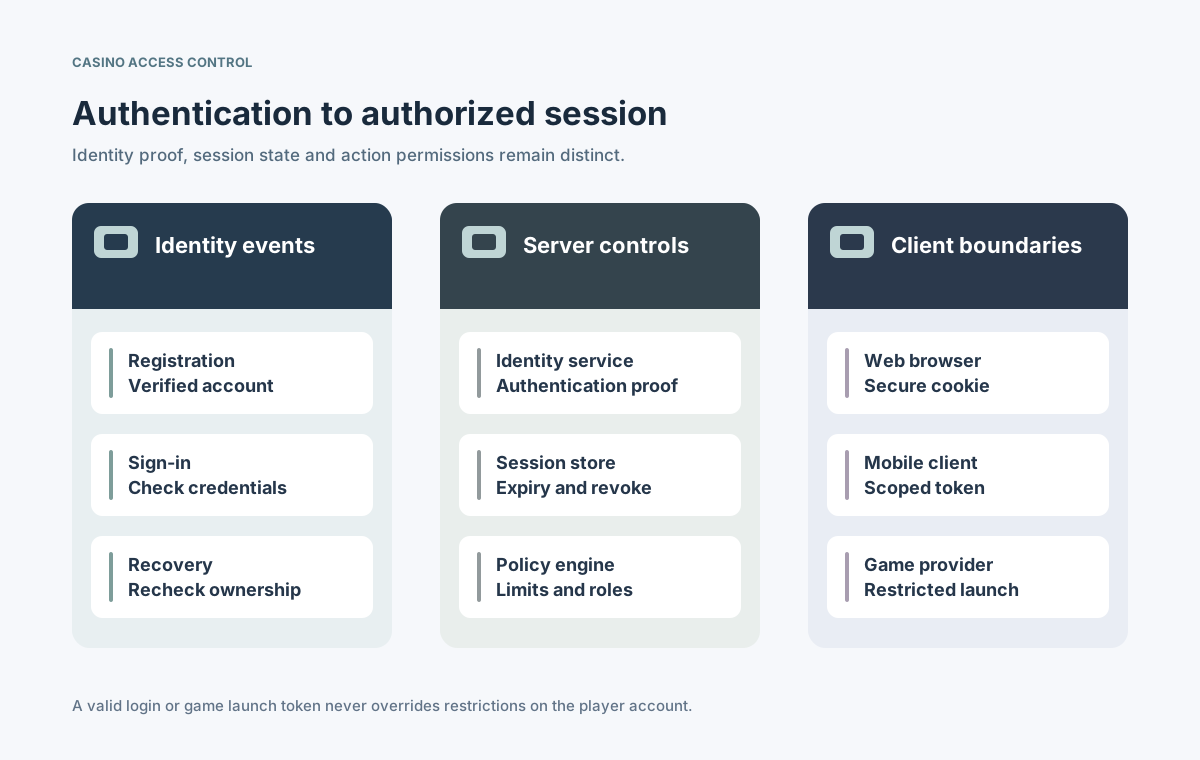
A clean flow begins with a credential exchange over a protected connection and ends with a limited, revocable session. The server binds the session to the correct operator account and evaluates the account policy for each sensitive request. If delegated login is used, the client and identity provider must follow the chosen protocol's security guidance rather than inventing a callback format. [5] [6]
Receive credentials or a validated external authentication response and apply abuse controls.
Verify the account, required factors and current eligibility, then create a new session identifier.
Return the client-appropriate session proof, bound to server-side expiry and revocation state.
For every protected API call, validate the session and recheck the operation's authorization.
⊕View largerIdentity proof creates a session; a separate policy decision determines which casino actions that session can perform.
Avoid sending the same long-lived bearer token to the browser, a messenger Mini App and a game supplier. Each surface has different exposure and trust assumptions. A provider game token should be narrow, short-lived and created only after the platform has authorized that launch. [2] [6]
How should session cookies and tokens expire?
For browser sessions, set appropriate cookie attributes including Secure, HttpOnly and a considered SameSite policy; evaluate cross-site integration needs before choosing one. Regenerate the session identifier on successful authentication or privilege changes. Inactivity and overall expiry must be enforced by the server, because browser closure and client-side timers cannot reliably revoke a stolen secret. [2] [5]
Control
Server-side rule
Validation case
Session creation
Fresh unpredictable identifier
Reject fixation at login
Cookie settings
Secure, HttpOnly, suitable SameSite
Check cross-origin behavior
Idle / absolute expiry
Both tracked and enforced by server
Expired proof gets denied
Logout / account lock
Revoke active server session
Old copied token fails
Refresh token
Rotation or sender-constrained design
Detect replay and reuse
Define timeout values through a documented risk assessment, product needs and applicable requirements; there is no single safe duration for every device and action. A short access token is not enough if refresh credentials remain endlessly valid or cannot be revoked. NIST distinguishes inactivity and overall limits; OAuth guidance addresses refresh-token protection. [5] [6]
When is MFA or step-up authentication appropriate?
Multi-factor authentication adds proof from a different factor; asking for two passwords is not MFA. Consider stronger methods for sign-in, unknown devices and privileged users, while designing recovery so loss of a factor does not become an easy account takeover path. OWASP discusses phishing-resistant authenticators and careful factor replacement. [3]
Identify actions needing greater assurance, such as password changes, factor replacement or high-risk withdrawal requests.
Require a fresh, sufficiently strong check when risk increases instead of relying only on an old cookie.
Record the assurance event server-side without storing the one-time code or exposing the authenticator secret.
Offer a protected recovery path with notifications, rate limits and an audit trail.
Step-up should not silently reset financial or responsible-gaming restrictions. A completed MFA challenge establishes additional confidence in the actor; it does not turn a disallowed deposit, market access or excluded account into an allowed operation. [3]
How do browser, app and game-provider sessions differ?
A web cookie, an app's API credential and a supplier-issued game launch token have different audiences and lifecycles. Centralized operator identity can allow a player to access several surfaces, but the service must authorize every exchange. A provider session often has its own expiration and round recovery rules; these must be documented by supplier, not assumed from the operator login. [2] [6]
Client surface
Credential boundary
Revocation or failure case
Browser
Operator cookie and CSRF defense
Logout and stolen cookie
Mobile app
Audience-scoped API access
Lost device and token reuse
Embedded game
Provider-specific launch token
Expired launch or open round
Support portal
Separate staff identity and role
Privilege change or termination
Federated login
Verified OAuth/OIDC flow
Redirect or code interception
Never expose an operator's internal session secret in a game URL or analytics event. Evaluate CSRF for cookie-authenticated state changes, validate callback origins and segregate provider secrets. An active game round may require settlement after the browser session has ended; finance must follow durable round records, not stale client access. [2] [7]
Which threats should the design explicitly defend against?
Account takeover can start with reused passwords, credential stuffing, session fixation, stolen cookies, malicious redirects or weak recovery. A generic login-rate limit cannot solve all of these. Layer credential protection, per-account and network-aware abuse detection, secure session storage and authorization checks. Use security events for investigation without placing secrets in logs. [1] [4]
Test stolen and copied cookies, session fixation and old refresh tokens after rotation.
Evaluate CSRF and cross-origin exposure on every state-changing cookie-authenticated endpoint.
Detect distributed credential stuffing and password spraying without locking out legitimate players unnecessarily.
Security alerts need an owner and response path: revoke sessions, suspend risky operations, retain evidence appropriately and help legitimate players regain access. Treat weak fallback endpoints as real login paths in a threat model; protecting only the primary web form is insufficient. [3] [4] [7]
What privacy, gaming rules and vendor boundaries matter?
Authentication records and session telemetry can contain identifiers, device indicators and sensitive account events. Collect only what is required for protection and audit, restrict staff access, define retention and avoid storing raw passwords, passkeys, live tokens or reset links. Operator and provider responsibilities should be written into technical contracts and incident runbooks.
Apply player age, KYC, self-exclusion, deposit and jurisdiction controls on the backend at each relevant action.
Review authentication and recovery logs for personal-data minimization and restricted access.
Verify which party owns login, session revocation, game-launch credentials and supplier support escalations.
Maintain an incident procedure for compromised accounts, leaked session secrets and emergency credential rotation.
Use security guidance as a technical baseline rather than a universal compliance claim. Market requirements, privacy rules and supplier integrations vary. Confirm them with qualified specialists and preserve a record of deviations and compensating controls. [1] [5]
What must be tested before authentication goes live?
Acceptance testing should cover both a clean player journey and adversarial states. Build cases for browsers, mobile clients, network interruptions, concurrent sessions, provider launches and staff roles. Each test should verify the response, server-side session state, account restrictions and audit events, not just what the screen displays.
Log in, rotate session proof, change privileges and confirm the old identifier is rejected.
Expire, revoke and copy a session; verify server authorization fails after each invalidation.
Replay recovery, password reset, MFA enrollment and factor replacement; check notifications and audit events.
Attempt a restricted withdrawal or game launch with a valid session; require correct policy denial.
Use simultaneous browser and mobile sessions to test logout-all-devices and supplier round boundaries.
Before release, require a documented owner for authentication incidents, a rollback path for identity-provider errors and tested rate-limit behavior under load. A successful login is only the start: the security property is that every subsequent operation stays authorized until the session is deliberately or automatically ended. [2] [3] [6]