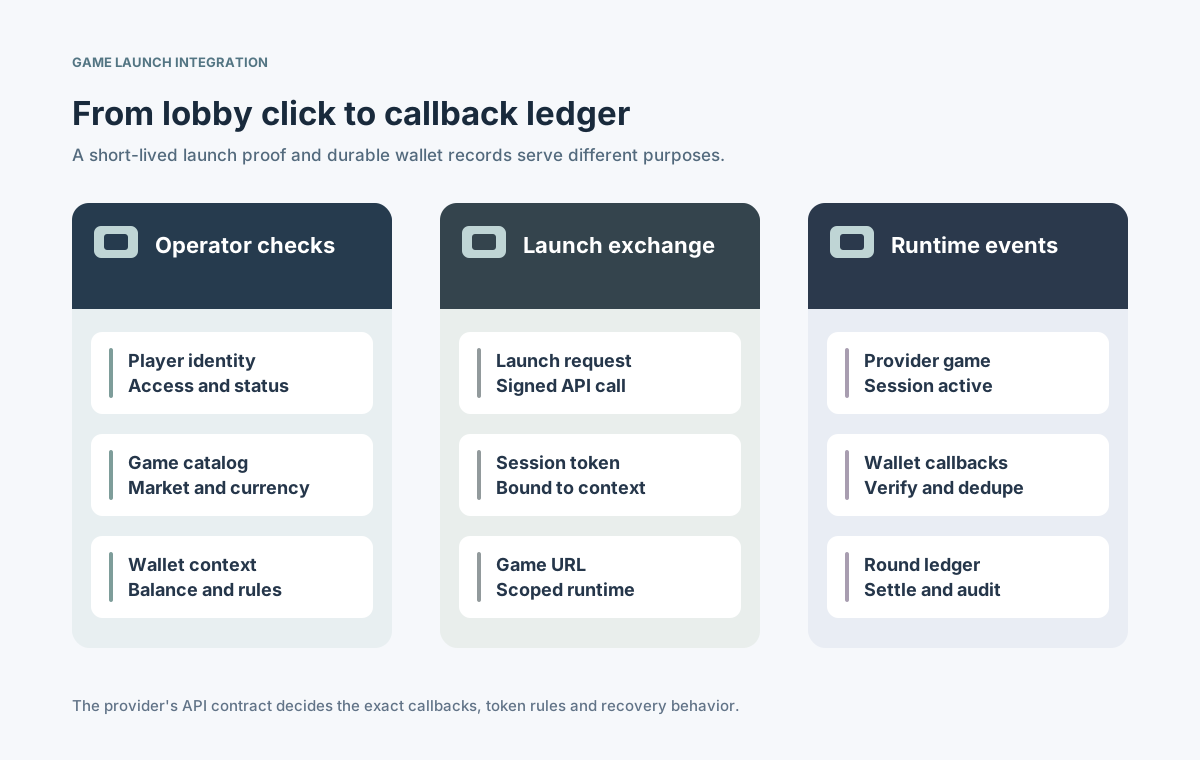
A casino lobby click can cross several trust boundaries before a player sees a game. The operator checks the account and selected game; an aggregator or studio creates a game session; a browser opens the returned launch URL; and a separate server-to-server channel may later request balance, bet, win or cancellation operations. Launch tokens connect these steps but do not replace operator login or financial records. Poorly scoped credentials, mismatched session IDs and duplicated callbacks can produce broken launches or ledger discrepancies. This article maps the flow, ownership and acceptance tests for a robust integration. The examples are architectural patterns; individual provider contracts and legal requirements must be verified separately.
Published
A launch credential bridges a permitted game entry and a provider runtime; wallet events still need independent server-side validation.
On this page
Why is a game launch token different from player login?
Operator authentication establishes the player account; the launch process authorizes entry to a particular supplier game. A game launch token is typically a restricted technical credential that the operator and aggregator or provider agree to recognize. It should not become a general-purpose cookie, payment credential or proof that every gaming action is allowed. The precise format differs between integrations. [1] [2]
An operator may keep its web session while opening multiple provider runtimes. Each runtime needs a clear mapping to a player, game and wallet context. When a player logs out or becomes restricted, new launches should be denied and existing sessions handled under documented provider and responsible-gaming rules. Closing an iframe does not itself reverse a committed bet or settle an outstanding round. [3] [4]
Which systems and identifiers participate in a launch?
An integration normally includes a casino frontend, operator backend, game catalog, account policy service, wallet ledger and aggregator or studio API. Some suppliers manage the game runtime directly; others act through an aggregator. Record which party issues each identifier, authenticates calls and owns callback retry behavior before building the adapter. [1] [2]
Artifact or actor
Purpose
Control boundary
Operator player ID
Identify a known account
Must match active operator identity
Game / provider code
Select an approved product
Catalog mapping and availability
Launch request ID
Trace one create-session attempt
Distinct from bet transaction ID
Game session token
Bind one provider runtime
Secret, scoped and revocable if supported
Wallet token or context
Authorize settlement calls
Contract-dependent lifetime
Round and transaction IDs
Identify financial operations
Durable deduplication and audit
Do not assume that a `session_id`, `token`, `round` or `transaction_id` field means the same thing across vendors. St8, 7SoftTech and Beexar document different launch and callback contracts. Maintain per-provider translation rules and avoid replacing supplier identities with one global counter. [1] [2] [3]
What must the operator validate before requesting a URL?
Launch eligibility is a server-side decision. Authenticate the player, verify any account restrictions, confirm the catalog mapping, check market and currency availability, and select the permitted game mode. A browser-supplied `game_id` or country flag is merely input, not authorization. Object-level permission checks remain necessary even when the request has a valid session. [1] [7]
Resolve the operator-side player from the active session instead of trusting a client-supplied player ID.
Check account status, responsible-gaming restrictions, age and verification gates where applicable.
Resolve the game against current provider catalog and region/currency entitlements.
Select real-money or demo mode explicitly and associate the correct wallet and tenant.
A failed check should stop the launch before generating an externally usable secret. Return an appropriate product-facing error without leaking partner API keys or internal eligibility logic. Vendor-specific deposit restrictions and market behavior need testing because they may be enforced at launch time or by the supplier. [2] [7]
What happens between the lobby click and the running game?
After authorization, the backend creates a unique launch context and sends a trusted server-to-server request to the aggregator or game provider. Depending on the contract, the operator supplies a token for later validation or receives a provider-issued session credential and URL. The frontend may then use the approved URL in an iframe or separate window. Do not construct it by concatenating untrusted browser parameters. [1] [2] [3]
Receive the player launch request and make a fresh backend authorization decision.
Create a traceable launch attempt and a limited, unpredictable session credential when required.
Authenticate the provider API request and validate the returned game, URL and session mapping.
Pass only the approved launch URL to the intended client and register the session state for callbacks.
⊕View largerA successful game URL establishes an entry path; subsequent financial callbacks follow their own authenticated server channel.
Capture correlation IDs across these systems without logging the raw token or complete credential-bearing URL. A launch API success does not prove that the game has rendered, its wallet channel is healthy or its round state can be recovered. Monitor those separately. [1] [3]
How should launch credentials and session expiry behave?
Treat a launch token as an unpredictable secret with a defined audience, player and game binding. The provider contract determines whether it is one-time, consumed at first game open, refreshable or valid across reconnects. Record creation, expiry and invalidation on the authoritative side; never rely on a browser timer as the only expiry control. OWASP's session principles apply even when a vendor uses a custom launch mechanism. [3] [4]
Session event
Required decision
Test case
Initial launch
Issue or accept correct scoped token
Reject wrong game/player
Expiry
Deny new use after deadline
Stale URL cannot reopen
Relaunch
Create or recover per contract
Old and new IDs remain traceable
Logout or account lock
Apply operator policy to active access
No new restricted launches
Open round after disconnect
Preserve durable financial state
Late settlement still reconciles
A short game token does not mean an old valid transaction may be silently discarded. Some documented provider models continue processing callbacks for rounds started before a relaunch. Keep the wallet's durable transaction references separate from ephemeral browser or gameplay access, and document how long historical tokens must remain resolvable. [1] [3]
How should wallet and authentication callbacks be verified?
Provider-to-operator callbacks are a different trust channel from the player browser. Depending on the contract, a provider may ask the operator to validate a launch token or request balance, debit, credit and cancel operations. Verify request authenticity through the agreed signature, mutual trust or secret mechanism, then check token ownership, game, player, tenant and currency before acting. [1] [2] [7]
Validate the caller and exact signed payload or agreed authentication proof before parsing a financial command.
Resolve the token to the intended player, wallet, supplier, game and permitted session state.
Validate event schema, amount precision, currency and identifiers using the provider contract.
Return deterministic error or retry responses without exposing credentials or unrelated player data.
A callback signature establishes which integration sent the request, not whether its object references are authorized. Apply object-level checks too; a validly signed debit naming someone else's player or round must fail. Keep provider credentials in backend configuration and rotate them through a documented incident procedure. [1] [7]
How do bet, win, cancel and round events relate?
A wallet API may receive balance checks, debits for stakes, credits for wins and cancellations or rollbacks. The authoritative ledger must keep each operation with its supplier transaction ID, round identifier, currency, player and final state. Events may arrive after a disconnect or a fresh launch, so the ledger cannot be scoped only to the current iframe. [1] [3]
Callback type
Ledger action
Important invariant
Balance / check
Read current wallet state
No unintended mutation
Debit / bet
Reserve or deduct stake
One effect per transaction ID
Credit / win
Post the valid payout
Link to intended player and round
Cancel / rollback
Compensate a prior effect
No duplicate reversal
Round close
Record final round status
Late events follow defined policy
A callback labeled `cancel` is not interchangeable with a chargeback or the deletion of history. Verify the supplier's exact semantics, whether zero-value events are allowed, how mixed bet-win events work and when a round is considered closed. Financial audit trails must remain append-only or equivalently reconstructable. [1] [5]
How should retries, duplicates and ordering be handled?
Network failure leaves an ambiguous outcome: a provider might have sent a bet, the operator committed it and the reply got lost. On retry, applying the debit again would be wrong. Persist an idempotency key built from the correct supplier and transaction scope, store the business outcome atomically with the ledger effect and return a consistent response to subsequent identical requests. [1] [5]
Deduplicate by stable provider transaction identity, not a freshly generated request timestamp.
Handle concurrent copies with a database uniqueness constraint or equivalent atomic claim.
Distinguish an identical retry from the same ID carrying conflicting amount, player or currency.
Allow approved late events through durable round state while rejecting unauthorized or impossible transitions.
Provide a reconciliation queue for unresolved callbacks and a clear operator repair procedure.
At-least-once delivery patterns permit repeated messages; arrival order is not necessarily the business order. Protect with explicit round state, durable idempotency records and carefully designed compensation rather than hoping retries are rare. Document retention long enough for the partner's practical retry and dispute windows. [5] [6]
What security, operations and vendor boundaries matter?
Treat launch URLs and bearer tokens as secrets. Remove them from analytics payloads, referrer exposure, support screenshots and ordinary access logs where feasible. Define separate credentials and rate controls for the operator frontend, aggregator launch API and wallet callback channel. Monitor launch failures, callback latency, duplicate event rate and unmatched rounds without storing sensitive payloads indiscriminately. [4] [7]
Document which partner creates the token, signs callbacks and controls token expiry or revocation.
Alert on wrong player/game mappings, signature failures, unexpected duplicate rates and settlement gaps.
Keep a test environment with realistic timeout, recovery and failure injection capabilities.
Record ownership for provider incidents, credential rotation, reconciliation and audit retention.
Keep supplier API versions and test evidence under change control. A new game catalog mapping, callback endpoint or signature scheme should trigger contract tests before production rollout. Regulatory and commercial decisions need their own review; the technical launch flow alone cannot establish eligibility to offer gambling. [1] [2]
What should an end-to-end launch acceptance test include?
Test the entire journey rather than only receiving HTTP 200 from the launch endpoint. Verify lobby authorization, actual game rendering, callback authentication, wallet effects, provider response handling and later reconciliation. Cross-platform clients, demo/real modes and market restrictions deserve independent cases.
Open one allowed real-money game and confirm token, URL, player, game and currency consistency end to end.
Try an expired, replayed or mismatched token; verify refusal without leaking another account's data.
Drop the reply after a committed bet, retry twice and verify a single ledger mutation.
Close and relaunch the game while a round remains open; verify late win or cancel is reconciled correctly.
Simulate invalid signatures, duplicate callbacks, out-of-order events and supplier outages; inspect alerts and audit trail.
Before a controlled release, obtain sign-off from the integration owner and wallet owner, pin test transaction IDs and rehearse rollback or routing disablement. The core acceptance criterion is not simply that a game starts; it is that all permitted financial outcomes remain correct and explainable through failures, retries and session changes. [1] [3] [5]