Casino Game API vs Aggregator API: Key Differences
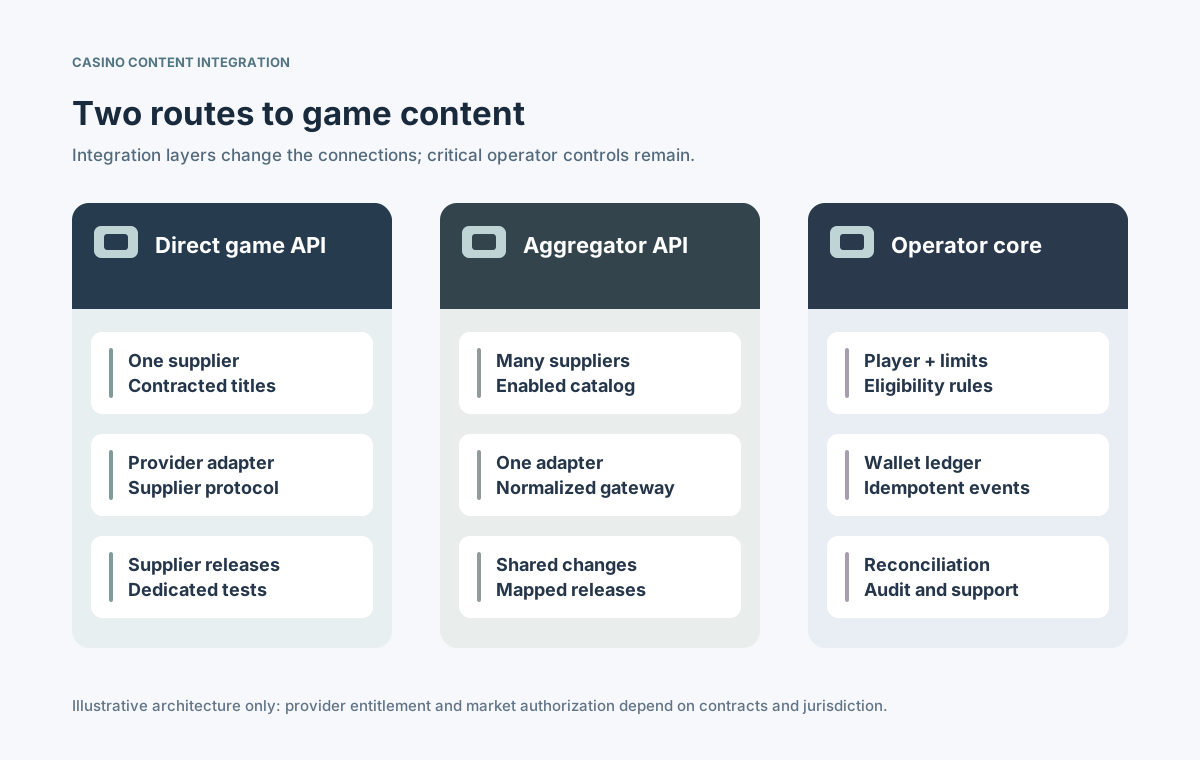
A casino game API and a casino aggregator API can expose similar endpoints: list games, create a session, receive wallet transactions. That resemblance hides a major architectural difference. A direct integration connects the operator to a specific game's supplier and its own protocol; an aggregator adds another contracting and technical layer that may normalize access to many studios. Neither label guarantees a particular catalog, wallet model, regulatory approval or integration timeline. This guide maps the responsibilities that remain with the operator, the capabilities that can move to a middleware partner, and the evidence needed to make a reliable build-versus-aggregate decision.
Published
Direct supplier access and multi-provider aggregation can share similar interfaces while allocating responsibilities differently.
On this page
What do game provider API and aggregator API mean?
A game provider API is the operator-facing technical interface of a particular studio or supplier. Depending on its contract, it may expose that supplier's slots, tables, live games or promotional services. A casino aggregator API instead sits between an operator and multiple participating suppliers, potentially presenting one catalog, session contract and wallet callback format. The aggregator's own agreement determines exactly which providers and products can be used.
Do not equate a game API with a single game, or an aggregator with guaranteed access to every title in the industry. A studio may offer several game verticals through one API, while an aggregator account may be enabled for only a restricted list. SOFTSWISS describes multi-provider delivery through one integration, and Pragmatic Play has publicly documented a direct supplier integration with an operator. These are two valid commercial paths, not universal promises. [1] [2]
How do their integration responsibilities compare?
The direct route gives the operator one supplier's documentation, versioning, credentials and escalation path. With aggregation, the operator typically implements one gateway adapter, while the intermediary maps provider-specific protocols and availability. The actual division depends on whether game hosting, certification, translations, bonuses or reporting are included in the signed scope.
Decision area
Direct provider API
Aggregator API
Supplier coverage
One supplier's contracted portfolio
Several separately enabled suppliers
Technical adapter
Supplier-specific contract
Gateway contract with mapping
Catalog changes
Supplier feed and release schedule
Merged feed with provider identifiers
Wallet interface
Supplier callbacks or wallet protocol
Potentially normalized wallet callbacks
Support route
Operator to game supplier
Operator to aggregator, then supplier
Release ownership
One direct adapter per supplier
Gateway adapter plus dependency changes
Aggregation reduces the number of interfaces the operator must maintain, not necessarily the number of parties involved in an incident. A practical RACI table should identify who owns player funds, session errors, provider outages, catalog disablement, jurisdiction rules and investigation of disputed rounds. [3]
How are game catalogs, IDs and entitlements handled?
Direct provider catalogs usually expose supplier-specific game codes and metadata. An aggregator commonly introduces its own canonical game identifier and provider code, sometimes alongside the original supplier ID. That mapping can simplify storefronts but requires traceability when a title is renamed, withdrawn or unavailable for a market or device.
Store the aggregator game ID and original provider/game ID as separate fields with a stable mapping history.
Represent market, currency, language, platform and operator-brand eligibility as explicit filters rather than assumptions.
Distinguish catalog availability from contractual permission and from a working launch in the target jurisdiction.
Track replacement assets, game versions, RTP variants and reporting labels where the partner supplies them.
A large catalog count is an inventory metric, not an integration acceptance test. For example, an aggregator may return only games enabled for a specific operator and provider configuration. Confirm that the same title can be launched in production with the correct player, country, currency and contract. [3]
What changes in the game launch and round lifecycle?
A player chooses a game on the operator's site. The backend verifies eligibility and creates a game session with the direct supplier or aggregator. The external service returns a launch URL or token; subsequent wagers and winnings reach the operator's wallet according to the integration contract. With aggregation, the additional gateway may translate the supplier session and financial events before forwarding them.
Authenticate the player and verify brand, game, country, currency, responsible-gambling limits and current wallet state.
Create the session using the contract's operator-scoped game ID, credentials and permitted launch parameters.
Handle the returned token or URL according to its expiry and reuse policy; never presume every launch URL is reusable.
Process signed bet, win, refund and rollback events with unique IDs, then reconcile the final round to source evidence.
⊕View largerThe intermediary can standardize launch and callbacks but does not replace the operator's financial truth.
A callback may be delayed, duplicated or delivered out of order. The published aggregator example shows operator, intermediary and game supplier as separate actors; its precise retry and token rules belong to that vendor's contract, not every casino API. Preserve the original transaction and round IDs across the chain. [4]
Who owns wallet callbacks and financial reconciliation?
The provider or aggregator may calculate game outcomes, but the operator platform usually remains responsible for accepting or rejecting wallet debits and credits when it maintains the player's balance. Aggregation may normalize the incoming payload, yet the operator must still verify signatures, player ownership, amount, currency, ordering and duplicate delivery. A successful HTTP response is not a substitute for a committed ledger event.
Financial event
Operator control
Evidence to retain
Bet/debit
Funds and limit check; apply once
Transaction and round identifiers
Win/credit
Credit once to eligible wallet
Original payout and currency
Refund/rollback
Reverse known posting safely
Linked original operation
Timeout/retry
Replay saved outcome, not new debit
Idempotency key and response
Daily settlement
Compare feeds and investigate deltas
Provider, gateway and ledger records
Do not infer an exactly-once delivery guarantee from a standardized API. An illustrated wallet callback contract explicitly describes provider transaction IDs, signed requests and normalized events. Your own durable idempotency record and reconciliation process remain essential. [4]
Which security and API contract controls are needed?
A direct and an aggregator integration both cross a trust boundary. The security review must identify who holds secrets, validates game launch permissions, authenticates server-to-server messages and protects the player's balance endpoints. An intermediary reduces custom protocol work, but it adds another system and credential boundary that must be monitored and rotated.
Require a versioned API contract with schemas, errors, retry semantics, idempotency, rate limits and deprecation policy.
Verify the authentication and signature scheme server side; do not accept a player or wallet ID merely because a request contains it.
Separate sandbox and production credentials, restrict access and document secret rotation and incident revocation.
Test replay attempts, unauthorized game/brand access, request tampering and callback storms before go-live.
The OpenAPI Specification is useful for documenting HTTP interfaces and building contract tests, but a spec alone does not prove runtime security. OWASP's API Security Top 10 highlights authorization and authentication risks that must be tested against actual endpoints. [5] [6]
What changes for licensing, certification and game rights?
Neither technical path automatically grants market access. An operator may need authorization to operate, supplier approvals, content distribution rights and certification evidence for particular products and territories. An aggregator can coordinate some supplier onboarding and documentation, but its commercial coverage should be established game by game and market by market.
Confirm the legal counterparty, content sublicense, approved markets, responsible supplier and termination rights.
Request certificates, approved game variants, technical standards and change notifications relevant to your licence.
Identify who suspends an unsafe title, handles regulator inquiries and retains round-level evidence.
Test geography, player status, brand rules and currency entitlements before allowing a session to open.
GLI publishes testing standards, including GLI-19 for interactive gaming systems, while each jurisdiction decides which requirements apply. A vendor's claim that its portfolio is certified is not sufficient evidence for a particular operator, game version and market without supporting documents. [7]
How do support, outages and updates differ?
With a direct contract, the operator typically investigates a faulty round with the content supplier. Under aggregation, an intermediary may be the first support desk and translate incident logs before escalating to the studio. Centralization can simplify routine changes, but can also concentrate outages and obscure responsibility unless observability is planned.
Operational scenario
Direct integration
Aggregation
One studio outage
Disable that supplier's titles
Disable affected titles in merged catalog
API version change
Update supplier adapter
Validate gateway contract and mapping
Disputed game round
Request supplier transaction evidence
Trace gateway and supplier references
Catalog update
Import one supplier's feed
Normalize feeds and detect changes
Service interruption
Supplier-specific fault isolation
Check gateway and upstream dependencies
Ask for separate service-level commitments covering gateway uptime, upstream studios, incident severity, reconciliation exports, notice periods and rollback. A single integration endpoint is operationally attractive only if incidents remain diagnosable across the full chain.
When is a hybrid model better than either extreme?
Operators with a broad catalog may use an aggregator for long-tail content while keeping direct integrations for strategically important studios or features. This can preserve flexibility, but it also introduces duplicate titles, identity and reporting differences, and potential disputes over which connection owns a game session.
Define one canonical internal game ID for each commercial title and map every direct or aggregator source separately.
Select the active route through a governed rule, not a last-minute frontend URL switch.
Prevent simultaneous duplicate catalogs, jackpot mismatches and incompatible promotional eligibility.
Migrate live sessions only through agreed expiry or recovery rules; never switch an unsettled wager to another provider contract.
A controlled migration compares the original catalog, live sessions, unsettled rounds, callback queues and reconciliation exports before any cutover. The goal is to change the delivery route without losing the ability to explain any player's financial history.
How should operators choose between direct and aggregator APIs?
Choose based on the number of suppliers you actually need, internal integration capacity, target markets, special studio features and your appetite for dependency concentration. Ask both candidates to prove the same live use cases and compare total ownership cost: setup, maintenance, certification work, support, content availability and settlement investigation.
Request the exact entitled game list, countries, currencies, brands and game types for your account.
Demonstrate game discovery, authorized launch, debit, win, refund and replay in a production-like sandbox.
Calculate annual engineering and operations costs alongside commercial fees and exit/migration effort.
A direct API is compelling when a small set of strategic suppliers matters and the team can own their adapters. An aggregator is compelling when many approved suppliers are required and consistent access matters more than avoiding an intermediary. A hybrid is viable only with a disciplined internal catalog, wallet contract and incident ownership. [1] [2] [3]