Casino Aggregator vs Direct Game Provider Integrations
A casino operator can access game content through an aggregator that offers a shared integration layer or connect separately to individual game providers. Both models can deliver a playable catalog, but they differ in API contracts, provider onboarding, ownership, monitoring and operational dependencies. A single connection does not remove the need to validate sessions, track transactions or confirm market permissions. This guide compares the technical routes, follows a typical game launch and settlement lifecycle, and gives teams a practical framework for choosing a model that fits their platform and supplier agreements.
Published
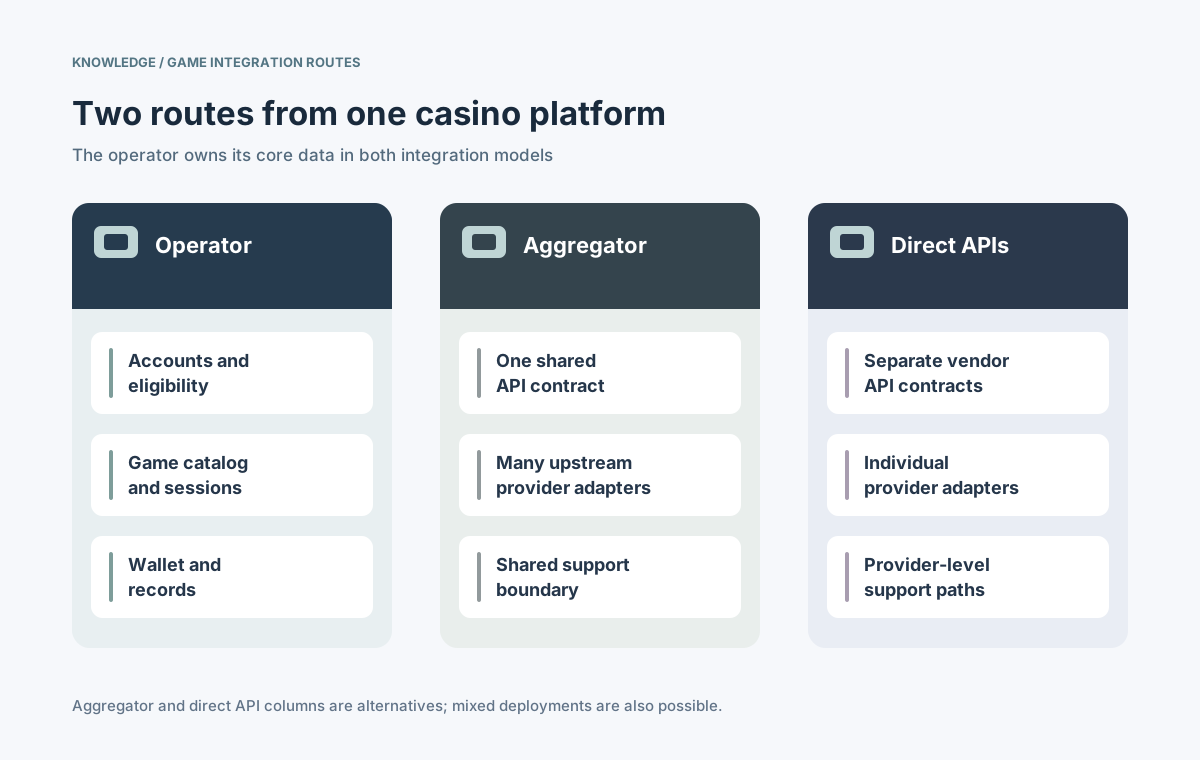
Two possible routes from the casino platform to game content: a shared aggregation layer or individual provider integrations.
On this page
What is the difference between an aggregator and direct integration?
A casino game aggregator is a service between the operator's platform and multiple game providers. It can offer a common entry point for catalog access, game launches and the supported transaction protocols. A direct integration connects the operator's platform to each provider's own API or remote gaming server (RGS). A provider's RGS and an aggregator are not interchangeable concepts: an RGS may operate the games, whereas an aggregator mediates access across suppliers. [1][2]
The choice is architectural and contractual. A single aggregator-facing API may simplify onboarding, but it does not make every provider's features, limits, currencies or release process identical. Direct APIs expose more provider-specific behavior and require the platform to normalize it. Both routes ultimately need authoritative session and financial records.
What does the casino aggregator manage?
Under an aggregation model, the operator implements the intermediary's approved API and uses its supported methods to discover games, request launches, process agreed transaction events and receive operational updates. A supplier may coordinate provider adapters and content onboarding. Actual coverage varies by product, market and contract; a marketing catalog is not a production entitlement. [2]
Integration concern
Typical aggregator contribution
Operator still owns
Provider connectivity
Maintains supported upstream adapters
Contracted access and platform readiness
Game catalog
Exposes normalized game metadata
Eligibility, localization and display rules
Game launch
Routes approved launch context
Account checks and launch authorization
Wallet events
Maps supported debit, credit or status messages
Authoritative balance and reconciliation
Provider updates
Coordinates supported version changes
Regression tests and release decisions
Operations
Offers an escalation and monitoring contact
End-to-end incident ownership
Consolidation has limits. A shared API can conceal differences in game capabilities, jurisdiction support, promotional features and error semantics. Ask which fields are normalized, which pass through unchanged, and how an unsupported provider feature is exposed or excluded.
What changes with direct game provider APIs?
With direct connections the operator implements and maintains separate vendor contracts. One provider might use a launch-token endpoint and server-to-server wallet callbacks; another might require different authentication, currency mappings or transaction acknowledgements. A platform-side adapter can give internal services one stable interface, but the operator maintains that adaptation for every vendor.
Keep credentials, allowlists, test environments and version documentation separately for each provider.
Map the provider's game IDs, studios, features and supported markets to canonical catalog identifiers.
Implement launch, session lifecycle and wallet or settlement protocols according to each signed contract.
Validate new provider releases, callbacks, game availability and error codes independently.
Assign incident contacts and retain traceable provider-specific transaction references.
Direct control can be valuable for deep provider-specific experiences or special commercial terms. The trade-off is cumulative maintenance, not simply the initial number of HTTP endpoints. A direct integration still may involve a vendor's own gateway or infrastructure rather than physical access to a game server.
How do the architectures and responsibilities compare?
One operator may use both routes: an aggregator for broad coverage and direct links where a particular provider requires a special feature or contractual relationship. The platform should normalize its own account, game-session and wallet contracts regardless of upstream route. Standard API descriptions improve clarity, but they do not prove that different providers share identical behavior. [3][4]
Define one canonical game and session model within the operator platform.
For the aggregator route, adapt that model to one documented intermediary interface and its provider-specific exceptions.
For the direct route, maintain separate provider adapters and map each response back to the same internal model.
Keep eligibility and financial authority with trusted platform services regardless of the connection route.
Expose the chosen route and provider IDs in support, monitoring and reconciliation records.
⊕View largerAlternatives for upstream connectivity; the platform remains responsible for its authoritative business records.
A mixed model needs explicit routing rules to prevent duplicate game listings and accidental switching between financial protocols. Document which route owns each game, market and commercial arrangement, and how a provider can be moved without losing transaction traceability.
How do launch and wallet flows differ?
The player sees a launch button, but the backend handles the session. In either route, the platform verifies the account and availability, resolves the chosen upstream provider and requests an approved launch context. Thereafter the provider, intermediary or platform may exchange wager and result messages according to the specific integration mode. Not all suppliers use the same callback sequence.
Lifecycle stage
Via aggregator
Direct to provider
Catalog selection
Aggregator game reference and mapping
Provider game reference and mapping
Launch request
One intermediary API, routed upstream
Individual provider launch API
Session checks
Platform and contract-defined intermediary checks
Platform and provider-specific checks
Transaction events
Normalized or relayed event protocol
Provider-specific wallet/event protocol
Reconciliation
Aggregator and original provider references where available
Original provider references and operator records
Timeouts and duplicate notifications require explicit handling. A retry does not mean the first financial request was never processed. Use stable references, agreed idempotency behavior, status queries and reconciliation rather than guessing from a missing browser response. [6]
Who controls catalog, markets and game availability?
A game can appear in a vendor's catalog yet be unavailable for a specific operator, currency, market, device or commercial agreement. The operator needs an approved intersection of entitlements, provider availability and its own eligibility rules. With aggregation the intermediary may supply some filtering; with direct integrations the operator obtains and combines provider-specific metadata.
Maintain canonical internal IDs and retain upstream provider and intermediary identifiers separately.
Record approved market, currency, platform and game-feature availability with an identified data owner.
Treat catalog updates as changes to review, not automatic permission to publish every game.
Validate launches against live restrictions even if the lobby displayed the title earlier.
Plan removal and migration behavior for discontinued, renamed or temporarily unavailable titles.
Ask for update frequency, data quality guarantees, provider identity provenance, disabled-game reasons and a change feed. A normalized catalog is useful only when downstream teams can explain why a title is listed or unavailable.
Which commercial and ownership questions matter?
API simplicity is not the full cost model. Aggregators may bundle access, support and commercial arrangements, while direct deals may increase control over individual providers. The actual fees, revenue sharing, minimums, settlement parties and right to distribute content depend on signed contracts. Do not infer them from a product page or API diagram.
Who contracts with each game studio, and who confirms content rights for every target market?
Which party supplies testing evidence, required certificates and release approval for a specific product?
How are fees, invoicing, reporting, settlement and disputes allocated between counterparties?
Can the operator export game mappings, transaction references and historical data when changing routes?
What happens to games, active sessions and support if the intermediary or a direct provider is terminated?
Compare one-time implementation effort with recurring engineering, commercial administration and operational overhead. A hybrid strategy can preserve options, but it increases the need for precise content ownership and routing governance.
Does an aggregator change security or compliance duties?
A middle layer changes who receives credentials, requests, personal data and transaction records; it does not eliminate controls. The operator must know which party validates player authority, protects tokens, stores logs and handles disputes. Object-level authorization, secure server-to-server authentication and the minimum necessary data remain important for both models. [5]
Control
Aggregator route
Direct route
Credential scope
One external integration plus intermediary trust
Separate scoped keys per provider
Account authorization
Platform must enforce account and resource rules
Same platform responsibility
Transaction audit
Track aggregator and underlying provider references
Track each provider's native references
Data exposure
Review intermediary access and sub-processors
Review each provider's access and retention
Market approval
Verify actual contracted content permissions
Verify per-provider rights and conditions
Technical standards such as GLI's RGS assessment descriptions show why platform and game-server responsibilities require independent attention. Required approvals vary by applicable market and agreement; this comparison is not a certification or legal opinion. [1]
How do outages, upgrades and support differ?
The aggregator route has fewer operator-facing interfaces but adds a shared upstream component whose failure may affect many providers. Direct routes can isolate some failures by supplier, yet increase the number of integrations the operator must monitor and upgrade. Neither architecture guarantees higher availability by itself. Consider timeouts, bounded retries, fallback behavior and meaningful correlation IDs. [3][6][7]
Measure launch success, transaction status, provider-level error rates and end-to-end latency per route.
Require visibility into which upstream provider failed, not just a generic intermediary error.
Test gateway overload, provider maintenance, delayed callbacks and partial catalog availability.
Agree on change notices, deprecation periods, incident escalation and response ownership.
Instrument a full player action across the operator, intermediary where present, and game provider. Distributed traces and stable correlation references help assign the incident to the correct owner without exposing credentials or unnecessary player data. [7]
How should a casino choose the integration model?
Start from the required markets, target providers, features, current platform architecture and available operations team. Compare a documented aggregator offer and a realistic direct-integration portfolio using the same test cases. The choice is not a universal aggregator-versus-direct ranking; many mature platforms use both.
List required games and features, then verify actual contracted market and currency access in each route.
Map launch, wallet, retry, refund and reconciliation responsibilities before accepting an API sandbox demo.
Estimate new-provider onboarding plus twelve months of maintenance, upgrades, QA and incident support.
Compare reporting detail, audit evidence, security scope, service levels and provider-level diagnostics.
Run fault, duplicate-event, downtime and migration tests; specify data portability and exit conditions.
An aggregator is compelling when broad coverage and a common operational interface are worth the added dependency. Direct connections fit cases requiring specific supplier control and a team ready to own every adapter. The durable architecture keeps internal player, catalog and transaction records independent of either commercial route.