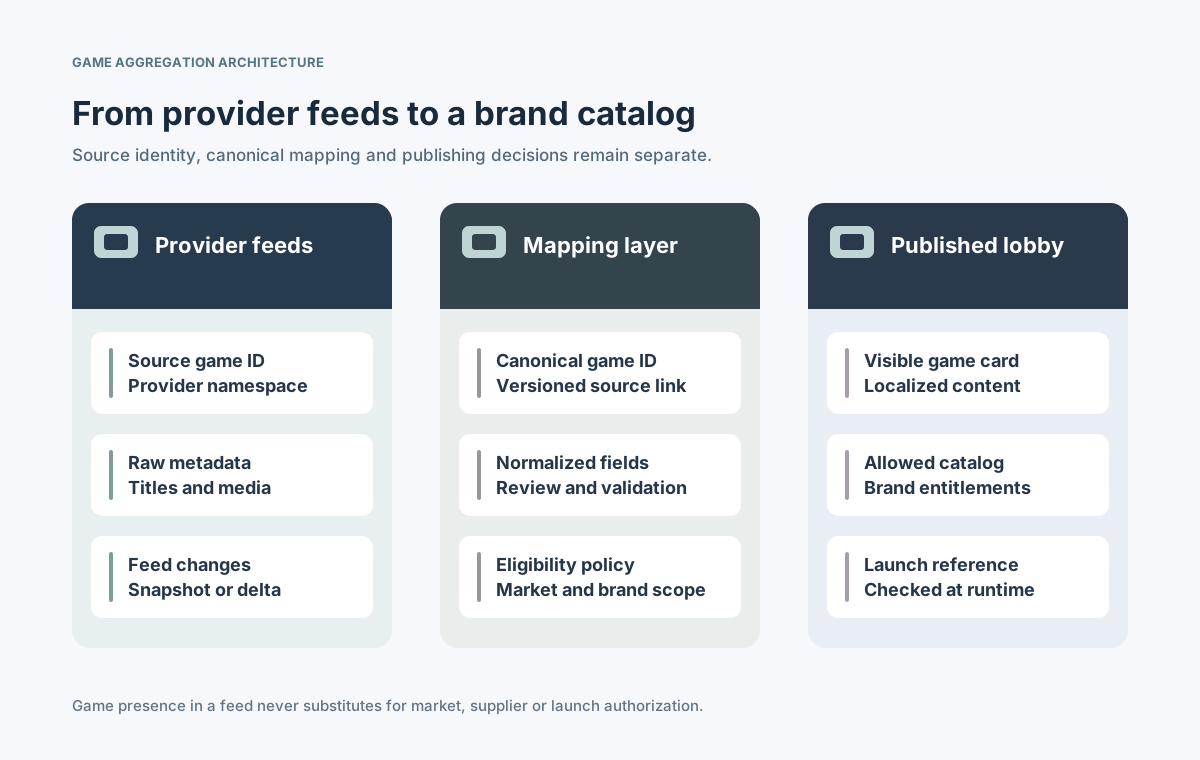
An aggregator may receive game lists from many suppliers, each with different identifiers, titles, categories, currencies, artwork and update schedules. Putting those feeds directly into a casino lobby creates inconsistent filters, duplicate titles and unpredictable game availability. Catalog mapping creates a controlled layer between external provider data and the operator-facing inventory. It links source records to stable internal IDs, validates metadata, applies contractual and market rules, then publishes approved versions to each brand. This guide explains the mapping workflow and its failure cases; it does not assume every supplier offers the same feed format or licensing rights.
Published
A mapping layer turns heterogeneous provider feeds into a validated catalog before brands publish games.
On this page
What is casino game catalog mapping?
Catalog mapping is the process of linking external game records to one internal inventory with known ownership, metadata and publication rules. A provider might call a game by a product code, while an aggregator stores a separate stable identifier and an operator chooses which localized title to show. Mapping keeps those identities connected without merging them.
It is more than formatting a spreadsheet. The mapping layer needs provenance, validation, updates, review states and controls that prevent an unapproved game appearing in a market. A catalog is a product and content inventory; a live launch request is a separate operation with its own rights and session checks. [1] [2]
How should provider IDs map to a canonical game ID?
Treat each supplier's identifier as unique only within that supplier's documented namespace. The same raw code can exist in different integrations, while a supplier may change codes during migration. Assign an immutable internal game_id and store versioned links to provider_id, source_game_id, integration version and, where needed, the game variant. Google's resource-name guidance illustrates why identifier scope and stable references matter. [2]
Identifier
Purpose
Mistake to avoid
Internal game_id
Stable catalog and reporting reference
Reusing an ID for another title
Provider ID
Supplier ownership namespace
Trusting a display name as identity
Source game ID
Exact supplier launch reference
Assuming globally unique codes
Variant ID
Separates genuine editions or modes
Merging distinct RTP or game variants
External alias
Preserves retired supplier references
Losing migration history
Mapping version
Audit trail for changed relationships
Silent reassignment after import
Use explicit unique constraints for provider plus source game ID, and preserve the original payload. Similar titles and thumbnails can suggest duplicates, but they are not safe identity keys. Confirm any cross-provider equivalence with evidence rather than automatically collapsing records.
Which game metadata fields need normalization?
Choose a canonical schema for the fields an operator actually needs: display title, supplier, broad game type, supported devices, languages, thumbnail assets, status, supported currency information and any documented technical capabilities. Record which source supplied each field and whether a value was verified, transformed or overridden. OpenAPI can describe the data contract between the mapping service and catalog consumers. [1]
Separate machine IDs from translated names and promotional descriptions.
Use controlled vocabularies for catalog filters, with an 'unknown' state when evidence is missing.
Validate field types, lengths, URLs, asset dimensions and supplier-defined enumerations.
Keep raw source values and mapping version so changes are reversible.
Never infer a game's regulatory approval, RTP or commercial permissions from its genre or filename. Optional data should remain absent until documented; a fabricated default can be worse than a visible gap in a backoffice review queue.
How do imports, changes and publishing work?
Suppliers may deliver full catalogs, paginated APIs, files or incremental change notifications. The importer must identify the source version, fetch every page when required, validate the payload and compare it with the prior accepted snapshot. A missing game in a partial page is not evidence of removal. Google's pagination guidance warns against assuming that one response contains a complete collection. [3]
Fetch a complete snapshot or a documented delta with a recorded source cursor.
Resolve provider namespaces and match source IDs to canonical records.
Validate metadata, assets, entitlement inputs and risky identity changes.
Publish an approved catalog version atomically or by controlled brand cohorts.
⊕View largerSnapshots and mapping decisions are reviewed before the brand receives a new catalog version.
Make import and publication operations idempotent: retries should not create new duplicate games, remove unrelated records or repeatedly change status. Record input hashes, import IDs and the exact published version for rollback and incident analysis. AWS documents idempotency as a reliability control for mutating operations. [7]
How should categories, features and filters be mapped?
A supplier's category names are often marketing or product-specific labels. Normalize them into an internal taxonomy built for the actual lobby filters, while keeping the original category and any uncertain classification. A 'slot' flag does not reliably prove that every optional bonus feature is supported or available to every customer.
Source field
Canonical treatment
Validation rule
Game type
Approved broad taxonomy
Flag unrecognized values
Feature tags
Evidence-backed filter facets
Do not derive from title
Device support
Explicit supported clients
Test real launch paths
Release date
Provenance-aware metadata
Avoid guessed dates
Popularity/ranking
Separate operator analytics
Never invent metrics
Store mapping rules as versioned configuration and review category changes that move many titles at once. Editors need a preview of search, facets and empty states before a taxonomy release reaches all brands.
How do localized names and artwork stay consistent?
Localize user-facing titles, short descriptions and accessibility text only when a trusted translation or approved editorial version exists. A display language tag follows the conventions of BCP 47; supplier language codes may need an explicit mapping. Missing translations should use a documented fallback rather than silently publishing another language as if it were localized. [4]
Keep one canonical game ID across language variants and store locale-specific fields separately.
Validate image ownership, approved crops, resolution, media type and cache invalidation.
Distinguish supplier-provided artwork from operator-created editorial assets.
Audit title changes so search aliases and historic links still find the intended game.
An image can be technically valid but commercially unauthorized. Record the approved source, usage scope and any restrictions. When a thumbnail changes, keep previous image identifiers available for controlled rollback instead of replacing unrelated files.
Why are markets, currencies and supplier rights separate?
A mapped title may be technically present while unavailable to a particular brand, operator, country, currency or client. Model a separate entitlement decision using supplier contract, market rules, game variant, device support and current operating status. Use ISO 4217 codes for fiat currencies where applicable, but do not mistake a currency code for proof of game support. [5]
Store a documented source and validity period for each entitlement decision.
Keep market, brand, operator and currency conditions explicit rather than a global enabled flag.
Recheck eligibility at launch time because catalog publication may precede contract changes.
Block or quarantine unknown permissions instead of treating missing fields as unrestricted access.
Search visibility and launch authorization must use the same current policy data but can expose different states: hidden, visible but unavailable, or enabled for play. Never imply that a listed provider automatically grants access to its complete library.
How are duplicates, versions and retired games handled?
Two feeds can list the same branded game, while one supplier can expose separate editions, mobile clients or market-specific variants. Deduplication should compare documented supplier identity and launch semantics, not just similar title strings. Mark suspected matches for editorial and integration review; keep aliases to protect reporting and saved links.
Event
Catalog action
Safety check
Exact source ID repeated
Idempotent update
No second canonical record
Potential alias
Flag for manual review
No title-only merge
New game variant
Separate variant mapping
Check launch and rights
Temporary outage
Change availability state
Do not delete record
Supplier retirement
Tombstone with provenance
Preserve history and links
A supplier's deletion signal may be delayed or ambiguous. Prefer explicit lifecycle states such as draft, approved, unavailable and retired; keep audit history and perform destructive cleanup only under a separate retention policy.
What should quality gates and monitoring verify?
Quality gates protect both users and integrations. Validate the feed schema, unique keys, page completeness, language tags, URLs and entitlement data. Investigate unexpected changes in catalog counts per supplier or market. Do not let a batch with thousands of missing entries automatically unpublish a whole lobby without human review. [1] [3]
Alert on import errors, source age, missing pages, mass field changes and failed asset checks.
Sample real game launch paths independently of catalog display tests.
Audit who approved mappings, entitlement overrides, deactivations and publication versions.
Authorize APIs that edit mappings or expose provider data at object level, not merely by endpoint role. [6]
Publish metrics such as source completeness, review backlog, duplicate suspects and entitlement mismatches. Reconcile against the source feed without assuming that a higher total game count always means better catalog quality.
What should teams verify before releasing a catalog mapper?
Test the mapper using a small but adversarial dataset: the same raw ID from two providers, one missing locale, a renamed game, an expired entitlement, a duplicate delivery and a partial API page. Verify the system never silently changes the canonical identity or grants a new market access on its own.
Freeze ID namespaces, schema and field provenance with documented owner approval.
Exercise paginated snapshots, retries, rollback and tombstone handling with audit evidence.
Review localized lobbies and real launch permissions for each planned brand and market.
Monitor production deltas and assign ownership for supplier exceptions and corrections.
A successful catalog mapping project is not the largest imported list. It is an explainable, maintainable contract between external game data, operator editorial choices and the independently enforced decision to make a game available.