An iGaming API integration is an agreed connection between an operator platform and another software service. It covers more than endpoints: identity, data ownership, event delivery, error recovery and operational responsibility all have to be defined.
Published
Conceptual illustration of an API integration boundary; not an image of a deployed IGSOFTAPI customer or provider connection.
On this page
What Is an iGaming API Integration?
An iGaming API integration is a defined exchange of requests, responses or events between an operator platform and another service used in online gaming. That service might supply games, player verification, payments, sports betting data or an operational tool. The API defines how the systems communicate; the integration is the wider work of deciding which information crosses that boundary, which system is trusted to act on it and what happens when communication fails.
There is no single universal “casino API”. One supplier might offer a launch interface and round events; another might expose an account or reporting service. An operator can connect directly, through a game aggregator or via a platform-owned adapter. These are architecture choices, not interchangeable promises about functionality or commercial access. A successful network connection also does not establish distribution rights, licensing or availability in a particular market.
Begin with the Interface Contract
Before writing an adapter, the parties need an interface contract: supported operations and versions; request and response schemas; mandatory identifiers; authentication; status and error meanings; timeouts; and how a change is announced. For money-affecting operations, the contract must also identify the authoritative record, uniqueness of transaction references and recovery rules. OpenAPI can describe HTTP operations, security schemes and incoming callbacks or webhooks, but a machine-readable specification does not replace those operational agreements.
Integration surface
Typical exchanged data
Boundary to agree
Catalogue or content
Supplier game IDs, product attributes, availability
Who maps IDs and confirms entitled markets
Player and session
Opaque player reference, session or launch context
Who authenticates and authorises access
Wallet or transaction
Stake, win, cancellation, unique transaction and round references
Which ledger is authoritative and how duplicates are handled
Verification or payment
Request reference, status and permitted attributes
Who owns the decision, data retention and status changes
Operations and reporting
Event ID, state, timestamp, correlation key
Who retries, reconciles and resolves incidents
Requests, Callbacks and Webhooks
A synchronous request is useful when the caller needs an immediate answer, such as whether a game exists or whether a launch request was accepted. An asynchronous callback or webhook reports an event after the original call has returned, or after a change occurs elsewhere. The receiver may be temporarily unavailable, so delivery, acknowledgement, retries and ordering must be specified for that particular provider. A successful HTTP response to the initial request is not necessarily the final business state.
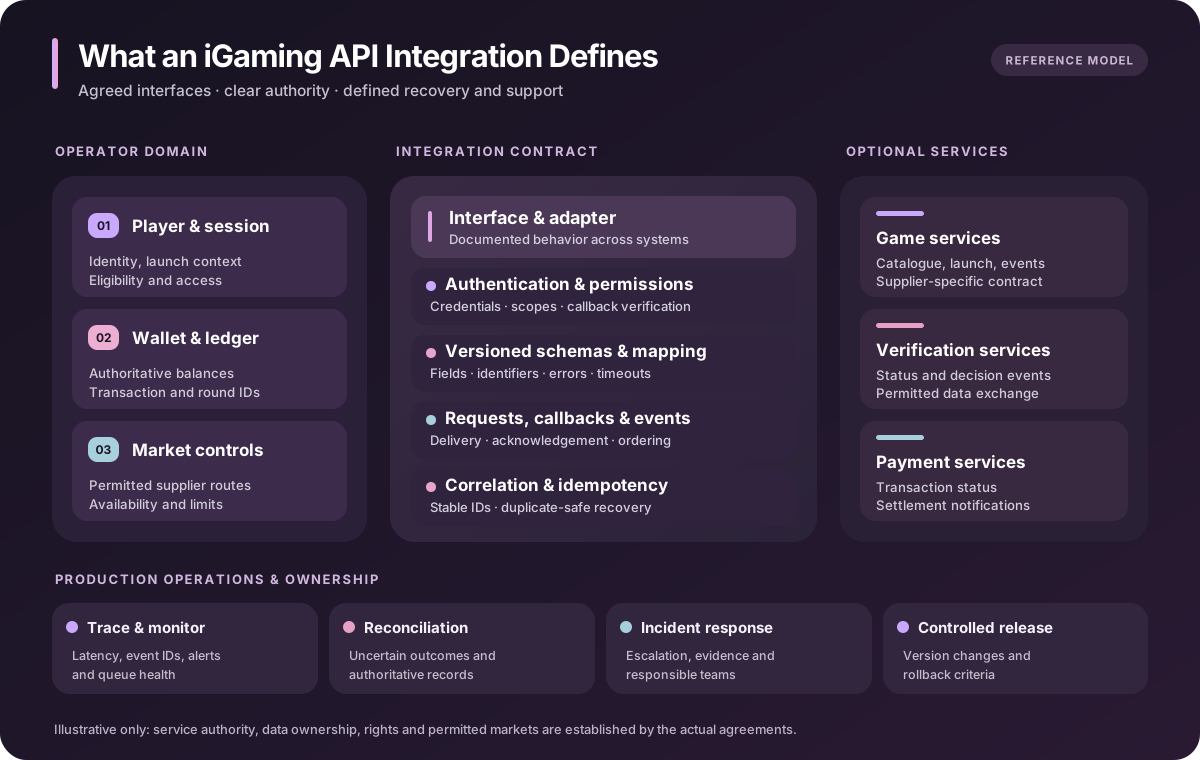
⊕View largerIllustrative responsibilities, not a universal product diagram. Each real integration has its own data paths, event semantics, service ownership and commercial constraints.
Useful event envelopes carry stable event and object identifiers, an event type and a documented schema version. The receiving system must still check authenticity and authorisation, decide whether the event has already been processed and apply transitions according to its state model. For example, mainstream webhook documentation illustrates that duplicate deliveries and out-of-order events are possible; an iGaming provider’s exact guarantees must be confirmed in its own contract, not inferred from another API.
Authentication and Trust Boundaries
A server-to-server integration may use an API key, bearer token, mutual TLS or another provider-defined mechanism. The important controls are secret storage, scoped permissions, transport security, credential rotation, environment separation and validation of who may act on each player, account or transaction. Provider credentials belong on trusted servers, not in a browser game frame or a mobile client. The operator must also avoid sending more personal or financial data than a service needs.
Authentication answers who sent a request; authorisation answers whether that party may perform a specific action. A valid key should not grant access to another operator’s player or wallet record. Inbound callbacks require the validation mechanism specified by their sender; signed payloads, trusted transport and replay controls can be part of that design, but no single webhook signing format applies across all vendors. OWASP identifies broken object-level authorisation and broken authentication as major API risks.
An Illustrative Session-to-Event Flow
A game launch is a helpful example because it crosses several boundaries. The sequence below is conceptual: some suppliers combine steps, some use an aggregator, and wallet arrangements differ.
A player selects a game in the operator interface. The platform resolves its local game reference and the intended supplier route.
The operator checks the player session, applicable market restrictions, currency and account access on a trusted server.
The integration maps required identifiers into the agreed launch contract and authenticates the server-side request.
The provider returns an accepted launch response, destination or error according to its documented behaviour.
The client opens the authorised game destination. It is not itself the source of truth for financial balances or player eligibility.
Any round, wallet or status events follow their agreed server-side path with stable identifiers and explicit acknowledgement semantics.
Operator and provider records are reconciled when an event is delayed, disputed or missing; the responsible team investigates unresolved state.
The same contract-first method applies beyond games. A KYC provider may return an asynchronous review status, while a payment provider may report a settlement change. Neither event should silently redefine the operator’s account or ledger rules without an agreed state transition.
Retries, Idempotency and Reconciliation
A timeout is ambiguous: the remote service might have rejected the request, accepted it or committed its effect while the response was lost. Automatically repeating a money-affecting operation without a stable transaction identity can create a second movement. The contract should define safe retries, duplicate detection and how to query or reconcile an uncertain outcome. HTTP itself distinguishes idempotent methods from operations that cannot be retried safely without additional knowledge.
Use stable, scoped transaction and event identifiers; record whether a reference has already been accepted.
Define permissible status transitions for stake, win, cancellation and correction rather than treating every event alike.
Keep enough correlation between the provider, adapter and authoritative ledger to investigate a missing response.
Document retry limits, dead-letter handling and manual reconciliation for events that cannot safely be replayed.
Interrupted play deserves a separate recovery plan. For example, the UK Gambling Commission’s RTS 10 sets expectations for fair interruption policies and recovery capabilities for operators to which those standards apply. It is a jurisdiction-specific illustration of why business recovery rules cannot be replaced by a generic “retry on error” handler; obligations elsewhere must be checked independently.
Test Failure Modes, Not Just the Happy Path
A sandbox demonstration proves little if only a valid request and response are exercised. Use contract fixtures and explicit acceptance criteria, then compare the observed response and persisted state with the expected result. Before production, test technical failures together with domain constraints:
Missing or expired credentials, insufficient scope and forged callbacks.
Inactive player session, restricted market, unsupported currency or unavailable content.
Unknown identifiers, incompatible schema versions and malformed error responses.
Duplicate transaction references, repeated webhooks and out-of-order status events.
Timeout after remote commit, network reconnection and incomplete game rounds.
Supplier outage, delayed reports and mismatched records requiring reconciliation.
Also agree who can pause an integration, roll back a deployment or disable a specific supplier route. Test and production credentials, endpoints and data should remain separated. Passing a test environment does not automatically establish content rights, regulatory approval or production capacity.
Observability and Incident Response
When a player reports an interrupted launch or an unsettled round, a team needs to follow the same operation across the operator platform, adapter and external service. Useful telemetry includes request and event IDs, partner route, latency, response category, retries, queue age and unresolved reconciliation items. Distributed tracing can help correlate service calls across boundaries, as described by OpenTelemetry; sensitive tokens and unnecessary personal data should not be put into traces or logs.
Operational ownership matters as much as telemetry. Monitoring needs agreed alerts, log retention, safe access for support staff, an escalation contact and a decision path for incidents. An interface may be technically healthy while a wallet or provider report is lagging; monitor business state and technical availability separately. Store credentials and player-related identifiers according to the applicable data and security policy.
Direct, Aggregated or Platform-Managed Integration?
The choice is not simply “one API versus many”. A direct connection can give a team close control of a supplier-specific contract but leaves it responsible for that adapter’s lifecycle. An aggregator can coordinate multiple game suppliers behind an agreed interface, while still requiring checks of content rights and service boundaries. A platform-managed integration can reduce some implementation work for an operator, but the operator still needs visibility into ownership, incidents and data exports.
Compare options against the actual services and markets needed, the quality of technical documentation, failure and reconciliation behaviour, security controls, change management and operational support. The presence of a supplier name on a website is not evidence of a live connection or licence. For the narrower content-aggregation model, see the related guide on casino game aggregators.
Production Handover Checklist
Confirm the current API version, endpoints, fields, identifiers, errors, rate limits and supported environments.
Assign ownership for player access, balances, event processing, data retention and any jurisdiction-specific controls.
Demonstrate duplicate-safe processing, retry policies, reconciliation and handling of unknown transaction state.
Complete negative, interrupted-play and outage tests with recorded results and recovery expectations.
Set up monitoring, alerts, operational runbooks, support contacts and an incident escalation path.
Agree a controlled rollout, rollback criteria, supplier change notices and a plan for version deprecation.
Confirm separately that the necessary commercial rights and market approvals are in place before enabling content.
An iGaming API integration is ready for production only when the teams can explain the normal data path and the recovery path, prove the contracted controls and identify who owns each important state change. The endpoint is the visible part of the work; the dependable integration is the shared operational contract behind it.