A casino game aggregator connects an operator's platform with multiple game suppliers through a coordinated integration layer. This guide explains catalogue mapping, launch sessions, wallet events, commercial rights and the checks required before production.
Published
Conceptual illustration of game content aggregation; not a claim that listed studios have been connected or licensed.
On this page
What Is a Casino Game Aggregator?
A casino game aggregator is an integration service that links a casino operator's software with games supplied by multiple studios or remote gaming server (RGS) environments. The operator generally connects to an agreed interface, while the aggregation layer maintains supplier-facing integrations and translates selected data and events between the two sides. In practice, aggregation can also include catalogue administration, launch management, transaction reporting and support tools. The exact scope is contractual and varies by product.
The useful distinction is technical access versus the right to offer a game. A common API endpoint does not by itself grant intellectual-property permissions, market approvals, supplier contracts or access to every title shown in a provider directory. Some aggregators also act as authorised content distributors, while others provide software for connections that the operator or another party must arrange. The agreement must make that difference explicit.
Where the Aggregator Fits in the Architecture
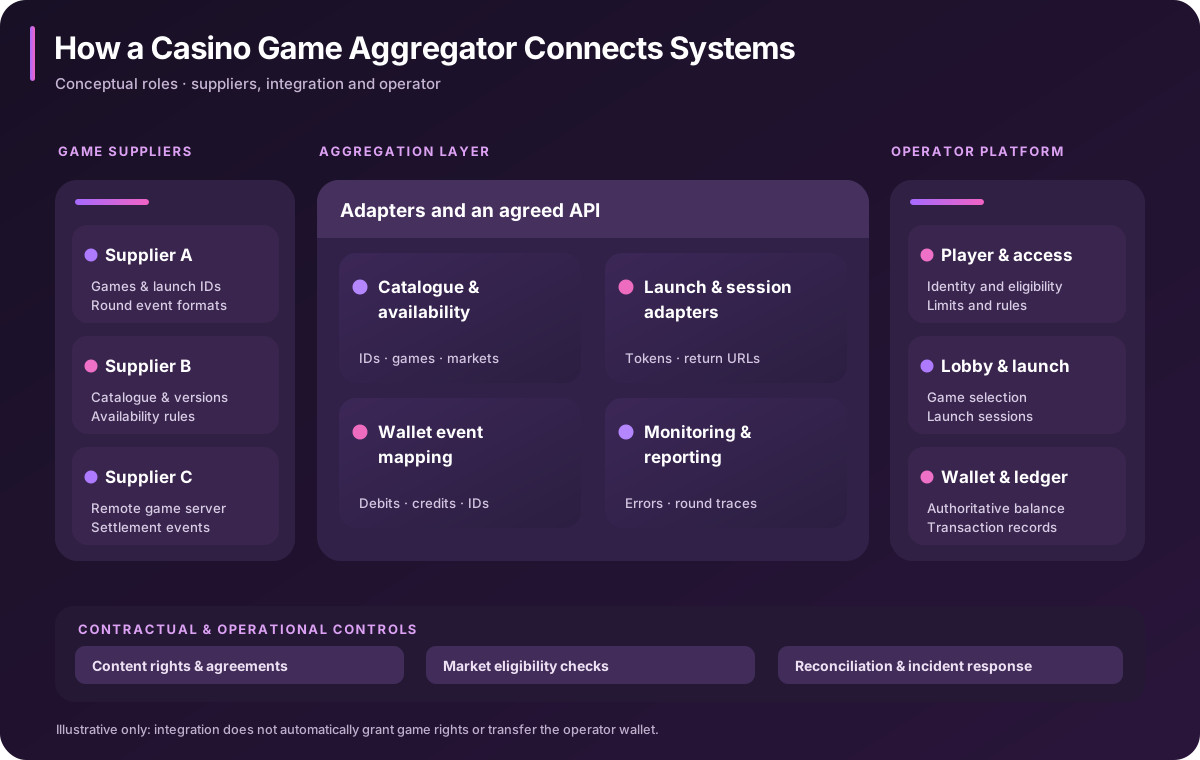
Think of the aggregator as a boundary, not as the entire casino backend. Game suppliers expose their own identifiers, game availability, launch rules and financial event contracts. The aggregation layer maps supported fields into an operator-facing agreement. On the other side, the operator platform remains responsible for the player session, access checks and whatever wallet and audit duties it has retained.
⊕View largerIllustrative system boundaries only. Each real integration may use different data paths, wallet arrangements, hosting and supplier agreements.
Party or service
Typical responsibility
Do not assume
Game supplier / RGS
Game logic, supported titles and supplier-side events
The operator can change or host the game's outcome logic
Supplier adapter
Translate supplier-specific catalogue, launch and event messages
Every supplier has the same request or failure semantics
Aggregation layer
Expose agreed catalogue, launch and reporting interfaces
Every listed title is contracted for every market
Operator platform
Manage player access, product rules and its assigned wallet or ledger
Aggregator software replaces player management and payments
Commercial and compliance teams
Confirm content rights, operating markets and assigned controls
Technical connection alone establishes permission to operate
How Game Catalogues and Availability Are Managed
A supplier may identify a title by its own game code, while the operator needs a stable internal catalogue identifier, name, category, device support, language and currency rules, media assets and market eligibility. The aggregator can standardise part of this metadata, but gaps and exceptions must be handled deliberately. Game discovery is a separate process from the final server-side decision to authorise launch.
Catalogue field
Why the operator needs it
Validation question
Supplier and game IDs
Resolve the exact content and launch route
Are IDs stable across environments and updates?
Market entitlement
Hide or reject unsupported content
Who confirms the contract and jurisdiction?
Currency, language and device
Display compatible content to the right player channel
Which values are accepted by the game supplier?
Game status and version
Manage maintenance, releases and disabled games
How are catalogue changes delivered and audited?
Media and presentation data
Build a usable lobby without inventing game facts
Who owns asset quality, licences and refreshes?
A well-designed lobby does not rely on a single static import. Operations need a controlled way to learn about titles added, retired, suspended or restricted for a market, and a reliable fallback when a supplier's availability feed is delayed. Publishing a game icon in an internal catalogue should not silently bypass the entitlement decision at launch time.
From Player Selection to a Game Launch
The following is a representative flow, not a universal list of endpoints. Real request names, session lifetimes, launch URLs and authentication methods depend on the operator, aggregator and game supplier.
The player chooses a catalogue item on the casino website or app; the operator resolves its internal game ID to an authorised supplier route.
The operator checks the player session, account status, market, currency and configured access restrictions on the server.
An authorised server-side request sends the agreed player reference, game reference and launch context to the aggregation layer.
The aggregator applies its mappings and contacts the corresponding supplier interface or resolves an approved launch destination.
The game client opens in the agreed channel. The front end may display a launch URL or embedded frame, but it is not the source of truth for eligibility or balances.
Game-round and wallet-related messages follow the contracted server-side paths, which may pass through the aggregator or through a separate wallet interface.
The operator and supplier retain identifiers and records needed to correlate a game session, its rounds and any operational exception.
A shared launch API reduces the number of interfaces the operator needs to learn, but it does not mean that live tables, multiplayer titles, slots and other game classes have identical capabilities. Integration acceptance needs representative tests for each supported supplier and game class, including unsupported combinations.
Wallet Events, Game Rounds and Reconciliation
Money-related events require more precision than a game launch. In a seamless-wallet design, the operator's wallet or an authorised wallet service may approve stake debits and win credits through trusted server-side messages. In transfer-based models, movement between an operator balance and a supplier-held balance introduces extra reconciliation points. The aggregator may translate those calls, but the contract must identify which system is authoritative for accepted transactions.
Identify the player, supplier game, session and round using agreed stable references.
Distinguish stake, win, cancellation, correction and inquiry events instead of treating all callbacks as equivalent.
For money-affecting calls, define replay protection and idempotent handling so a repeated request cannot create another accepted movement under the same transaction identity.
Keep correlation between supplier reports, aggregator events and the operator's authoritative ledger or transfer records.
Investigate unresolved rounds and ambiguous timeouts by reconciling records; do not assume a missing response proves the original transaction failed.
Beyond prevention of duplicate movements, operations need to know whether reports are preliminary or final, when a round may close, how manual corrections are recorded and how supplier disagreements are escalated. These are testable requirements, not just accounting paperwork.
Does Aggregation Include Game Rights and Licensing?
Not necessarily. The software and the commercial distribution relationship are separate questions. Some providers include content sourcing or resale rights within a contracted package; others supply an integration platform that connects to supplier agreements held by the operator. A provider directory is useful for research, but it is not evidence of a live integration, licensed catalogue or a right to distribute a named studio's games.
Question
Evidence to request
Possible owner
Can we technically launch the game?
Test credentials, supported API version and supplier sandbox
Technical integration parties
May our brand offer this title?
Signed scope of supply and distribution rights
Operator, aggregator or authorised reseller
Is it allowed for this market?
Jurisdiction-specific permissions, testing and content availability
Relevant licensees and compliance owners
Who manages incidents?
Escalation paths, service boundaries and support terms
Contractually assigned operations teams
Regulatory obligations are jurisdiction-dependent. For example, Great Britain's Gambling Commission publishes remote gambling and software technical standards and explains when gambling software and operating licences apply. Those rules must not be presented as universal requirements for all markets. Technical integration should be reviewed alongside the permissions and controls relevant to the intended deployment.
Aggregator vs Direct Provider Integration vs Full Platform
There are three useful categories of procurement decision. An aggregator can centralise supported game interfaces. Direct supplier connections can give a team greater control of individual integrations. A managed casino platform may bundle aggregation with other operating services. These are not equivalent purchase items, and an operator can use more than one approach at the same time.
Route
Where it can help
What to evaluate
Game aggregator
One agreed operator-facing interface for several supplier connections
Available rights, mapping gaps, wallet model and dependency on the layer
Direct supplier APIs
Supplier-specific feature access and a direct technical relationship
Per-supplier implementation, monitoring, support and commercial overhead
Managed casino platform
Potentially combines content with PAM, wallet and operations
Actual included modules, data ownership, migration and exit terms
The correct comparison is not simply one API versus many APIs. Ask what remains your team's responsibility after integration, which records you can export, which supplier features are exposed and whether an outage in the shared layer changes your operational recovery options. A detailed side-by-side choice deserves a separate guide; here the aim is to make the basic roles clear.
Security, Monitoring and Supplier Failure Scenarios
Aggregation introduces another trust boundary. An operator should authenticate service-to-service calls, validate which account and game a request is authorised to affect, protect supplier credentials, and separate diagnostic correlation IDs from secrets or personal information. The OWASP API Security Top 10 identifies broken object-level authorisation and unsafe consumption of third-party APIs among important risks; those considerations apply wherever external integration messages are accepted.
Supplier outage: stop unsupported launches, display a controlled status and distinguish new sessions from unsettled existing rounds.
Lost response: perform an agreed status inquiry or reconciliation instead of guessing whether a stake or win was accepted.
Schema or mapping change: version, test and roll out supplier identifiers, catalogue fields and callback formats deliberately.
Unreconciled events: correlate supplier round IDs, aggregator references and operator ledger movements for support investigations.
Credential or tenant isolation: ensure one operator, brand or player cannot access another's records through a reused integration path.
Observability: propagate safe trace context through trusted services when supported, and avoid sending credentials or personal data in telemetry.
The UK Gambling Commission's interruption standard gives a concrete example of why failure recovery matters: systems subject to its rules need appropriate policies and recovery capability when gambling is interrupted. The precise behaviour for a particular integration still depends on its games, jurisdiction and contracts.
A Practical Casino Aggregator Evaluation Checklist
Before accepting a supplier demo as proof of production readiness, ask for a testable contract and a responsibility matrix. These questions are useful whether the aggregation layer is purchased, hosted by a partner or developed in-house.
Which named game studios and titles are actually connected, contractually available and approved for our intended markets?
Who owns provider access, commercial rights, content certifications and market-specific changes?
What are the exact catalogue, game launch, session and callback contracts—and which supplier exceptions remain visible?
Which system is the source of truth for player identity, wallet balances, round state and adjustments?
How are duplicate debits, delayed wins, refunds, cancelled rounds and timeouts handled and reconciled?
What identifiers and reports let our team trace one disputed round across all involved parties?
How are disabled games, expired entitlements, supplier outages and maintenance windows communicated?
What security boundaries, authentication methods, audit records and key-rotation controls exist?
Which capabilities are supported in a realistic sandbox and which must be validated separately in production?
Who provides incident response, upgrades, operational reporting, data export and exit support?
A casino game aggregator is useful when it makes game integrations easier to operate and explain. Its limits are equally important: a shared interface cannot create missing content rights, remove the need for a trustworthy wallet, or guarantee uniform behaviour across every supplier. Operators should choose the arrangement whose records, responsibilities and failure cases remain clear.