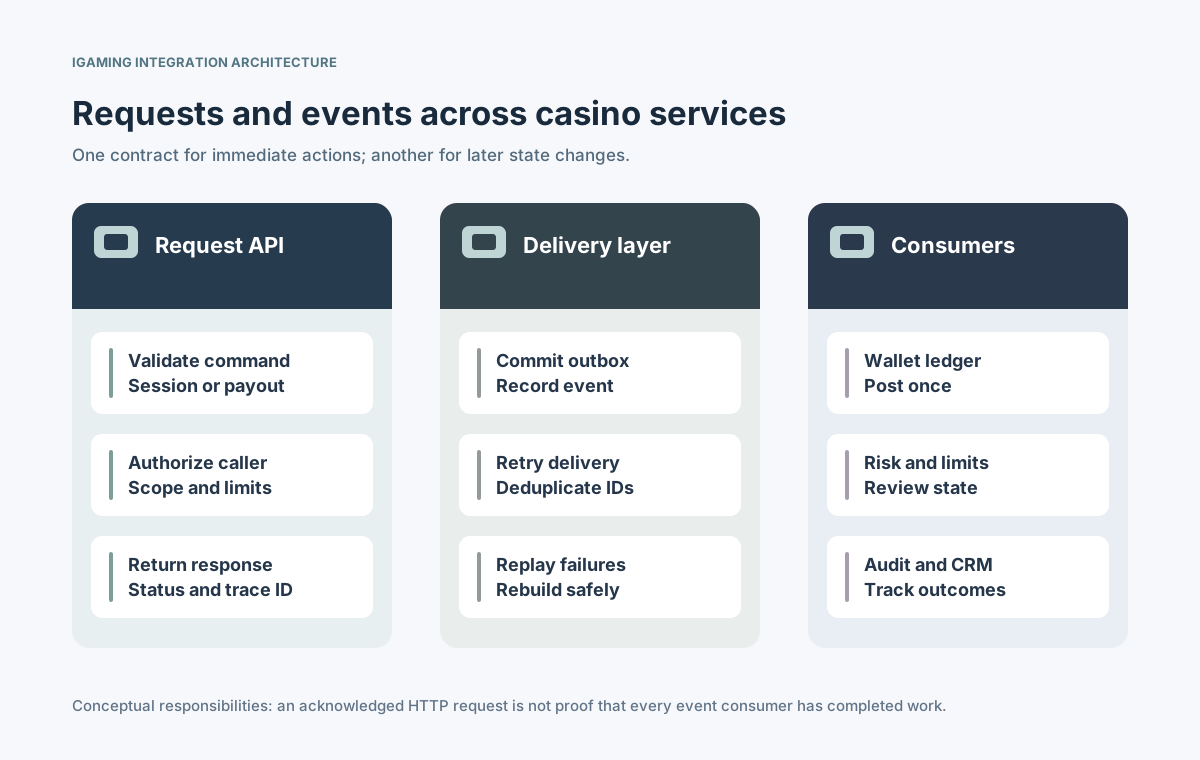
An iGaming platform can ask a service for a game session through a REST API and still need to learn about a settled bet, a changed player limit or a completed payment later. Those later updates often arrive as webhooks or messages rather than as part of the original HTTP response. Designing both paths together is essential: requests can time out after succeeding, callbacks can be retried, and independent services may observe events in different orders. This guide explains the difference between commands and notifications, the controls needed for financial and player-sensitive events, and the operational evidence an operator should demand from an integration partner. Examples are architectural patterns, not promises about any particular supplier's product.
Published
A synchronous response and an asynchronous event are different parts of one reliable integration contract.
On this page
What roles do REST APIs, webhooks and events play?
A REST-style HTTP API is commonly used when an operator needs an immediate answer: retrieve a game list, authenticate a player, create a session or submit a supported transaction. A webhook is an outbound HTTP notification sent by another system when an event occurs. A message broker can distribute similar events internally without exposing a public webhook endpoint. These patterns can coexist inside one integration, with the precise guarantees defined by each provider's contract.
An HTTP 200 response can mean that a request was accepted or completed according to that endpoint's contract; it does not automatically mean that unrelated consumers have updated their state. Conversely, a webhook may arrive after the original connection has closed. OpenAPI describes HTTP interface contracts, while AsyncAPI supplies a description model for message-driven interfaces. Neither document replaces runtime delivery tests. [1] [2]
How does request-response differ from event delivery?
A request-response call keeps the caller waiting for a result, usually within a defined timeout. An event notification allows the originating service to report a state change later, possibly to multiple independent consumers. Neither communication style is inherently more reliable: reliability depends on durable records, retry contracts and the receiving system's behavior.
Design question
REST request
Webhook or event
Direction
Caller invokes an endpoint
Producer notifies a subscriber
Typical timing
Response within request timeout
After the event is recorded
Primary purpose
Read or request an action
Report that state changed
Acknowledgement
Endpoint-specific HTTP response
Receipt acknowledgement to sender
Failure handling
Caller retry or status lookup
Redelivery, queue or replay
Consistency
Result limited to called service
Consumers can lag or disagree temporarily
For instance, a game-launch API can return a session token immediately, while wallet and reporting systems process subsequent round events. A webhook receiver should acknowledge only after performing the minimum durable work required by its contract; lengthy downstream jobs belong behind a queue or persistent processing record. [3]
What belongs in a versioned event contract?
A robust event envelope identifies the event itself separately from the business object it describes. It should include a unique event ID, type, schema version, occurred-at time, producer, correlation or trace ID and the scoped business identifiers required to interpret the payload. The payload's financial amount, currency and state semantics must be unambiguous where money is involved.
Define event ID and transaction ID as different concepts; multiple events may describe one transaction lifecycle.
Carry operator, brand, provider and account scope where IDs are not globally unique.
Separate delivery metadata such as attempt count and signature from business facts such as a settled round.
A machine-readable OpenAPI or AsyncAPI contract helps teams test request bodies, event types and compatibility, but teams must also publish concrete examples for refund, rollback and disputed state. Treat breaking event changes as migrations with consumer readiness checks, not silent field renames. [1] [2]
What happens from an API command to a casino event?
Consider a platform that requests a player game session and later receives wager and settlement callbacks. The command boundary validates the player, brand, allowed game and server-side credentials. After the external provider creates a session, its own round lifecycle may produce wallet operations or events. The operator should be able to trace each event to the correct player, session, round and source provider without relying solely on a frontend URL.
Accept the authenticated request and assign a correlation ID before calling the external API.
Validate the response contract, persist the session reference and explicitly handle a timeout with unknown outcome.
Receive a signed callback, validate the producer and commit an idempotent processing record before acknowledgement.
Apply allowed wallet state transitions once, then publish downstream audit or analytics events from durable state.
⊕View largerA delayed delivery can be retried without turning one game round into multiple financial postings.
The Aggregator's published wallet callback guide is an example of an explicit provider-scoped transaction identity and documented retry behavior; it should not be mistaken for a universal callback schedule. The operator must verify the exact partner protocol before implementation. [7]
How should retries, duplicate callbacks and idempotency work?
Network failures make it possible for a sender to miss an acknowledgement even when the receiver committed the action. Retrying is often necessary, but it can deliver the same business event more than once. A financial callback handler therefore needs a durable, uniquely constrained idempotency key scoped to its producer and business operation; a short-lived in-memory cache is not sufficient evidence of exactly-once posting.
Condition
Safe receiver behavior
Persistent evidence
First valid delivery
Validate and post once
Source scope plus transaction ID
Exact duplicate
Return prior result
Stored outcome and response
Same ID, changed amount
Reject and investigate conflict
Original and conflicting payload hashes
Timeout with unknown outcome
Look up committed state
Operation reference and audit trail
Refund or rollback
Link to original posting
Reversal ID and original transaction
Stripe documents idempotency keys for safely retrying supported API requests, while its webhook guidance describes separate event-delivery safeguards. Those are two different mechanisms: a caller's request key does not automatically deduplicate inbound provider callbacks. The casino's own transaction identity and ledger constraints must be designed explicitly. [3] [4]
How do ordering and eventual consistency affect player state?
Event delivery order is not always business order. A bonus reward event may be observed before a preceding account update, or a rollback may reach a receiver while its original wager is still being processed. Amazon SQS standard queues, for example, document at-least-once delivery and possible reordering. That is a platform-specific example of why consumers cannot assume globally ordered delivery. [5]
Attach a version or monotonic sequence where the business source can supply one; do not invent one from arrival time.
Enforce a state machine that defines which transitions are legal and how to hold an early reversal.
Keep authoritative wallet postings in one ledger transaction boundary and treat projections as eventually consistent.
Expose processing lag, pending events and missing predecessors for investigation rather than silently discarding them.
Ordering guarantees should be stated per entity or partition, not advertised as universal. If a contract supplies no sequence, reconciliation against the authoritative transaction API or statement is safer than sorting by timestamps and hoping the financial balance matches.
Which authentication and signature checks are required?
Public webhooks are internet-facing trust boundaries. An endpoint should authenticate the claimed producer with the mechanism specified by the integration, validate a signature over the original request bytes when signatures are supported, enforce acceptable clock skew or replay windows, and verify the actual operator and transaction scope. TLS protects transport but does not make an arbitrary payload authoritative.
Verify request signature and timestamp before parsing business effects; rotate secrets with an overlap procedure.
Apply authorization to object IDs, player IDs and financial operations, not only the HTTP endpoint itself.
Limit payload size, request rate, processing time and retries; keep secrets and personal data out of logs.
Keep sandbox and production keys separate, and audit all manual replay and reconciliation privileges.
Stripe documents signature verification for its own webhook format, and OWASP's API Security Top 10 highlights broken authorization, authentication and resource-consumption risks. Those references motivate a security review; the signing algorithm must still match the actual game or payment partner. [3] [6]
How should queues, replay and failed-delivery recovery work?
A reliable receiver persists an authenticated event before acknowledging it, then processes it through a controlled worker or equivalent durable workflow. The design needs retryable versus permanent error classifications, a dead-letter destination or equivalent quarantine, and a controlled replay path. An event that repeatedly fails validation must not be retried forever as though it were a temporary network error.
Failure mode
Recovery control
Owner's evidence
Temporary receiver outage
Backoff and redelivery
Attempt history and last response
Poison or invalid payload
Quarantine, alert and review
Payload hash and reject reason
Consumer deployment failure
Pause or replay from durable record
Consumer version and checkpoint
Missing sequence predecessor
Hold and request source state
Entity ID and missing reference
Reconciliation mismatch
Investigate before corrective posting
Source feed, event and ledger record
A queue acknowledgement is not the same as a committed financial update. AWS documentation describes queue-specific duplicate behavior and dead-letter patterns; teams must choose retention and replay windows to match their own contractual recovery obligations. Use a controlled operator action for replaying money-related events, with full audit. [5]
How do teams observe delivery and reconcile results?
Monitoring should follow one business operation across the HTTP request, event producer, delivery attempts and every required consumer. Useful metrics include time since the last successful delivery, oldest unprocessed event, retry rate, dead-letter volume, duplicate suppression, schema rejection and age of unresolved financial differences. A single green endpoint-health check does not prove event completeness.
Propagate correlation IDs and keep distinct request, event, session, round and transaction references.
Compare provider or payment records with the wallet ledger and downstream projections at an agreed cadence.
Alert on both hard failure and quiet non-delivery: no events at expected volume can be an incident.
Assign incident escalation, manual replay permissions and customer-impact communication before launch.
For disputed rounds, preserve the source's original identifiers and evidence chain even if a normalized event is sent to CRM or reporting. A reconciliation difference should trigger investigation, not an unreviewed compensating credit.
What should an iGaming integration team test before go-live?
A useful acceptance test demonstrates the complete chain with realistic failures, not merely a successful session create. Operators should agree the API version, callback subscription, idempotency scope, rollback rules, data retention and support contacts in writing. The security and operations review must include every service that can affect a balance, limit or dispute decision.
Exercise authorized requests and rejected requests with the exact account, market, brand, currency and player scope.
Replay an identical callback, mutate its payload, deliver events out of order and force a timeout after commit.
Simulate queue backlog, lost acknowledgement, invalid signature, provider outage and a controlled dead-letter replay.
Reconcile wallet postings, source transaction feed, notifications and audit evidence until every test ID is explained.
REST APIs, webhooks and message delivery work best as one documented integration rather than three separate conveniences. The final decision is not whether the platform supports webhooks; it is whether its commands, event facts and financial records remain consistent, auditable and recoverable under real operating conditions. [1] [2] [7]