Connecting a payment gateway to an online casino is more than adding a checkout button. The operator must connect a merchant account and payment method to an internal player wallet without treating a browser redirect as proof that money arrived. Payment initiation, authorization, capture, settlement, refunds and payouts can be separate events with different identifiers and timelines. This guide explains the integration boundaries, a reliable deposit and withdrawal flow, webhook security, duplicate-event handling, reconciliation and the checks needed before any payment method goes live.
Published
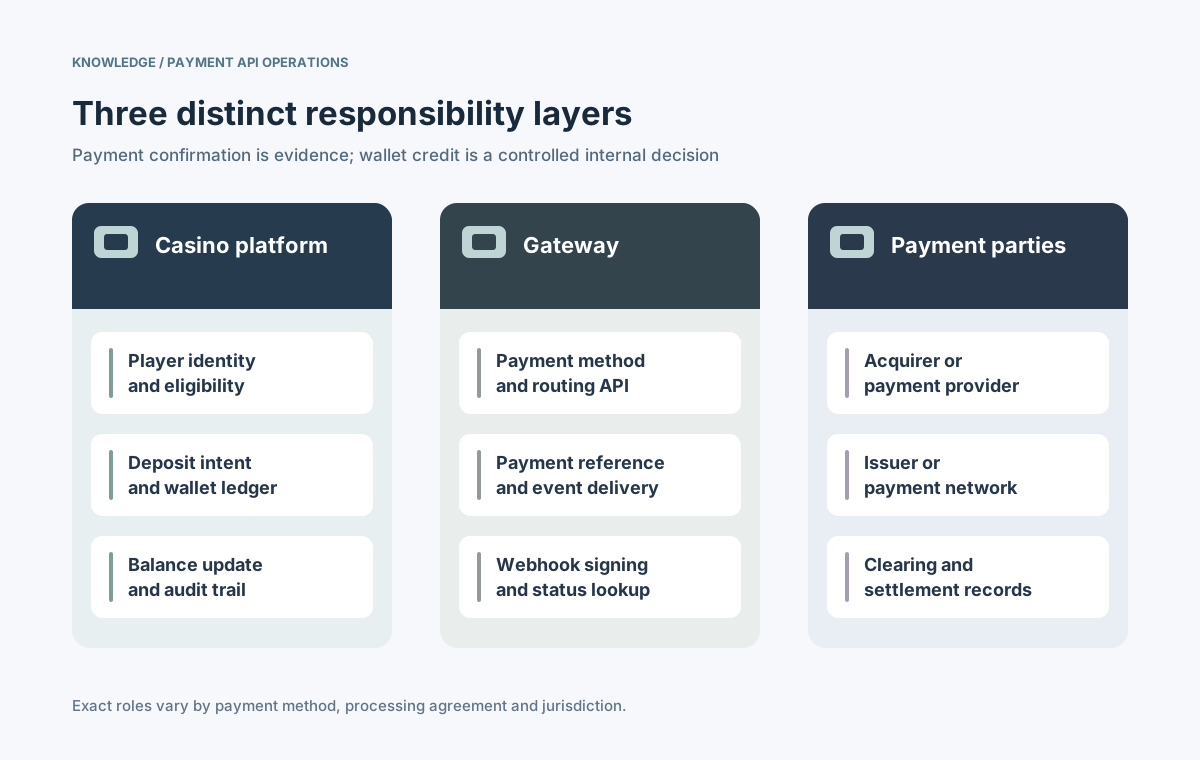
The gateway passes payment instructions and status; the casino platform remains responsible for its player balance and transaction records.
On this page
What does a casino payment gateway actually connect?
A payment gateway provides the operator-facing technical interface to payment methods or downstream processors. It may create payment sessions, route requests, collect status updates and expose reporting APIs. The gateway is not automatically the bank, acquiring institution, payout provider or party holding merchant funds. Those roles depend on the actual contract and payment method.
The casino platform owns a separate player ledger. A successful payment API response, customer redirect or pending authorization cannot, by itself, authorize an irreversible player balance change. The system needs a defined evidence threshold for crediting, an internal transaction ID and an auditable connection to the provider reference. Payment providers can expose several lifecycle states rather than one final success flag. [3]
Which contracts and API details must be established first?
Before implementation, identify the legal merchant, contracting processing party, approved payment methods, supported deposits and withdrawals, settlement currencies, rolling reserves, dispute responsibility and relevant markets. A sandbox credential only proves access to a test system. Production approval is a distinct business decision.
Integration area
Gateway or provider specification
Operator validation
Merchant coverage
Entities, countries, payment methods
Explicit gambling approval and permitted player markets
Deposit API
Create, status, redirect or hosted flow
Unique order ID, supported currency and amount
Callbacks
Signed events, retries, delivery rules
Signature check, durable intake and deduplication
Withdrawals
Payout API or separate partner
Eligibility, approvals and beneficiary verification
Funds lifecycle
Capture, settlement, refunds, disputes
Ledger status and accounting ownership
Operations
Reports, limits, cutoffs, escalation
Reconciliation and incident playbook
Ask for the exact API contract and state diagram for each method, not a general claim that the gateway supports every transaction. Record who is allowed to initiate refunds, which side can reverse a payout and how the operator will be notified of late failures.
How does a casino deposit move through the gateway?
A deposit begins with a server-side intent linked to an authenticated and eligible player. The casino stores the requested amount, currency and an immutable internal payment reference, then asks the approved gateway to create a payment. The response can provide a hosted checkout session, redirect URL or provider token; the exact method depends on the integration.
Validate the player, jurisdiction, payment method, currency and deposit limits before creating the intent.
Store the internal order ID before calling the gateway; map any returned payment reference to it.
Treat a pending, redirected or authorized response as a state to monitor, not an automatic wallet credit.
Use the provider's verified final event or status lookup to trigger a controlled, idempotent ledger posting.
A customer can abandon checkout, finish an authentication challenge or return to the casino before the processing result is final. Browser return URLs should display progress and request an authoritative status check, never serve as the only payment confirmation. [3][7]
Why are signed webhooks essential for wallet credit?
Payment outcomes can arrive after the HTTP request has timed out. A secure webhook intake separates receipt of the external event from changing the internal wallet ledger. Adyen documentation describes HMAC verification for applicable webhooks; each provider has its own signature format, retry policy and event taxonomy. [5]
Receive the event over HTTPS and validate its provider identity, signature, payload format and merchant scope.
Persist the raw event and a unique provider-event key in a durable queue or inbox; acknowledge within the provider's delivery window.
Resolve the provider payment reference to a known internal order and validate amount, currency, player and transition.
Under a database transaction, post a permitted wallet credit only once and persist the resulting ledger entry.
Handle duplicate or out-of-order notifications as repeat evidence; investigate contradictory statuses instead of rewriting history.
⊕View largerPayment events cross system boundaries; the operator retains the authoritative wallet ledger.
Idempotency has two directions: outbound requests need stable retry keys where supported, and inbound events need deduplication plus unique constraints around ledger postings. Provider-side idempotency scopes and retention periods vary, so the operator must maintain its own long-lived financial invariant. [4]
What is the difference between authorization, capture and settlement?
For card-based flows, an authorization may reserve funds; capture can be a separate step; clearing and settlement can happen later. Some payment methods do not use these stages in the same way. The gateway's event model must be mapped to a controlled casino-specific credit policy rather than flattened into a single success flag. [3]
Observed event
What it can mean
Safe platform interpretation
Payment created
A request or session exists
Pending; no final money movement proved
Authorized
Issuer approved or reserved funds
Not the same as final settlement
Captured or confirmed
Provider reports completed capture/payment
Apply agreed credit policy with dedupe
Settled or paid out
Funds enter a later accounting stage
Match to settlement and bank reports
Refunded or disputed
A later reversal or claim occurred
Post a separate adjustment and investigate
An operator may credit the wallet before merchant settlement under a deliberately approved risk policy, but should never describe that credit as proof that the bank has already paid out. Maintain provider events, wallet postings and settlement entries as linked yet separate records.
How should withdrawals and payouts be integrated?
A withdrawal is not simply a deposit API call with a negative amount. It usually requires eligibility and beneficiary checks, an internal withdrawal request, reservation of player funds, approval steps and an approved payout rail. The payout provider may differ from the deposit gateway, and available methods depend on the operator's agreement and location.
Create a withdrawal request with player, balance, method, beneficiary and policy checks.
Reserve funds in the internal ledger while the request awaits approval and processor submission.
Submit once to the permitted payout endpoint and store the external reference and lifecycle state.
Release, complete or reverse the reservation according to verified provider outcomes; reconcile later settlements.
Distinguish 'submitted', 'accepted for processing', 'paid' and 'failed'. Do not present acceptance by a payout API as a guaranteed credit to the beneficiary. Exceptions should enter a controlled review queue rather than an automatic repeat transfer.
How do hosted checkout and tokenization affect PCI scope?
Hosted payment pages or provider-managed fields can reduce exposure to raw card data, but they do not automatically eliminate PCI DSS responsibilities. The PCI Security Standards Council explains that even merchants outsourcing processing retain obligations such as oversight of third-party providers; payment-page script security also matters. [1][2]
Prefer the provider's supported hosted or tokenized interface so the casino backend does not receive unnecessary PAN or security codes.
Never store card verification values, payment secrets, bearer tokens or full sensitive payloads in general-purpose logs.
Protect payment-page scripts, integration origins, API credentials and webhook verification keys according to the applicable assessment.
Define token ownership, allowed reuse, retention and deletion with the provider; a gateway token is not a universal card identifier.
Document the actual card-data flow and confirm the applicable PCI validation method with the responsible acquirer or compliance assessor. A screenshot of a hosted iframe is not a substitute for a scoped architecture review.
Where do 3-D Secure, risk checks and market eligibility fit?
EMV 3-D Secure is an authentication framework for qualifying card-not-present payments; the precise challenge or frictionless flow is determined by the participating parties and supported payment setup. Authentication is not the same as authorization, settlement or gambling merchant approval. [7]
Control
External payment role
Operator responsibility
3-D Secure
Issuer/network authentication where applicable
Handle challenges, cancellation and state continuation
Risk screening
Processor fraud tools and signals
Apply player and transaction controls separately
Market coverage
Allowed payment rails and merchant setup
Confirm gambling permissions per entity and market
Limits and currency
Processing bounds, FX or cutoffs
Apply player rules and record exact amount
Disputes and refunds
Network/processor adjustments
Maintain evidence, balance policy and audit trail
Method availability, licensing, age restrictions and risk obligations cannot be inferred from an API response or a vendor product page. Obtain the current written terms for the operator entity, target jurisdictions, accepted business model and deposit/payout instruments before launch.
How are payment mismatches and outages reconciled?
Real payment systems have delayed events, duplicate callbacks, reversals, partial captures, settlement fees and cutoffs. Match internal wallet entries to payment references and separately to processor accounting and bank settlement data. Adyen's Payment accounting report is one example of a provider report that records lifecycle changes and fees; report formats are provider-specific. [6]
Track requests, provider events, wallet ledger entries and reconciliation records with distinct immutable identifiers.
Alert on unresolved pending payments, duplicate references, amount mismatches, failed webhook deliveries and unexpected refunds.
Use bounded retries with provider-specific idempotency keys and backoff; investigate an unknown outcome before starting a new charge.
Define finance and support ownership for settlement breaks, disputes, cutoffs and payout failures.
Monitoring should distinguish gateway availability, payment-method acceptance, processor status, callback latency and the operator's own posting queue. A green HTTP health check does not prove that players can deposit or withdraw correctly.
What must pass before production payment traffic?
The go-live gate should cover business eligibility and money movement, not only successful test card payments. Require the payment provider, compliance owner, finance team and casino engineering team to sign off on their respective boundaries.
Confirm written acceptance of the gambling business, merchant entity, methods, currencies, markets, deposit and payout flows.
Run an incident drill for processor outage, reconciliation mismatch, disputed payment and manual operational escalation.
A robust integration defines which system owns each state, who can authorize corrections, how every change is audited and what evidence supports the final player balance. The gateway moves payment messages; the operator must maintain a trustworthy casino wallet.