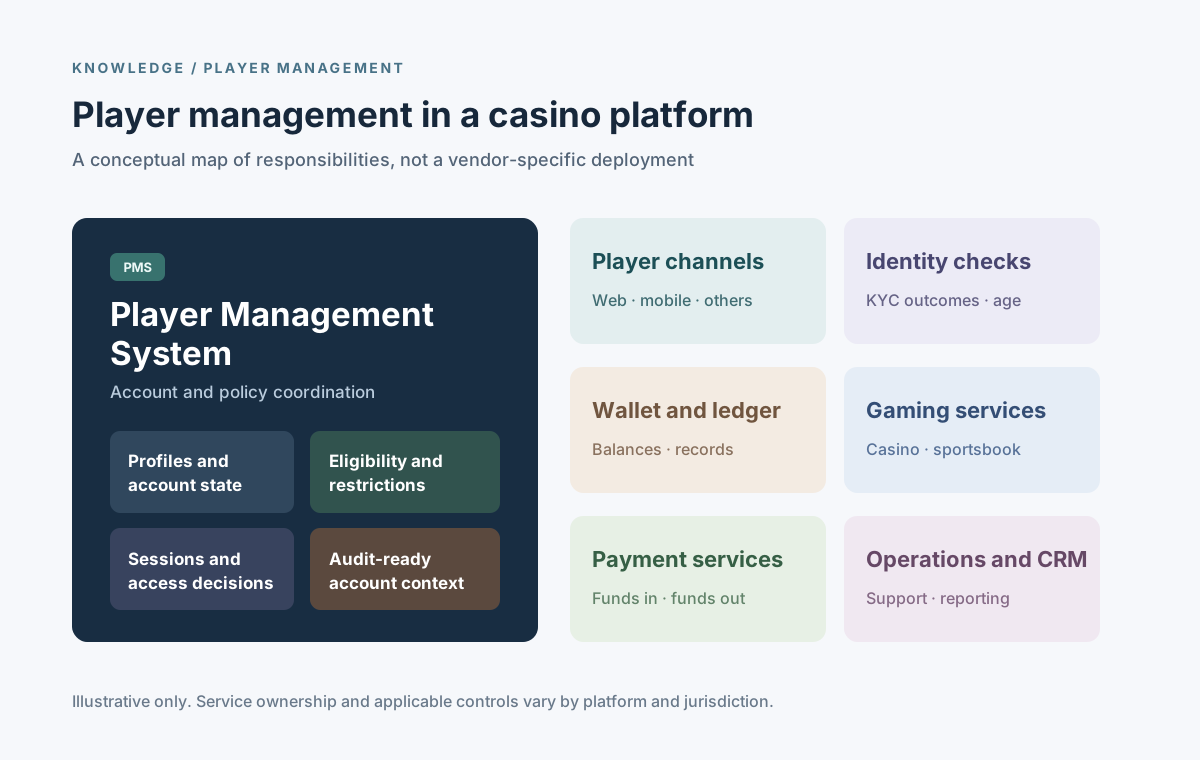
What does a player management system do?
In iGaming, a PMS commonly manages player profiles, account states, identity-verification results, access rules, and links to wallet, gaming, and operational services. Its exact scope varies: one platform may include bonuses and a wallet within the PMS, while another uses separate specialist services. Understanding those boundaries is more useful than assuming every product labeled “PMS” has an identical feature set.
A PMS provides a consistent view of a player's account and the policies governing that account. It records or references information needed to make operational decisions, such as whether registration is complete, whether verification has succeeded, whether play is permitted in the relevant market, and whether an account restriction is active.
Its role is both informational and operational. A profile page may display an account status, but the more important requirement is that the status be enforced wherever the player interacts with the platform. A web casino, mobile interface, game launcher, and support workflow should not make contradictory decisions about the same account.
The PMS does not inherently determine game outcomes, settle sportsbook markets, or process card payments. Those responsibilities may sit with game providers, sportsbook platforms, payment services, or a financial ledger. The PMS coordinates with them according to the integration design.
Core functions of an iGaming PMS
The following capabilities often appear in player-management architecture, although the owning service may differ between implementations.
| Function | Operational purpose | Important boundary |
|---|
| Player profile and account state | Maintain a stable player identifier, account details, and status | A profile is not proof of identity or permission to gamble |
|---|
| Verification and eligibility | Store or reference age, identity, market, and account eligibility decisions | External KYC services may perform checks; the operator remains responsible for applicable obligations |
|---|
| Authentication and access | Associate authenticated sessions with accounts and apply access rules | Authentication does not by itself authorize gambling |
|---|
| Responsible-gaming controls | Apply restrictions, limits, time-outs, or self-exclusion decisions where required | Exact controls and obligations depend on the jurisdiction and licence |
|---|
| Wallet and transaction linkage | Connect accounts to balances, payments, and gambling transaction records | The authoritative ledger may be a separate service |
|---|
| Bonuses and segmentation | Provide eligibility information to promotion or CRM services | Campaign management and financial bonus accounting may be external |
|---|
| Audit and support context | Preserve decision history and trace relevant account changes | Sensitive information needs access controls and appropriate retention rules |
|---|
The design goal is not to concentrate every piece of player data in one system. It is to establish authoritative records, clear ownership, and reliable enforcement across components.
A typical player lifecycle
An illustrative lifecycle makes the role of the PMS clearer. Actual statuses and transitions differ by platform, market, and operator policy.
- Registration. The system creates a player identifier and captures the minimum information needed to begin the account process. A newly registered account is not necessarily eligible to gamble.
- Verification. Identity, age, and other required checks are completed internally or through specialist services. The PMS records their outcomes and any unresolved requirements.
- Eligibility decision. Account status, jurisdiction, restrictions, and product rules are evaluated before an activity is permitted. Eligibility can change after registration.
- Funding and product access. Payment and wallet services handle financial transactions. A casino or sportsbook can initiate permitted product sessions according to the applicable checks.
- Ongoing controls. The platform processes account changes, customer interactions, limits, exclusions, risk signals, and support actions. Relevant decisions must reach the services that enforce them.
- Restriction or closure. The account can be suspended, restricted, excluded, or closed as appropriate. Financial settlement, access removal, audit records, and data retention require their own controlled procedures.
For example, the UK Gambling Commission's customer identity verification condition requires relevant remote licensees to verify identity before allowing a customer to gamble. This is a Great Britain-specific regulatory example, not a universal statement about the timing or content of checks in every market. [1]
It is useful to keep verification, eligibility, and session state separate. A player may be identity-verified but temporarily restricted; a session may be authenticated but not authorized to start a game. Treating all three as one Boolean flag creates avoidable errors.
PMS vs CRM, backoffice, and wallet
These terms often appear together in commercial platform descriptions, but they refer to different responsibilities.
| Component | Primary question it answers | Example responsibility |
|---|
| Player Management System | Who is this player, and what is the account allowed to do? | Account state, eligibility, restrictions, identity linkage |
|---|
| CRM | How should the business communicate with eligible customer segments? | Campaigns, communication preferences, retention workflows |
|---|
| Casino backoffice | How can authorized staff operate and supervise the business? | Support tooling, reports, manual reviews, approvals |
|---|
| Wallet or ledger | What money or value has been recorded, and why? | Balances, debits, credits, transaction references, reconciliation |
|---|
A single commercial platform may package several of these capabilities together. The distinction is architectural rather than a claim that separate products must always be purchased. Buyers should identify which component is authoritative for each record and who is accountable when two services disagree.
Wallet integration and financial consistency
The PMS may display a player's balance or supply an account reference to the wallet, but the authoritative financial record must be clearly identified. A displayed balance is a view of financial state; it is not a substitute for a transaction history that explains how the balance changed.
For a platform integrating casino games, sportsbook betting, and payments, several questions matter:
- Which service authorizes a debit and records its final result?
- Can an incoming transaction be recognized if the same request is delivered again?
- How are late, failed, reversed, or out-of-order messages handled?
- How are provider records reconciled against the operator's financial records?
- Which account and currency identifiers remain stable across services?
For example, if an upstream system sends the same settlement notification twice, the receiving workflow needs a way to recognize an already-applied transaction. Stable transaction references, controlled retries, and reconciliation are common techniques. HTTP POST is not inherently idempotent; retry safety must be designed rather than assumed. [2]
This separation also matters to players. In Great Britain, the Gambling Commission's remote technical standards address access to current account balances and transaction history. The applicable requirements go beyond merely showing a number on a profile page. [3]
Identity, authentication, and authorization
Three concepts should be designed separately:
- Identity concerns the account and the evidence used to establish who the person is.
- Authentication establishes that a session is associated with a legitimate account holder.
- Authorization decides whether a particular action is allowed in the current account and market context.
Successful sign-in therefore does not automatically authorize a bet, withdrawal, bonus, or game launch. Each action may depend on account state, risk controls, product rules, financial state, and local requirements.
Session security is part of this design. NIST SP 800-63B discusses session secrets, termination, timeouts, and reauthentication. These guidelines are a useful technical reference for session architecture, but they do not replace a gambling operator's own jurisdiction-specific obligations. [4]
Administrative access deserves similar care. Support agents should receive only the permissions necessary for their tasks. Sensitive actions — such as changing restrictions or viewing protected data — should be controlled and traceable. OWASP ASVS provides a primary security reference for logging authentication and authorization events without unnecessarily logging sensitive data. [5]
Responsible-gaming controls and jurisdictional rules
Responsible-gaming requirements are not an optional marketing feature. Depending on the market, the operator may need mechanisms for limits, self-exclusion, timely identification of risk, intervention, and records showing how relevant decisions were handled.
For illustration, the UK Gambling Commission has separate provisions addressing remote customer interaction and remote self-exclusion. Its self-exclusion rules include taking reasonable steps to prevent excluded customers from gambling and preventing gambling marketing from reaching them. The precise scope and exceptions are specified in those rules. [6] [7]
From a PMS integration perspective, the critical design issue is propagation of restrictions. A restriction recorded against an account must reach the systems that actually allow or deny activity. Operators should test cross-channel behavior: an account prevented from gambling on the website must not silently retain permission through another connected interface where the same restriction applies.
Legal duties remain with the relevant licensed entities, even where a vendor supplies technical tools. A PMS feature list alone does not establish regulatory compliance, a licence, or the right to operate in a market.
Integration reliability and operational visibility
Player status changes are often communicated across multiple services. Some connections are synchronous; others use events or callbacks. Problems arise when messages are delayed, repeated, or received in the wrong order.
An integration design should define the source of truth for every key attribute, the ownership of each update, and the safe behavior when another service is unavailable. For a high-impact restriction, a documented fail-safe behavior is more important than an optimistic assumption that all systems always respond.
Useful pre-release scenarios include:
| Test scenario | What the team should verify |
|---|
| Identity check remains pending | No prohibited product access is accidentally granted |
|---|
| Account is restricted during an active session | Relevant channels and transaction paths enforce the new decision |
|---|
| A status event arrives twice | The account reaches one consistent final state |
|---|
| Wallet response is delayed | No duplicate debit or unsupported balance assumption is made |
|---|
| Backoffice action changes eligibility | The change is authorized, attributable, and visible to enforcing services |
|---|
Observability should connect relevant requests, account decisions, and transactions through safe correlation identifiers. Logs need to be useful for incident investigation while avoiding unnecessary exposure of personal data. Where the GDPR applies, data minimization and data protection by design are relevant obligations. [8]
How to evaluate a player management system
The strongest evaluation starts with operational questions rather than a long feature checklist:
- Account model: How are player IDs, brands, markets, and account states represented?
- Authority: Which service owns each decision, record, and financial balance?
- Eligibility: Which checks are enforced before play, and how are restrictions propagated?
- Integrations: What are the supported authentication, event, and failure-handling contracts?
- Financial integrity: How are repeated messages, reconciliation, and disputed transactions handled?
- Operations: What can staff view or change, and how are sensitive actions approved and audited?
- Privacy: Which personal data is stored, shared, retained, and deleted under the applicable rules?
- Resilience: What happens during an outage or partial failure, and how is state recovered?
- Commercial scope: Which capabilities are actually included in the proposed integration and contractual arrangement?
These questions help distinguish a product demonstration from a deployable operating model. A PMS can be technically capable yet unsuitable for a particular market, account structure, or existing wallet architecture.
Key takeaway
A player management system is the account and policy coordination layer of many iGaming platforms. Its value is not measured solely by the number of modules on a feature list. It depends on whether player identities, statuses, permissions, restrictions, and integration decisions remain consistent across the whole operation.
For a broader architectural context, read How an Online Casino Platform Works and What Is an iGaming API Integration? For the game-content layer, see What Is a Casino Aggregator and How Does It Work? Teams planning connectivity between existing components can also explore IGSOFTAPI's API integration overview.