Choosing casino software involves more than comparing feature lists. Two platforms may look almost identical to a player while having very different arrangements behind the scenes: who operates the service, who controls the technology, who owns the customer relationship, and who can change the product after launch. White label, turnkey, and custom are common descriptions of delivery approaches, but they are not internationally standardized licensing categories. The same term can cover different contracts from one supplier to another. A useful comparison starts with the actual allocation of responsibilities, not the marketing label on a proposal. This guide examines the three approaches from an operator's perspective: technical control, integration work, regulatory responsibilities, data portability, operational effort, and total cost over time.
Published
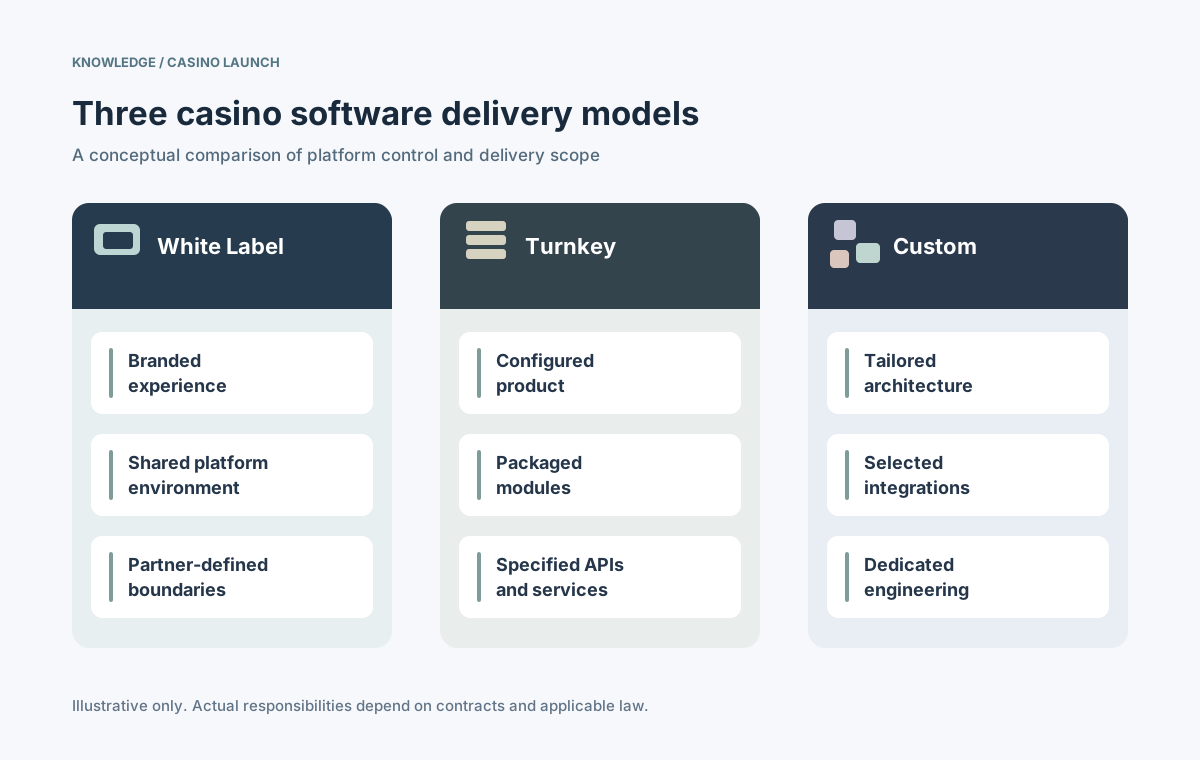
Conceptual comparison of casino software delivery models, not a depiction of a specific vendor product.
On this page
How do the three casino software models differ?
At a high level, the main distinction is how much of the operating environment is shared or supplied, and how much the buyer is expected to assemble and maintain. The precise answer depends on the contract.
Decision factor
White label arrangement
Turnkey platform
Custom-developed platform
Typical starting point
An existing operating environment and brand-facing configuration
A packaged platform with an agreed set of integrations and services
A product specification and architecture owned or commissioned by the buyer
Product changes
Usually constrained by the underlying platform and contract
Configuration plus negotiated extensions
Greater design flexibility, subject to budget and engineering capacity
Operating responsibility
Depends on which licensed entity actually offers gambling
Usually assigned through the operator, supplier and service contracts
Must be assigned across the operator, development team and suppliers
Integration choices
Often limited to approved options
May offer supported modules and APIs
Can be designed around selected services, but requires more integration work
Deployment effort
May reduce initial assembly work
May reduce platform-building work
Requires discovery, engineering, testing and operational setup
Long-term dependency
Potentially high dependency on the operating partner
Dependency on platform, contracts and proprietary interfaces
Dependency on internal staff, contractors, infrastructure and external services
⊕View largerIllustrative models only. Actual roles and boundaries depend on contracts and applicable law.
These are tendencies, not guarantees. A turnkey vendor may provide deep source-code access, while a custom project may use many licensed third-party components. Both cases change the practical trade-offs.
What is a white label online casino arrangement?
In a white label arrangement, a business generally brings a customer-facing brand into an existing service or platform arrangement. The partner may supply the gaming environment, operational processes, commercial infrastructure and certain support activities. The brand participant's scope may focus on acquisition, positioning and marketing, but the actual split must be documented.
For a concrete jurisdictional example, the UK Gambling Commission describes white label partnerships in Great Britain as arrangements where a licensed operator provides the gambling facilities through partner brands. The Commission says that compliance for those gambling websites remains with the licence holder. This is a description of the GB regulatory position, not a statement that every country treats white label arrangements identically. [1]
Before accepting a white label proposal, clarify:
Which legal entity contracts with the player and provides gambling facilities?
Which entity holds any required permissions in each proposed market?
Who approves brand content, promotions, player terms and marketing?
Who can see or export customer, wallet and transaction records?
Who handles complaints, player restrictions, fraud alerts and support escalation?
Can the brand migrate to another platform, and on what terms?
The potential attraction is a smaller initial platform-integration burden. The corresponding risk is limited control over components that determine how the business can evolve.
What does turnkey casino software include?
Turnkey usually describes a substantially assembled technical platform that a buyer can configure and connect to its operating arrangements. It may contain a player-facing interface, account management, wallet integration, game catalogue access, a backoffice and reporting. Suppliers differ substantially in what is bundled, hosted, maintained or optional.
A turnkey purchase should not be mistaken for a ready-made authorization to offer gambling. Technology supply, gambling operation, payment processing and other regulated activities can have separate legal requirements. In Great Britain, for example, the Gambling Commission distinguishes licensing questions for gambling software manufacture or supply from those for the entity providing gambling facilities. [2]
The real value of turnkey delivery is the ability to start with tested product modules and known integration boundaries. Buyers still need to verify the scope of the platform, complete market-specific obligations and design operations around the supplied system.
Key questions include whether the operator can choose its payment providers, add game suppliers, integrate an existing CRM, maintain separate brands or currencies, and export transaction history in a usable format.
When is custom casino software the right approach?
Custom software is designed around requirements that may be difficult to satisfy through a standard package. The owner may build with an internal team, commission an external development company, or combine both approaches. In practice, “custom” rarely means every component is written from scratch: game content, payments, identity services, monitoring and specialist infrastructure may still come from external providers.
Custom development offers stronger opportunities to shape the player experience, account model, integration contracts and deployment architecture. It also creates direct responsibilities for engineering quality, security, release management, documentation and long-term maintenance.
NIST's Secure Software Development Framework is a useful general reference for organizing secure development activities across software life cycles. It is not a gambling licence or certification, and following it alone does not establish regulatory compliance. [3]
Custom development may be appropriate when the product requires unusual workflows, integration with existing systems, or a roadmap that cannot be delivered reliably through vendor configuration. It is a poor fit when the project has no committed product owner, test strategy, maintenance budget or capacity to oversee vendors.
Who is responsible for licensing and compliance?
The commercial model does not by itself answer who is legally entitled to operate. A marketing partner, a software supplier and a gambling operator can be separate entities with different legal obligations. The relevant answer depends on the jurisdiction, licence category, actual activities and contract structure.
Two examples show why a universal rule would be misleading:
In Great Britain, the UK Gambling Commission explains that a white label brand does not transfer an operating licensee's compliance obligations to its marketing partner. Its separate software-licensing guidance also examines manufacture, supply, installation and adaptation of gambling software. [1] [2]
In Malta, the Malta Gaming Authority distinguishes authorizations and compliance obligations for B2C gaming services and B2B critical gaming supply. These are regulatory classifications, not synonyms for the three marketing terms used in software proposals. [4]
Whichever model is shortlisted, the team should map entities to jurisdictions and activities, then obtain qualified legal and compliance review before relying on a launch plan. Do not infer that a supplier's licence automatically covers the buyer's intended business.
How much control will the operator have over data and technology?
“Ownership” is often used loosely in proposals. It can refer to the brand and domain, customer relationship, intellectual-property rights, source code, infrastructure accounts, or contractual access to data. These are separate items.
Item to verify
Contract and technical evidence to request
Player accounts
Identifiers, lawful access, export format, restrictions on reuse and transfer
Financial records
Authoritative wallet/ledger, transaction identifiers, reconciliation and retention rules
Source code
Ownership or licence terms, permitted modifications, dependency licences
Hosting and infrastructure
Account ownership, backup access, disaster recovery and exit procedures
Integrations
API documentation, credentials, provider contracts, switching costs
Brand and content
Domain, design assets, game catalogue rights and marketing permissions
An export clause is useful only when the promised data can actually be extracted, interpreted and lawfully transferred. A migration exercise should account for outstanding withdrawals, bonuses, exclusions, open sessions and historical reporting—not just profile names and email addresses.
Where personal-data legislation applies, controller/processor roles and the obligations attached to them must also be assessed independently of the marketing label. For example, the EU GDPR addresses contracts with processors and the principles of data protection by design. [5]
What integrations and operations are required in each model?
An online casino operates through several distinct systems. Regardless of the commercial arrangement, the project needs an accountable owner for each workflow:
Player management and access: identity, session state, eligibility and restrictions.
Wallet and payments: financial records, deposits, withdrawals, reconciliation and disputes.
Game delivery: supplier access, launch sessions, callbacks and market availability.
Backoffice and support: roles, approvals, incident handling and audit records.
Reporting and compliance: evidence collection and controls required in the target market.
Monitoring and security: secrets, access reviews, alerting, backups and recovery.
The difference is who builds and operates each connection. A white label partner may provide much of the environment; a turnkey vendor may expose a defined set of supported interfaces; a custom team may implement a more tailored integration architecture. None of these descriptions establishes whether a particular API is included in a particular commercial offer.
For integrations involving authentication, authorization and sensitive transactions, a defined security verification process matters. OWASP ASVS offers technical security requirements that can be used to frame implementation and testing discussions. [6]
Which approach is faster and more affordable?
No reliable universal price or launch-time comparison exists without project scope. A smaller initial build can be offset by revenue shares, minimum fees, paid customization, limited data portability or operational services. A custom platform can require more investment before launch but may change its long-term cost profile when the business has sufficient scale and internal capability.
Evaluate total cost of ownership, not only the setup quote:
Cost area
Questions to ask
Entry
Setup, design, configuration, compliance preparation and integration work
Recurring
Platform fees, hosting, support, security, monitoring and supplier minimums
Transaction-linked
Revenue share, processing, game supplier charges and commercial reporting rules
Change
New markets, extra brands, APIs, features, testing and release approvals
Exit
Data export, transition assistance, termination, parallel running and replacement integrations
A meaningful delivery estimate should identify its assumptions: which integrations exist today, which are contracted, what requires development, which approvals are pending, and who performs acceptance testing. “Fast launch” without those dependencies is not a useful engineering commitment.
How should a business choose between the three?
Work backward from the intended operating model rather than starting from a supplier label.
Define jurisdictions and legal entities. Establish where the service will be offered and which entity performs which regulated activity.
Describe the product. List brands, channels, account types, currencies, games, reporting and responsible-gaming needs.
Set required control. Identify capabilities the team must configure directly, customize or own.
List current assets. Existing payments, CRM, identity infrastructure, content partnerships and staff skills may affect the choice.
Map service ownership. Assign support, security incidents, wallet reconciliation, restriction enforcement and outages to named parties.
Model three-year scenarios. Compare recurring fees, expected change requests, engineering headcount and exit cost under realistic volumes.
Test a failure and an exit. Ask how the system recovers from missing callbacks, a provider outage or a decision to migrate elsewhere.
White label can be worth evaluating when brand operations fit a clearly defined partnership. Turnkey can suit a team that wants an integrated technical base and accepts its contractual boundaries. Custom can suit a differentiated product with sustained development ownership. These are decision cues, not fixed outcomes.
What should appear in a software proposal or contract?
A practical request for proposal should describe evidence, not merely tick-box features.
Due-diligence topic
Minimum answer to request
Legal and regulatory scope
Contracting parties, activities, permissions and market limitations
Product scope
Included modules, excluded services, configuration limits and change process
Integration evidence
API specifications, supported versions, testing environments and exception handling
Money and player protections
Ledger authority, limits, exclusions, reconciliation and escalation responsibilities
Security and availability
Role-based access, incident process, backup testing, recovery targets and evidence
Commercial structure
Fees, dependencies, third-party charges, termination and handover terms
Data and portability
Access rights, export format, retention, deletion and migration support
Ask suppliers to demonstrate a representative workflow end to end: registration, eligibility, wallet update, game launch, callback, reporting and an account restriction. The response should identify which party owns each system and failure mode.
Final takeaway
White label, turnkey and custom casino software describe different starting points for building and operating a casino business—not three levels of regulatory permission or guaranteed launch speed. The best fit depends on the actual contract, the target market, the platform's integration boundaries and the buyer's capacity to run and evolve it.
Use a responsibility matrix, a realistic cost model and a verified exit plan before choosing. A polished demonstration can show what the interface looks like; it cannot replace evidence about control, compliance and operations.