Casino Audit Logs, Monitoring and Incident Management
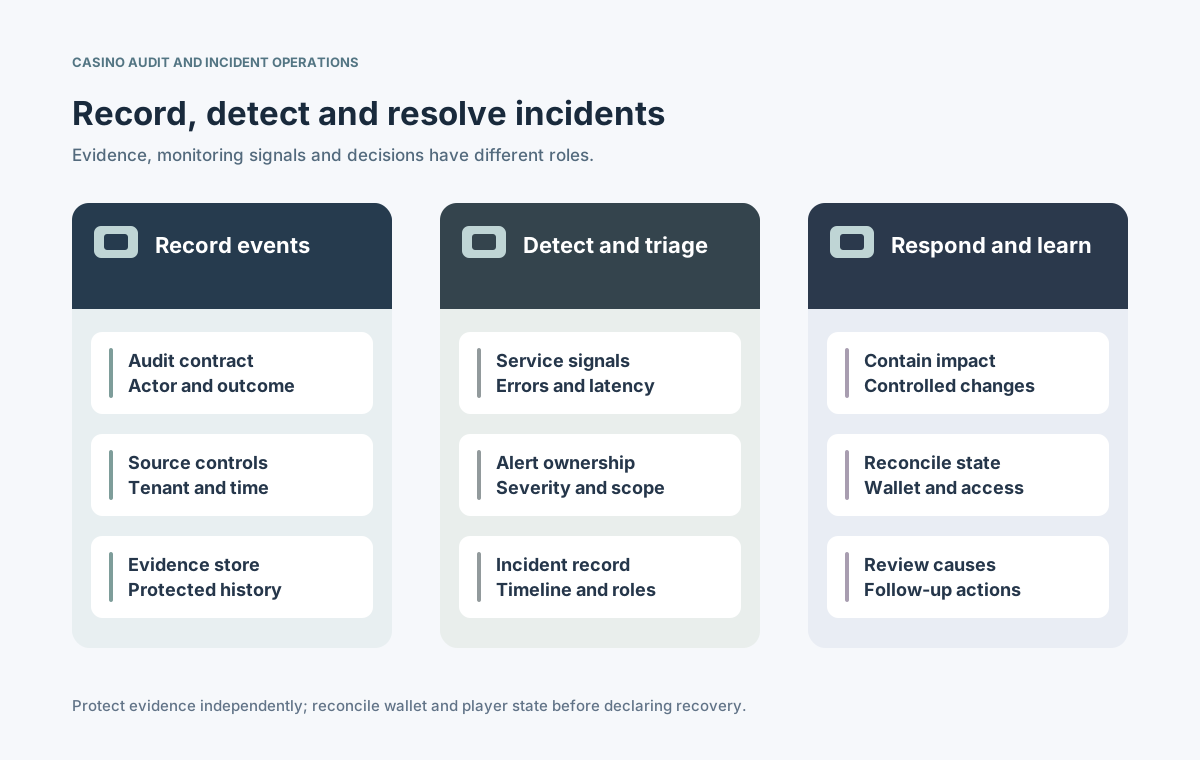
A casino operator needs three distinct capabilities: an audit trail of significant business and administrative decisions, monitoring that detects service degradation, and an incident process that assigns responsibility for containment and recovery. A dashboard alone is not a forensic record, and application debug logs are not an authoritative wallet ledger. The design must connect reliable event identifiers, controlled access, useful alerts and reconciliation of player-facing outcomes. This guide develops an operational model for casino platforms; retention, evidence and notification duties must be checked separately for each applicable market and licence. [1] [2] [3] [4] [5] [6] [7]
Published
Audit evidence, live service signals and incident decisions share correlation IDs but retain separate authority and access controls.
On this page
What should casino audit logging and monitoring cover?
An audit trail records material state changes: who or what initiated an action, which account or configuration it affected, what decision was taken, and whether it succeeded. Monitoring observes system health and business symptoms over time; incident management coordinates a response when those signals indicate unacceptable impact. Each has a separate owner, access policy and retention basis. [1] [2] [3]
A wallet ledger is authoritative for financial entries, a player account service for restrictions, and a game or payment integration for its own callback status. Audit events provide traceable evidence about those changes but must not become a second editable source of balance truth. Define the boundary between application logs, security events, business audit records, traces and metrics before building dashboards. [2] [3]
Which casino actions need an audit event?
Begin with a risk-ranked catalog owned jointly by platform, finance, security and operations. Prefer completed transitions over generic click events; distinguish an attempted action from an accepted change. Sensitive interactions, including responsible-gambling restrictions and admin access to player data, require extra access and purpose controls. [3] [4] [5]
Event family
Example event
Question answered
Account and KYC
player.verification_changed
What status changed?
Wallet and payout
wallet.adjustment_approved
Who authorized value?
Games and settlement
game.round_settlement_finalized
Was the outcome posted?
Bonus and limits
player.limit_updated
Which rule changed?
Admin and permissions
admin.role_granted
Who gained access?
Configuration
payment.routing_changed
Which route was modified?
For each event document its producer, entity key, allowed viewers, business effect and reconciliation source. Failed authentication and rejected privileged actions may also be security events, even when no business state changes. Never infer that an absent log line proves an action did not occur. [2] [3]
What fields and protections belong in an audit event?
Use a stable event envelope so investigators can connect an admin change, wallet entry and downstream provider response. OpenTelemetry supplies a useful model for timestamps and severity, while OWASP recommends recording who, what, when and where without exposing secrets. The event schema is a contract; its meaning should not silently change between releases. [2] [3]
Record event_id, schema_version, event_type, outcome and both occurred_at and observed_at where they differ.
Add tenant_id, pseudonymous entity_id, actor_id or service principal, role and authorized action context.
Propagate request_id, correlation_id or trace_id across adapters and retries without using them as financial keys.
Redact credentials, session tokens, raw KYC documents, payment secrets and unnecessary personal data before persistence.
Synchronize clocks and retain provenance for transformations. Apply least-privilege read access, separate administrative duties, integrity controls and a documented retention schedule. A searchable operations copy can be shorter-lived than a separately protected audit or financial record. [3] [4] [5]
How does an end-to-end casino audit event flow work?
The authoritative service commits its business operation and captures a related audit fact through a durable, testable mechanism. A controlled pipeline validates schema and tenant scope, then routes protected audit records and a minimized monitoring projection to different destinations. A transactional outbox can reduce lost events, but failed transport and clock skew still need detection. [2] [3]
Commit the wallet, player or configuration transition with its authoritative transaction identifier.
Create a unique audit event with actor, decision, effect and correlation context.
Validate and classify the event, restrict sensitive attributes and preserve ingestion failures for review.
Route evidence to protected storage, publish approved metrics and verify downstream completeness.
⊕View largerOperational dashboards use approved projections while restricted audit evidence retains provenance and ownership.
Do not publish sensitive full-fidelity evidence to a broad dashboard or claim that a broker guarantees legal record completeness. Compare source transaction counts with accepted audit events and investigate unexplained gaps. [2] [3]
What metrics and alerts reveal an operational incident?
Track player-facing impact as well as infrastructure health. A low error rate at the API gateway may hide delayed withdrawals, missing game settlement callbacks or a broken account restriction workflow. Calibrate thresholds against approved service objectives and normal traffic patterns; each alert needs a responder and a practical next action. [1] [6]
Signal
Useful interpretation
First response
Login or session errors
Players cannot enter
Check identity dependency
Wallet reconciliation gap
Balance may be uncertain
Pause unsafe writes
Unsettled game callbacks
Rounds waiting for final state
Inspect provider queue
Privileged action anomaly
Unexpected role or access
Revoke or contain
Audit delivery lag
Evidence arrives late
Inspect pipeline backlog
Use rates, duration, affected tenants and known dependencies rather than alerting on every individual retry. A page-worthy alarm should lead to a defined containment or investigation action; low-priority trends belong in a review queue. Verify synthetic monitoring with real transaction outcomes. [3] [6]
How should casino incidents be classified and escalated?
Severity reflects real impact: unavailable deposits, incorrect settlements, compromised administrator access or ineffective player restrictions may need different specialist responses even at similar traffic levels. Define incident triggers before an outage, nominate an incident commander and separate technical remediation from financial, customer and regulatory decisions. NIST's current incident guidance integrates preparation, detection, response and recovery into ongoing risk management. [1] [6]
Declare an incident with an owner, start time, affected market, tenants and known player impact.
Assign commander, technical lead, evidence custodian and business or compliance contacts.
Choose reversible containment steps, record approvals and protect the current evidence snapshot.
Maintain a timestamped decision log and scheduled internal updates until handover or closure.
Publish external status only from verified facts. Escalate potential data breaches and licence obligations to qualified legal and compliance owners; the applicable rules differ between markets and incident types. [1] [7]
How should evidence, retention and access be governed?
Evidence must survive the incident it describes. Protect collection, integrity verification, privileged access history and export authorization; record who examined or transferred records. Do not promise one universal retention period. UK Gambling Commission security standards and audit guidance illustrate jurisdiction-specific requirements, while privacy rules require purpose and access limitations. [3] [4] [5]
Record class
Primary safeguard
Retention decision
Security audit
Integrity and restricted access
Security and licence scope
Wallet ledger
Authoritative transaction history
Financial and market rules
Debug and trace
Secrets redacted
Operational necessity
Player safety action
Role-restricted evidence
Applicable safety duties
Incident decision log
Chain of custody
Investigation obligations
Keep searchable indexes, raw evidence and backups under explicit schedules. Avoid mass downloads of personal data by incident responders; use filtered exports and record every exceptional access. Changes to retention policy should have an accountable owner and evidence of review. [3] [4] [7]
Who communicates and decides during a casino incident?
The incident commander coordinates work and timeline; engineers diagnose and contain; finance validates monetary effects; player safety teams review restrictions; customer support communicates approved service facts. Security and compliance determine evidence and notification obligations. Clear roles prevent parallel fixes from altering the same wallet or account state. [1] [6]
Maintain one incident channel and an independent, access-controlled decision record.
Identify which teams may pause payment, game or bonus processing and who can authorize restart.
Tell support what is known, uncertain and actively being checked; avoid speculative balance claims.
Evaluate breach-reporting triggers by relevant jurisdiction; do not apply one market's deadline globally.
For example, the UK ICO explains a 72-hour reporting expectation for notifiable personal-data breaches under UK GDPR, not for every outage. Capture when a responsible team became aware of the qualifying breach and seek market-specific advice. [7]
How can the platform recover and avoid repeated harm?
Recovery is a controlled business-state transition, not merely restarting pods or clearing an alert. Confirm that log ingestion, authentication, payment routing and provider adapters are healthy, then reconcile wallet postings, unsettled game rounds, limit changes and player notifications against authoritative records. Replaying callbacks without idempotency checks can create a second incident. [1] [2]
Freeze ambiguous financial operations until transaction IDs and ledger states are reconciled.
Replay only verified missing operations with scoped idempotency keys and recorded approval.
Check account exclusions, responsible-gambling limits and admin permissions after restoration.
Verify monitoring coverage and audit event completeness before declaring normal service.
Hold a blameless review that assigns measurable changes, owners and verification dates.
Post-incident work should test the exact failure mode, including missing or delayed evidence, unclear ownership and dangerous retries. Feed corrections into alert rules, runbooks and future change reviews. [1] [6]
Which tests establish audit and incident readiness?
Run tabletop and technical exercises across a representative operator, locale, provider and payment path. Simulate suspicious admin changes, lost audit messages, a game callback backlog, an uncertain wallet settlement and an account restriction failure. Observe whether investigators can reconstruct the timeline without unrestricted player-data access. [1] [3] [6]
Verify event schemas, timestamps, actor identity, correlation and permitted access for each high-risk event.
Drop, delay and duplicate messages; confirm gaps are visible and audits remain tamper-evident.
Trigger wallet, provider and security alerts; confirm severity, paging ownership and escalation times.
Exercise containment, evidence export, regulated-notification triage and approved communication.
Reconcile financial and player state after recovery and record exceptions, sign-offs and follow-up owners.
Publish a versioned acceptance record covering detection time, accountable decisions, evidence completeness, customer impact, recovery verification and market scope. A demonstration dashboard is not an incident capability until it passes realistic failure and restoration tests.