Wallet Transaction Reconciliation in Online Casinos
A casino wallet can show a plausible balance while individual game rounds, payout callbacks or payment reports disagree. A correct integration must explain every debit, credit, reservation and reversal, not merely reproduce a number on the player screen. Reconciliation compares independent records at a defined moment, checks exact identifiers and amounts, then investigates what does not match. This guide covers the operator's wallet, game suppliers, bonus balances and payment providers as separate sources of evidence. Example ledger designs are engineering patterns, not claims that any particular supplier provides accounting or that one jurisdiction's requirements apply worldwide.
Published
Reliable reconciliation links each balance movement to its original operation and independent supporting evidence.
On this page
What is casino wallet transaction reconciliation?
Reconciliation checks whether the same economic event is represented consistently in the supplier's round or payment record, the operator's wallet ledger and the relevant external statement. A game win may be reported before a callback is processed, and a withdrawal request may exist before money leaves the payment provider. A screen balance alone cannot distinguish those states. [3]
The objective is to establish which operation occurred, who and what currency it affected, whether it was posted or pending, and which evidence confirms it. Reconciliation should run at the transaction level and also produce opening-balance, movement and closing-balance controls for a fixed reporting interval.
Which system owns the balance and the audit trail?
Define an authoritative wallet ledger before connecting game aggregators, bonus engines or payment gateways. An append-only posted-entry history with balanced debits and credits is a practical accounting pattern; the exact account model depends on the operator's product and contract. Posted entries should be traceable through unique source references, and corrections should add links instead of silently rewriting history. [1] [2]
Movement
Typical source evidence
Ledger control
Game stake
Round and wager reference
Single debit or reserved stake
Game win
Result and payout reference
Single credit to eligible funds
Canceled round
Original round plus cancel ID
Linked reversal, not erased history
Deposit
PSP settlement and payment ID
Credit on defined confirmed state
Withdrawal
Operator request and PSP status
Reserve, pay or release explicitly
Bonus adjustment
Campaign and eligibility event
Separate restricted balance treatment
Use exact decimal arithmetic or integer minor units for each currency, with precision rules agreed across systems. Do not net different currencies or combine restricted bonus value with withdrawable cash. Modern Treasury's ledger guarantees illustrate balanced entries, atomic posting and immutable posted history, but those are design principles to verify in your own implementation. [1]
How are round IDs, operation keys and amounts matched?
A robust match key includes the supplier namespace, player or wallet identity, game session and round, event type and a provider-defined unique transaction ID. Store the raw request and response alongside a canonical internal operation ID. A naked round number is often insufficient because a round can contain several bets, wins or corrections.
Normalize provider and brand namespaces before comparing transaction identities.
Record event ID, wallet posting ID, original operation ID and reversal relationship separately.
Keep amount, signed direction, currency, scale and event status with every posting.
Use distinct event time, received time and ledger-posted time; preserve the source timezone.
A matching amount without a matching operation is not conclusive evidence. Likewise, identical IDs with different amounts or currency indicate a conflict, not a successful deduplication. Investigate mapping changes, supplier resends and precision differences against original payloads. [2]
How do stake, win, cancellation and bonus flows work?
Model each game round as a set of stateful events rather than one final delta. A wager authorization may reserve money before a supplier confirms the bet. A win credits funds only under the defined settlement rules. A cancellation or rollback references the original posting, while bonus-funded bets may affect a separate restricted bucket. Each financial transition needs one durable operation key.
Record the game's raw wager event with supplier, round and transaction identity.
Check wallet state and post or reserve the approved stake exactly once.
Apply a verified win or loss event against the original round and posting.
If canceled or corrected, append a linked compensating entry and reconcile the resulting state.
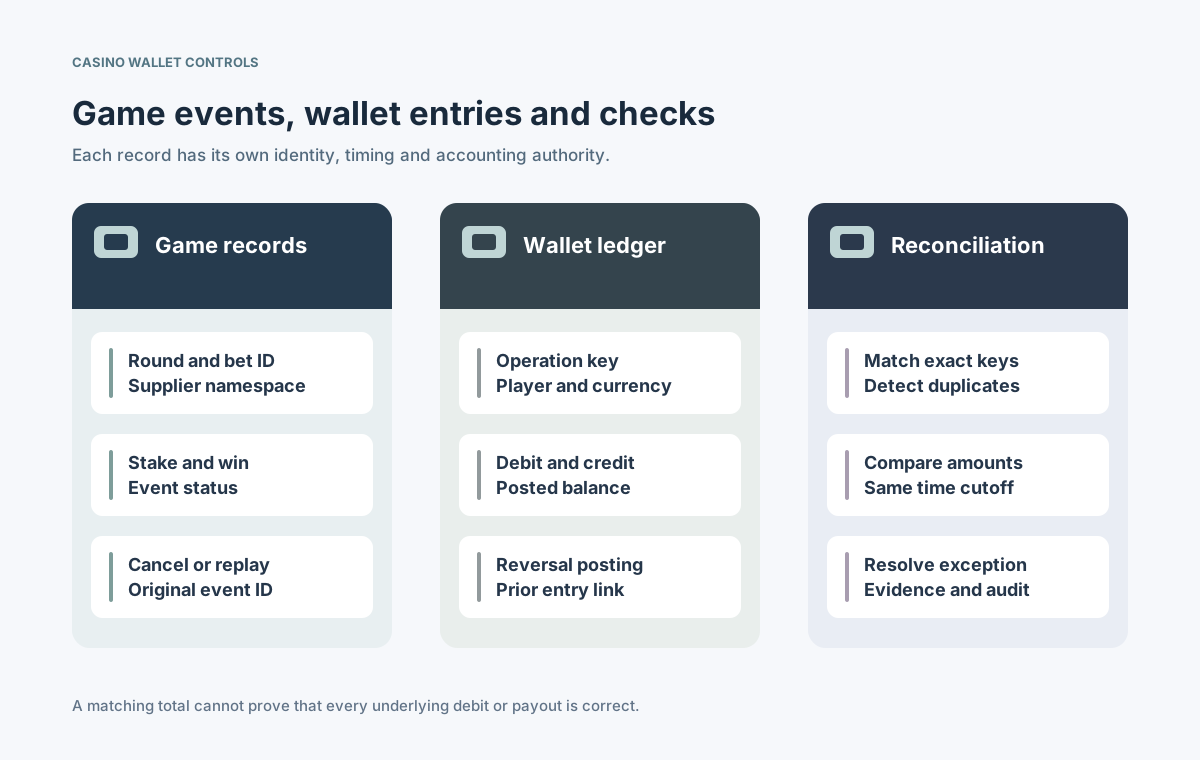
⊕View largerEvent delivery, financial posting and independent reconciliation are related but separate controls.
If a game gateway or wallet service times out, treat the outcome as unknown until a lookup confirms the original operation. Do not invent a payout or repeat a debit simply because the first response did not arrive. Stripe's idempotency guidance explains why distributed retries require an operation identity. [5]
How does a reconciliation job identify discrepancies?
Collect immutable source records for a known window, normalize identities and currencies, join each source event to the expected ledger posting, then compare amount, direction, state and posting count. Match one-to-one where the contract requires it; when a supplier batches events, preserve the many-to-one evidence map. Reconciliation products use separate representations of internal ledgers and external account balances for this purpose. [3]
Exception
What it indicates
Safe next step
Missing wallet posting
Source event lacks ledger match
Inspect event and posting state
Orphan ledger entry
Posting lacks source evidence
Trace request, operator and audit ID
Duplicate event
Repeated source reference
Confirm no repeated financial effect
Amount or currency drift
Same identity, conflicting value
Hold, compare raw payload and scale
Unresolved pending
State not final at cutoff
Carry forward with owner and expiry
A useful report lists matched, unmatched, disputed and pending items separately; includes the reporting window and reconciliation version; and retains the underlying evidence. Aggregate totals are useful for detecting a difference but cannot replace the item-level explanation.
How should duplicates, retries and corrections be handled?
Network delivery is not a guarantee of unique business execution. A retried POST or redelivered callback can carry the same operation again, and an acknowledgement can be lost after a ledger write succeeds. Server-side idempotency must key the business operation, reject mismatched reuse and return the recorded outcome on a genuine retry. HTTP method semantics alone do not protect arbitrary payment POSTs. [5] [6]
Persist the operation key and payload fingerprint before a financial side effect is acknowledged.
Apply posting and the durable event/outbox record in a controlled transaction where feasible.
On redelivery, look up the original posting rather than creating a second debit or credit.
For a true correction, post a new explicit reversal or adjustment referencing the previous entry.
When a system updates its database and sends a message to another service, the transactional outbox pattern reduces dual-write gaps; consumers must still handle duplicates. Exactly-once business effect is an application invariant that needs testing across crashes and retries. [4]
What about pending holds, voids and reversal entries?
An available balance may differ from a posted balance when bets or withdrawals reserve funds. Track the original hold, capture, release and expiry as separate states, then reconcile each to its corresponding ledger activity. A voided game transaction should not be confused with a payment refund, and a bonus adjustment may be non-withdrawable even when it has a positive face amount.
State
Customer-visible meaning
Reconciliation evidence
Reserved
Funds temporarily unavailable
Hold reference and expiry
Posted debit
Stake or payment committed
Unique debit and source event
Posted credit
Eligible balance increased
Win or deposit confirmation
Released
Unused hold returned
Original hold and release ID
Reversed
Prior posting compensated
New entry linked to original
Never erase the original operation to make a reconciliation report balance. A ledger transaction's posting and reversal references preserve the financial chain, while reporting must respect the ledger's status and effective time. [2]
How do PSP settlements and reporting cutoffs fit in?
The casino wallet, payment gateway and acquiring bank do not share the same timeline. An accepted deposit request may not be settled, and a withdrawal reservation is not proof of an external payout. Compare transaction states using source-specific settlement references, fees and currency, not merely the requested amount. Clearly distinguish an internal wallet credit from externally received funds.
Reconcile PSP transactions and fees against the operator's payment ledger separately from game rounds.
Use the same currency, timezone, opening balance and end-of-window cutoff on both sides.
Carry unsettled deposits, withdrawals and reversals into the next reporting period with references.
Record the origin of exchange rates if a payment involves conversion; never silently merge currencies.
Modern Treasury documents how an account reconciliation compares internal ledger values with balances reported by an external institution. Timing mismatches are expected and must be classified rather than automatically 'fixed' by a compensating credit. [3]
What should monitoring, security and audit reviews cover?
Separate the permissions to view source events, post wallet funds, approve an adjustment and close a reconciliation exception. Require authenticated callbacks, object-level authorization, restricted credentials and immutable audit references. Record who approved manual corrections and why, while limiting access to sensitive player and payment details.
Alert on duplicate posting keys, negative unexpected balances, unmatched high-value movements and stale pending holds.
Monitor reconciliation lag, source delivery gaps and mismatches per supplier, currency and brand.
Test parallel wagers, callback retries, game rollback sequences and PSP status changes under failure.
Keep a documented escalation path, adjustment approval rules and evidence retention policy.
An operational dashboard should expose an explainable unmatched-items queue and its age, not just a green total-balance indicator. Security and finance teams should be able to reproduce a posted balance from its contributing transactions. [1] [7]
What should be proven before a wallet goes live?
Run a controlled test ledger through deposits, withdrawals, cash and bonus wagers, win payouts, canceled rounds, delayed messages, retries, duplicate callbacks, balance reservations and provider reconciliation reports. Capture every test's input, expected ledger entries and final status, including unresolved exceptions.
Validate unique references, currency precision, balanced postings and reversal relationships.
Prove crash-safe idempotency and no repeated money movement across retries and replays.
Compare item-level and opening/closing totals at documented cutoffs with known pending items.
Require finance, security, operations and jurisdiction-specific approvals before real funds are enabled.
A trustworthy casino wallet is not merely a fast balance API. It is a chain of auditable financial decisions where each game or payment event maps to an explainable posting, each pending item has a defined owner, and every correction can be reconstructed without deleting its history.