Online Casino Launch: Technical Requirements and Checklist
An online casino launch is a coordinated release of regulated business operations and interconnected technical services. A live website means little if the wallet cannot reconcile a game round, withdrawal decisions are not traceable, identity checks are incomplete or an incident has no owner. The correct launch plan starts with a defined market, licence and operating model, then proves each critical player journey against the actual production configuration. This guide maps minimum system components, explains evidence needed before go-live and ends with a practical technical checklist. Requirements differ by jurisdiction and business model; the examples below are not a substitute for market-specific licensing advice.
Published
Launch readiness depends on validated connections and operating procedures, not merely on whether the front end opens.
On this page
Which market and operating model define the launch?
Start with the countries and customer groups to be served, the licensed legal entity, product types, currencies, customer-funds model and allocation of duties between the operator and technology suppliers. A platform built for one market cannot be treated as authorized for another merely by translating the interface. Keep a market-by-market requirements register with named legal and technical owners.
For illustration, the UK Gambling Commission describes when a remote casino operating licence is needed for Great Britain and links licensed remote operations to technical standards and a testing strategy. These are GB-specific obligations, not a global licence or an automatic approval of software used elsewhere. Supplier contracts should separately define who controls the wallet, games, verification and evidence. [1] [2] [3]
What minimum technical architecture is needed?
A launch-ready design identifies the authoritative owner of each record and the API boundary between services. A vendor might bundle modules into one product, but the operator still needs a coherent inventory of responsibilities, data flows and failure modes.
Component
Core responsibility
Proof before launch
Player identity / PMS
Account state, eligibility and access
Verified account lifecycle
Wallet and ledger
Balance, holds and financial events
Reconciled double-entry or equivalent trail
Game aggregation
Catalog, sessions and provider routing
Valid provider and market mappings
Payments
Deposits, payouts and status callbacks
Matched gateway and internal records
Risk and safeguards
Verification, limits, exclusions and cases
Enforced policies and review evidence
Reporting / backoffice
Operations, audit and exception queues
Restricted access and usable exports
Also map DNS, certificates, CDN, secrets, infrastructure, communication services, analytics and disaster recovery. These are supporting dependencies, not substitutes for the six core business functions. GLI-19 v4.0 provides a technical testing reference for interactive gaming systems; its applicability depends on the regulator and certification engagement. [4]
How should game sessions and wallet transactions be validated?
Trace a real-money round from an eligible account to a game launch, provider session, wager, settlement and reporting record. The wallet must remain authoritative even when the game provider, network or callback channel is delayed. Operators need traceable IDs across the casino, aggregator, provider and ledger.
Confirm catalog, provider, currency, market and game-version mappings against approved configuration.
Test launch tokens, session expiration, duplicate requests and a blocked or excluded account.
Reconcile debit, win, cancellation and rollback events, including repeated or late callbacks.
Prove round and account balances agree across provider reports, internal ledger and backoffice.
A successful iframe load is not a financial acceptance test. Require replayable transaction evidence, explicit error ownership and separate treatment of a temporary network failure versus a final business rejection.
Which payments and verification flows must work end to end?
Deposits, withdrawals, identity checks and player protection interact. Define which service makes a decision, which service applies the resulting restriction, what the customer sees and what an operator can inspect later. Validate the actual payment provider and merchant configuration rather than a mock response.
Create test accounts representing approved, pending, rejected and restricted states.
Exercise withdrawal eligibility, approval, payout failure, refund and reconciliation against settlement data.
Prove verification decisions propagate to login, game launch, deposits and withdrawals according to market policy.
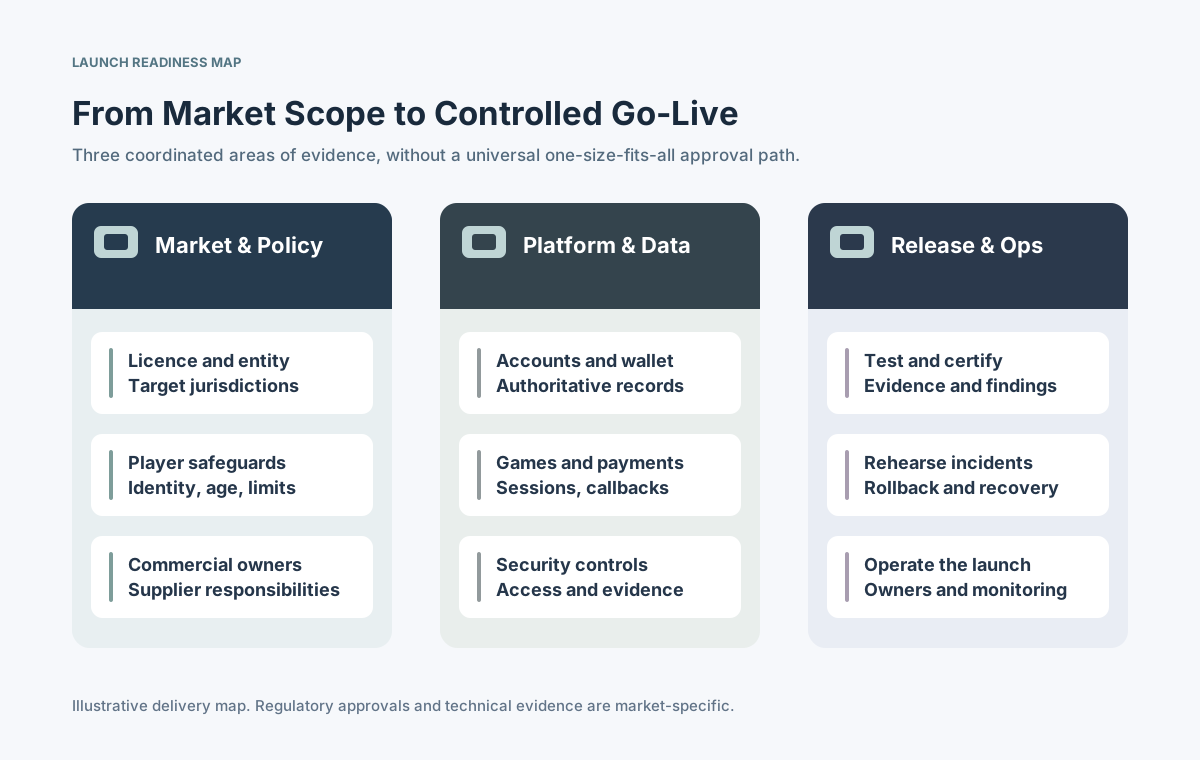
⊕View largerEach group needs an accountable owner and demonstrable evidence before a real-money launch.
Card handling and payment scope must be determined with the acquirer and qualified security advisers. PCI DSS applies according to the organization's cardholder-data environment and processing responsibilities; using a hosted payment page can change scope but does not by itself prove compliance or gambling-merchant acceptance. [5]
Which player-protection and risk controls are launch-critical?
Player protection cannot be implemented solely as a footer link. Market rules may require age and identity verification, financial-risk procedures, deposit or play controls, exclusion handling and customer interaction processes. Translate each applicable requirement into an enforced service rule, customer journey and auditable event.
Control
Failure to prevent
Acceptance evidence
Age / identity checks
Unverified access where barred
Approval and rejection traces
Limits and exclusions
Spending or play despite restriction
Cross-session enforcement tests
Risk case handling
Unreviewed high-risk account
Queue ownership and decisions
Market / location rules
Ineligible territory or product
Deny and override tests
Player communications
Missing or misleading notices
Localized messages and records
Make the denial path as testable as the happy path. When requirements vary, implement the stricter applicable product and market configuration as documented, not an undocumented universal rule. UKGC RTS is one example of a jurisdictional technical regime. [2]
What infrastructure and application security are required?
A stable launch needs environments, secrets, deployment controls and meaningful recovery tests. Record who can deploy, who can change payment or game configuration and how sensitive operations are authorized. Security reviews should cover the browser, APIs, admin panel, third-party connectors and internal infrastructure.
Separate staging from production data and secrets; use controlled, reviewable releases.
Enforce strong authentication, least-privilege roles and independent approval for sensitive administrative changes.
Test input validation, session protection, access control, API authorization and secure dependency management.
Verify backups, restore time, key rotation, incident escalation and observability against realistic failure scenarios.
OWASP ASVS 5.0.0 offers a structured application-security verification benchmark, while NIST CSF 2.0 organizes governance, identification, protection, detection, response and recovery. Both support evidence-based planning; neither replaces a licence or jurisdiction-specific audit. [6] [7]
What must be tested or certified before production?
Build the testing plan from applicable licence conditions, regulator or laboratory instructions and supplier contracts. Independent game or security testing may be required for particular markets and changes; a test report for one environment does not automatically cover every subsequent configuration.
Integration failure drills: timeout, duplicate callback, stale balance, provider outage and partial settlement.
Security and performance: privilege boundaries, vulnerability handling, peak traffic and rate limits.
External evidence where applicable: lab testing, approvals, release artefacts and signed findings.
In Great Britain, the UKGC publishes a testing strategy for remote gambling products and RTS compliance. Maintain a release evidence index linking tested version, configuration, assessor, deviations and approval, without generalizing the British process to every country. [3]
Which operational systems are needed on launch day?
The first live session should already have support, finance, risk, engineering and incident owners. Reporting is not only an executive dashboard: it must expose discrepancies, stuck transactions, access changes and unavailable dependencies while someone is on duty to act.
Operational queue
Launch-day signal
Owner and response
Game sessions
Launch failure / rollback mismatch
Platform / provider support
Payments
Deposit status / unmatched payout
Finance and processor operations
Player safeguards
Restriction or verification failure
Risk and customer operations
Security and availability
Access anomaly / service degradation
Security and on-call engineering
Reporting
Ledger vs supplier discrepancy
Finance control and investigation
Set alert thresholds, documented escalation windows and a common incident timeline. The NIST Cybersecurity Framework treats response and recovery as functions to prepare alongside protection and detection. [7]
How do teams rehearse a go/no-go decision?
Run a full dress rehearsal using the release build, intended configuration, production-like integrations and named observers. The rehearsal should produce failures and documented decisions, not just green checklist boxes from teams working in isolation.
Replay a complete eligible player journey including settlement and withdrawal evidence.
Force a payment-provider timeout, game-provider outage and duplicate settlement callback.
Demonstrate blocked-account access denial, an admin privilege test and a recovery drill.
Confirm responsible staff can find evidence, escalate incidents and halt or reverse a release safely.
Record each gate with a test run, owner, result, open issue, mitigation and final decision. A phased rollout limits exposure but does not excuse an unresolved critical control.
What should the final online casino launch checklist include?
The checklist should reflect the actual licensed business, product mix and technology stack. Use the items below as a technical starting point, then attach local legal and certification requirements, not a generic claim of regulatory approval.
Market and ownership: document licence scope, entities, suppliers, processor permission and market eligibility.
Architecture and transactions: sign off identity, wallets, games, callbacks, payment settlement and reconciliation.
Protection and security: sign off limits, exclusions, verification, access controls, audits and backup restoration.
Evidence and people: archive test reports, approvals, incident playbooks, contacts and operational dashboards.
Release and observation: approve a reversible deployment, staged traffic, monitoring window and rollback decision authority.
A launch is complete when the operator can demonstrate safe and reconcilable player activity, recover from predictable failures and explain who owns each decision. Keep this evidence current after software updates or expansion into new markets.