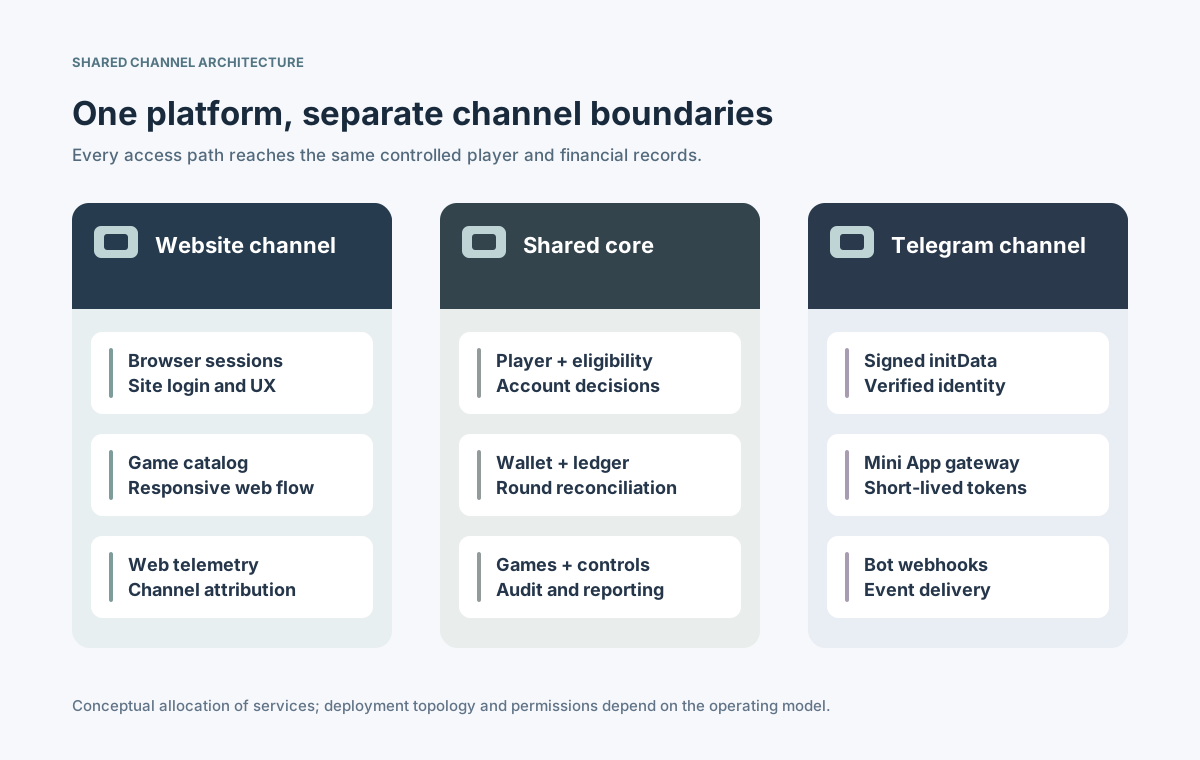
A website and a Telegram interface may look like two separate casinos, yet the reliable technical model is one operator-controlled platform with two channel-specific frontends. Shared player identity, wallet accounting, game routing, verification and reporting should remain authoritative in the backend. Telegram introduces its own launch context, signed data, bot webhooks and platform rules; none of those should replace a regulated casino's controls. This article explains the boundaries, integration patterns and failure tests for a shared architecture, assuming that the intended jurisdiction, Telegram platform policy and payment arrangements independently permit the proposed service.
Published
Two presentation channels, one controlled backend: identity, wallet, games and audit remain central.
On this page
Can one casino platform serve a website and Telegram?
Yes, at the architectural level: a browser frontend and a Telegram Mini App can call the same backend APIs for eligible player accounts, balances, game sessions and operational reports. They should not maintain separate authoritative wallets and reconcile them only at the end of the day. The shared core makes cross-channel decisions consistent while each frontend controls its own navigation and session presentation.
A technically possible integration is not necessarily a permitted product. Telegram's Bot Developer Terms restrict use of its platform for certain regulated or questionable services, and local gambling rules differ by market. Before implementing real-money functionality, obtain a documented legal and platform-policy assessment; Telegram integration itself is not a licence or approval. [4] [7]
Which services must remain shared and authoritative?
The shared platform should own every record that affects money, eligibility or a regulated decision. Channel adapters translate website or Telegram interactions into authenticated platform requests; they never create independent balances or account approvals.
Service
Authoritative responsibility
Channel boundary
Player management
Internal player ID, status and verification
Separate web and Telegram sign-in
Wallet and ledger
Balances, reservations and settlement trail
Read-only display of confirmed state
Games and aggregation
Provider routing, catalog and round ownership
Channel-specific launch UI
Risk and safeguards
Limits, exclusions and market eligibility
Enforced for every channel request
Payments
Deposit and payout decisions, reconciliation
Approved channel/payment paths only
Operations
Audit log, support cases and reporting
Channel attribution and alerting
Publish a clear service inventory: who issues tokens, who can change limits, which ledger records a rollback and which team resolves a mismatch. Shared infrastructure is useful only when the ownership and isolation rules remain explicit.
How should web and Telegram channel adapters differ?
The website typically uses browser sessions and its own authentication flow. A Telegram Mini App is a separately hosted web application running in Telegram's client context. It needs an adapter that validates Telegram-origin data and issues a narrowly scoped internal session before calling platform APIs. Telegram's Mini Apps guide explains the available initialization data and launch modes. [1]
Use separate API clients, credentials, allowed origins and rate limits for browser and Telegram entry points.
Keep business validation in backend services; a Mini App button or disabled browser control is not an authorization check.
Normalize locale, currency, device context and referral attribution without allowing those values to override market eligibility.
Return channel-appropriate errors while recording one shared event identifier for support and reconciliation.
This design lets one channel be disabled without rewriting player or wallet state. A channel adapter may cache presentation data, but it must not become a second source of truth for financial events or access restrictions.
How are Telegram identity and existing player accounts linked?
A Telegram user identifier is not proof that the same person owns a casino website account. Treat Telegram authentication, casino account linkage and required identity verification as three separate decisions. The server validates Telegram Mini App initData rather than trusting client-supplied initDataUnsafe; it also checks freshness, expected bot context and replay handling. Website login can use a distinct supported authentication flow. [1] [3]
Verify raw Telegram initData server-side using the documented signature method and reject missing, stale or invalid claims.
Create a short-lived, channel-bound backend session; never expose a bot token or player account secret to the Mini App.
Link a verified Telegram principal to an existing player only after an authenticated confirmation and applicable eligibility checks.
Record linking, unlinking, session revocation and disputed ownership events in the shared audit trail.
⊕View largerChannel-specific sessions terminate at a shared authorization and accounting boundary.
Do not automatically merge accounts based on a matching username, phone number, display name or referral parameter. Telegram usernames may change and profile fields are not equivalent to a regulated KYC record.
How do one wallet and game-session state stay consistent?
Both channels must present the same authoritative balance and game state for the same eligible internal player. A single ledger enforces reservations, wagers, settlements and rollbacks, while the game service preserves the provider round ID and the channel where launch began. A player switching devices must never cause a duplicate debit or an unauthorized parallel round.
Cross-channel event
Required invariant
Evidence
Balance read
Same committed ledger state
Matching revision or snapshot ID
Game launch
Eligible account, valid market and provider
Authorized channel session
Duplicate callback
One financial effect per business event
Idempotency and replay log
Channel switch
Expired access cannot revive a round
Session transition and denial test
Exclusion or limit
Restriction active on both clients
Immediate cross-channel enforcement
The browser and Telegram views may update at different moments; that is a display-latency problem, not permission to invent local balances. Show pending state until the ledger confirms settlement and expose exceptions to backoffice reconciliation.
What happens to payments, compliance and player safeguards?
Payment providers, regulators and Telegram can each impose restrictions. A payment method available on the website cannot be assumed available inside a Telegram Mini App. Telegram Stars documentation concerns payments for digital goods and services in Telegram; it does not establish permission to use Stars as a real-money gambling deposit or withdrawal rail. [4] [5]
Map applicable licence, market, age and identity rules before exposing any real-money action through either channel.
Confirm processor and Telegram permissions independently; refuse unsupported deposit or payout journeys rather than redirecting around a restriction.
Enforce account exclusions, limits, fraud blocks and payment holds in the central authorization layer.
Keep transaction records, customer notices, dispute procedures and financial reporting consistent across channels.
A regulated operator may decide to keep Telegram limited to information or account notifications if the proposed gambling function is not permitted. In Great Britain, UKGC remote technical standards offer an example of market-specific controls; they are not universal rules and do not override Telegram's own terms. [7]
How should bot webhooks, events and notifications work?
Telegram Bot API updates are a delivery channel, not a transactional ledger. Its setWebhook interface sends HTTPS updates and may retry unsuccessful deliveries. Verify the configured webhook secret token and process each update idempotently. A received message should request an authorized platform action; it should not directly adjust a balance. [2]
Validate webhook origin controls and the X-Telegram-Bot-Api-Secret-Token header when a secret is configured.
Deduplicate update IDs, retain traceable processing outcomes and separate temporary retry failures from final rejects.
Use a bounded event queue for notifications; separate message-send failure from a completed wallet transaction.
Respect opt-in, user communication consent, rate limits and account restrictions before sending sensitive updates.
Design outbound messages as optional views of server state. If Telegram is unavailable, the website, wallet and backoffice must continue operating; delayed notifications can be replayed without re-executing payments or game settlements.
Which security and data-governance boundaries matter most?
A shared backend increases the impact of a broken authorization rule. Every API operation must resolve the internal player from a validated session and check ownership, eligibility and function privileges. OWASP's API Security Top 10 highlights broken object-level and function-level authorization as major API risks. [6]
Security boundary
Failure mode
Required safeguard
Channel credentials
Leaked bot token or browser token
Secret storage, rotation, scope
Player identity
Cross-account data exposure
Object-level authorization
Mini App payload
Forged or stale initData
Server verification and freshness
Admin operations
Unauthorized ledger or limit change
Least privilege and dual review
Data retention
Unnecessary chat/profile collection
Minimization and deletion policy
Keep personal and financial data in the operator-controlled services, with documented retention and access rules. Avoid including balances, sensitive verification status or secret URLs in chat messages. Channel analytics should be attributable without becoming a shadow customer database.
What must testing and monitoring prove before rollout?
End-to-end testing should include eligible, blocked and unlinked accounts, with both clients active. Add failure drills for expired Telegram data, channel-token theft, provider outage, duplicate callbacks, unavailable Telegram delivery and disputed account linkage. Verify that financial state remains consistent through each case.
Measure shared wallet drift, late game callbacks, failed token exchanges and duplicate webhook handling by channel.
Test exclusion, limit and KYC changes against simultaneous browser and Mini App sessions.
Reconcile event IDs through channel adapter, player service, ledger, provider and support dashboard.
Rehearse disabling the Telegram adapter without deleting accounts or interrupting the website.
Keep signed release evidence with owners, exact builds, market configuration, test results and rollback criteria. A gradual channel rollout reduces the blast radius but cannot convert prohibited functionality into an acceptable service.
What belongs in the shared-platform architecture checklist?
The final design review should separate channel-specific tasks from shared business invariants. The list below is a starting point for discussions among the operator, platform vendor, legal counsel, security team and payment partners.
Permission and scope: record applicable law, licence, Telegram developer terms, data policy and payment constraints for each market.
Identity: document web login, signed Telegram verification, explicit account linking, eligibility checks and revocation.
Core services: confirm a single player ID, ledger, game-round lifecycle, limits, exclusions, reporting and incident ownership.
Delivery: specify API scopes, webhook validation, idempotency, rate limits, telemetry and notification consent.
Release: attach cross-channel financial tests, abuse tests, rollback drills and signed go/no-go approval.
The objective is not to make Telegram a second independent casino. It is to keep any permitted Telegram presentation channel subordinate to the same controlled platform, with no ambiguity about the owner of player, money and compliance decisions.