A Telegram casino bot and a Telegram Mini App are not simply two versions of the same screen. A bot primarily handles messages, commands and button interactions; a Mini App presents a hosted web interface inside Telegram and can work alongside that bot. For a casino platform, the choice affects navigation, integration contracts, identity checks, game launch, support and operational risk. It does not change who must control regulated activities or financial records. This guide compares the interfaces from the perspective of a platform architect or operator, without assuming that a technically possible implementation is permitted in every market or under Telegram's platform terms.
Published
Conceptual interface comparison; the shared backend remains responsible for platform state.
On this page
Are a Telegram bot and a Mini App competing products?
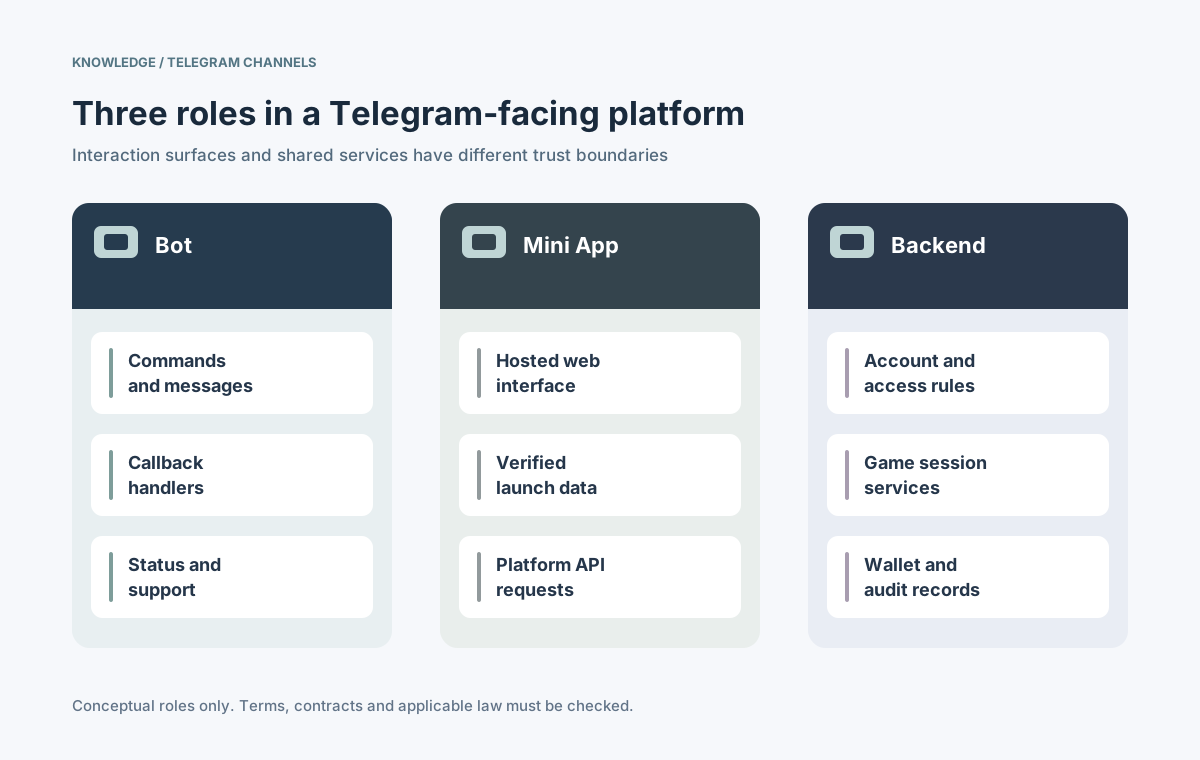
Not exactly. The Telegram Bot API provides an HTTP interface for programs that receive updates and send messages. A Mini App is a web application displayed within Telegram, often opened from the bot's menu, a button, profile or a supported direct link. A single project can therefore use a conversational bot for entry and notifications and a Mini App for navigation and complex screens. [1][2][3]
The distinction is the interaction surface, not ownership of the business system. Neither Telegram messages nor an embedded webview should become the source of truth for an account, balance, game session or operator decision. Those responsibilities belong to independently designed and controlled platform services.
How do the interaction models differ?
Bot conversations work well when a task can be expressed as a short sequence of commands, messages and button responses. Mini Apps support richer layouts, navigation, forms and dynamic data inside a browser-like view. They still depend on network availability and backend APIs, and their capabilities vary by launch context and Telegram client. [1][2]
Decision factor
Bot conversation
Mini App interface
Primary UI
Messages, commands, keyboards and callback buttons
Hosted HTML/JavaScript rendered inside Telegram
Navigation
Conversation steps and message history
Screens, forms, filters and in-app navigation
State changes
An update triggers a server-side handler
A client request reaches the platform API
Suitable tasks
Status, support, simple selection and notifications
Catalog browsing, account views and complex interaction
Client dependency
Telegram message and button capabilities
Embedded webview behavior and Mini App API support
Important limitation
Long workflows become message-heavy
Client-side state is not authoritative or automatically trusted
The preferred interface follows the task. A support escalation may be clearer in a conversation, while a catalog with categories, search and dynamic filters is easier to operate in a Mini App. Avoid equating a polished screen with a complete platform.
Where do messages, events and API requests go?
A bot typically receives updates through a webhook or getUpdates, processes the command or button callback and calls its own service layer. A Mini App loads a hosted UI and calls the application's backend over HTTPS; it may also use supported Telegram Mini App methods. These are different entry points into services that should share consistent authorization and audit rules. [2][3]
Mini App path: Telegram launch, server validation of initData, platform session, authorized API request, rendered result.
Shared path: platform account mapping, eligibility checks, game gateway, ledger, records, monitoring and support workflow.
⊕View largerBoth channels can reach the same controlled services, but they have different trust boundaries.
This diagram shows logical responsibilities, not a prescribed deployment topology. A message queue, API gateway or dedicated session service can be added according to load and operational requirements. The next architecture guide in this Knowledge Hub will cover shared-platform topology in more depth.
What remains the platform's responsibility?
An interface must not approve a transaction merely because a user pressed a Telegram button or sent an API request. The platform should decide whether the account is active, whether the proposed action is allowed, and which authoritative record will change. A bot and a Mini App can use the same business APIs but should not bypass those checks.
Capability
Channel responsibility
Platform responsibility
Account view
Display a permitted summary
Authenticate, authorize and protect personal data
Game launch
Request an eligible game and show the result
Check market, product and session eligibility
Balance
Display a server-provided value
Own the ledger, reconciliations and transaction history
Notification
Present a status or support message
Determine the event, audience and delivery policy
Limits and exclusions
Explain a restriction and prevent misleading UI
Enforce the actual restriction before an action
This separation also reduces channel lock-in. If Telegram access changes, the operator can retain its own records and processes instead of losing them inside conversation state. It does not remove the need to verify whether the proposed Telegram use is permitted.
How should identity and sessions be handled?
Telegram user identifiers and application accounts are distinct concepts. A bot receives user details within an update; a Mini App receives launch data including initData. For a Mini App, the backend must validate the signed initData using Telegram's documented method and check freshness before relying on it. The convenient initDataUnsafe object is explicitly not trusted. [3]
Verify the Telegram-origin data on a trusted server and reject stale or altered launch data.
Map the verified Telegram identity to a separately governed platform account using an approved linking process.
Issue a scoped application session; enforce authorization and expiry on every relevant API request.
Revoke or step up the session when the account status changes or a sensitive action requires new assurance.
Telegram login alone is not a substitute for an operator's onboarding, age or identity checks where required. Avoid putting reusable secrets or authoritative financial state into chat messages, URL parameters or the Mini App client. OWASP's session guidance provides general security controls for session tokens and lifecycle management. [6]
Can either interface own game sessions or the wallet?
No interface should be treated as the accounting system. A game launch normally involves a server-side eligibility decision and a short-lived, scoped launch context. Gameplay state, provider callbacks and wallet entries belong to the relevant platform and contracted services. The Telegram UI may show the session or balance, but should not infer success from a button animation or a timeout.
Keep wallet changes atomic and idempotent; duplicate requests must not produce duplicate debits or credits.
Store durable game and transaction references independently of Telegram chat or webview state.
Display pending, completed and failed operations based on server-confirmed statuses.
Treat Telegram payment features as separate platform capabilities, never as proof that wagering transactions are supported or permitted.
Detailed cross-channel wallet and game-session synchronization is a separate planned guide. Here the practical decision is whether the chosen interface can safely present backend-confirmed state and recover when the user closes it mid-operation.
Which security and platform restrictions matter?
For bot webhooks, Telegram offers a secret_token whose value is sent in the X-Telegram-Bot-Api-Secret-Token header. Validate it, restrict exposure of the endpoint and deduplicate updates by stable identifiers. For Mini Apps, validate initData on the server and authorize every subsequent request. These controls protect different boundaries and are complementary. [2][3]
Document what data Telegram and the operator each receive, who responds to access or deletion requests, and what can happen if the bot or Mini App is restricted. Do not advertise Telegram as an approved regulated gambling channel without independently verified authorization.
What happens when the channel fails?
Both models depend on Telegram availability, but they fail differently. Webhook deliveries can repeat after an unsuccessful response; users can press a button twice, abandon a conversation or close a webview during an API operation. A resilient platform separates command acceptance from final business state and lets the user request the latest status. [2]
Failure scenario
Unsafe assumption
Safer handling
Repeated callback or tap
Each event represents a new financial action
Use idempotency keys and transaction references
Mini App closed during a request
The operation was cancelled
Query server-side status before retrying
Telegram delivery delay
The account or game failed
Separate notification delivery from platform state
Stale user session
An old client token remains valid
Expire and reauthorize on the platform
Bot or Mini App unavailable
There is no remaining audit trail
Retain records, support tools and incident logs outside Telegram
Monitor webhook failures, rejected initData, API latency, repeated business commands and channel-specific support cases. Test real Telegram clients and small-screen layouts; a successful HTTP response alone does not prove the user can complete the workflow.
When should a project choose a bot, a Mini App or both?
Choose by task complexity, permitted use case and operational boundaries. A bot is well suited to short supported conversations; a Mini App suits complex interactive views; a combined arrangement can use the bot for entry and messages while a hosted UI handles richer navigation. This is an engineering comparison, not a recommendation to deploy a regulated service on Telegram.
Bot-first: informational queries, account-safe status notices, support routing and simple opt-in workflows.
Mini-App-first: searchable catalogs, settings, detailed account screens and workflows requiring forms or multiple views.
Combined: a conversational entry point, explicit launch into a Mini App, one backend account and consistent session policy.
Neither: when Telegram's terms, local permissions, data handling or uptime requirements make the channel unsuitable.
Compare a working prototype using task completion, accessibility, error recovery, backend call patterns and support load. Do not choose solely by a shorter development estimate or a visual demo.
What should be checked before an implementation decision?
A useful technical brief names the interface, trust boundaries, authoritative records and failure behavior. It also records unresolved legal and platform-policy questions rather than hiding them inside a generic compliance line. The following checks should be resolved before procurement or development is scoped.
Specify game and wallet API contracts, idempotency, reconciliation, audit records and recovery paths.
Test mobile clients, deep links, webhook retries, network interruptions, limits, accessibility and support escalation.
The central lesson is simple: Bot versus Mini App is a choice about interaction and integration boundaries. The real platform remains responsible for state, security and permissible operations. Build the channel only after those responsibilities and permissions are understood.