Casino Backoffice Software: Core Modules and Features
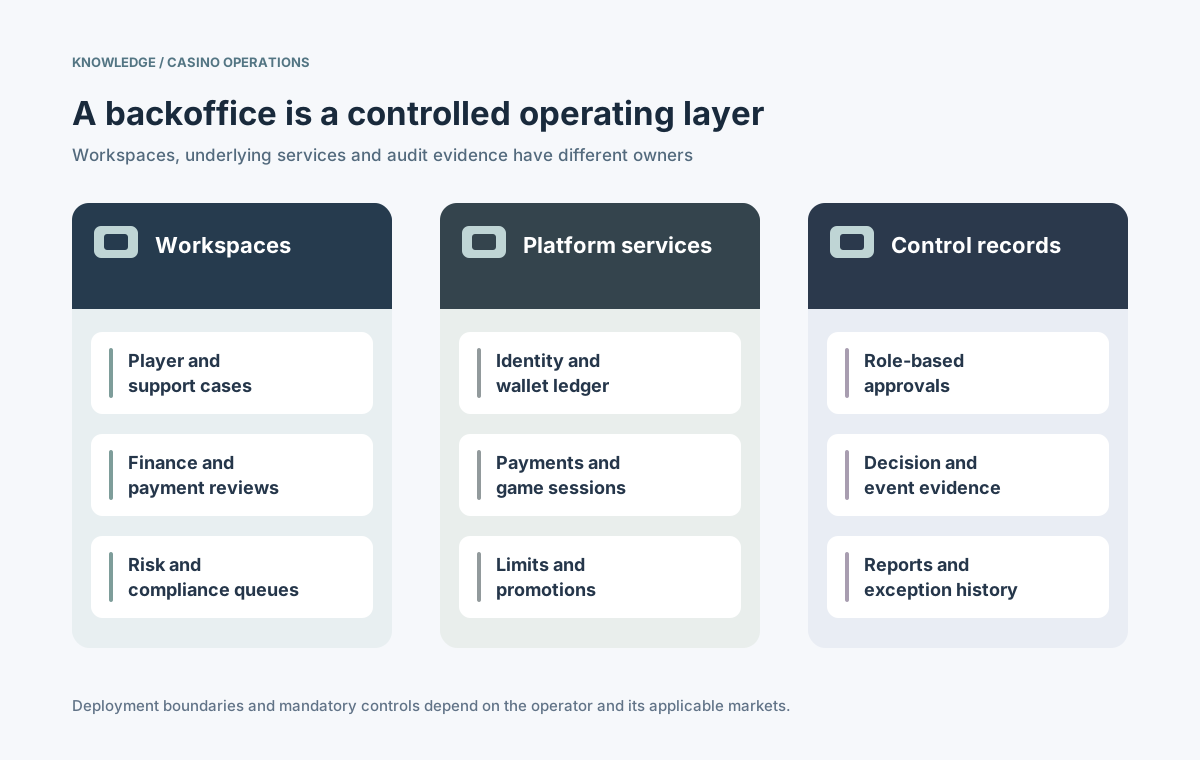
Casino backoffice software is the operational workspace behind an online casino. Support agents investigate player cases, finance teams reconcile payments, risk staff review alerts and authorized managers change content or promotions. These actions touch several services, but the backoffice should not become an uncontrolled shortcut into wallet balances or account rules. This guide maps the core modules, explains their data boundaries and shows how case queues, permissions, audit evidence and reporting should fit together before an operator selects or launches a backoffice system.
Published
The backoffice connects operational teams to controlled platform functions, reporting and evidence—not to unrestricted database editing.
On this page
What does casino backoffice software actually do?
A casino backoffice is a collection of restricted interfaces and workflows used by the operator's teams. It typically brings together player support, account reviews, payment investigations, promotions, game configuration, risk queues, compliance evidence and financial reporting. It is distinct from the website or app used by players: an operator screen can show more sensitive information and must enforce tighter authorization.
It is also broader than a player management system (PMS). A PMS may own account identity, status and player-level rules, while the backoffice exposes authorized operations spanning the PMS, wallet ledger, payment provider, game platform and reporting services. The interface is not itself proof that these services are integrated or that staff can safely alter their records. GLI-19 v4.0 discusses information retention, reporting and account controls as capabilities of the interactive gaming system; responsibilities may be assigned across components. [1]
Which modules belong in a practical casino backoffice?
Module names differ by supplier, but the useful comparison is what each module lets a team decide, what system owns the data and what evidence remains afterward. A glossy dashboard may cover only a small fraction of the work required when a payment fails, a player disputes a result or an account needs restricted access.
Backoffice module
Typical operator task
Authoritative data or control
Player and support
Inspect account timeline and manage tickets
PMS, identity service and support history
Wallet and payments
Review transactions, withdrawals and mismatches
Wallet ledger, gateway and settlement records
Risk and compliance
Triaging verification and safer-gambling cases
Policy service, evidence store and reviewer decisions
Games and content
Control catalog availability and maintenance
Game aggregator, provider and market rules
Bonuses and CRM
Approve campaign changes and review awards
Promotion engine and eligibility records
Reporting and audit
Export reconciled reports and trace actions
Reporting store, immutable event and access logs
Check whether each module is available in the offered product, requires a separate service or depends on a third-party integration. An administrative menu label does not establish licensing coverage, automation maturity or data completeness. Document ownership and read/write boundaries for every screen.
How should player accounts and wallet activity appear to staff?
A useful player view brings together identity state, verification progress, account restrictions, deposits, withdrawals, game activity and relevant support interactions. Staff need a consistent timeline built from stable identifiers—not contradictory snapshots copied from several databases. Access to private or financial details must depend on the staff member's role and the purpose of the case.
Show the source and freshness of a balance or transaction status; label pending and settled states separately.
Separate cash, bonus funds, reserved withdrawals and adjustments when the underlying wallet supports them.
Provide linked references for payment events, wallet postings and game rounds rather than editable free-text balances.
Record who viewed, exported or changed sensitive data, with masking and access controls appropriate to the action.
In Great Britain, UKGC RTS 1 addresses access to current balances and account and gambling history for customers. That is a jurisdiction-specific example of why trustworthy underlying records matter; an operator console is not a replacement for the player-facing disclosures required in a particular market. [2]
How do operational cases cross module boundaries?
A backoffice becomes valuable when a case can move between support, finance and risk teams without losing evidence. Consider a player who reports a missing deposit. Support can locate the internal order, finance can check the processor reference, and an authorized ledger service can resolve a verified mismatch. The case record should preserve decisions and handoffs while the wallet remains the source of truth.
Create a case with a stable ID, affected player, issue type, severity and restricted visibility.
Attach read-only payment, wallet, provider and communication references; avoid copying secrets or complete identity documents into notes.
Route investigation tasks to the right team with deadlines, approval levels and a clear escalation owner.
Execute any approved adjustment through a controlled service that validates state and produces a distinct ledger event.
Close the case with a reason, reviewer identity, evidence links and an outcome the support team can explain.
⊕View largerAn operator case spans several domains, but each domain keeps its own authoritative records.
Treat requests, approvals and resulting events as different objects. An attempted action may be denied, time out or complete later. The UI must not report success simply because the agent clicked a button; recover the definitive state from the owning service.
What should payments, withdrawals and finance modules control?
Finance operations need more than a transaction search. A backoffice should distinguish the casino's wallet entries from gateway events, payout-provider responses and bank settlement reports. A withdrawal may be requested, reserved, reviewed, sent, accepted, paid or failed at different times. The backoffice must expose those states without promising a final result prematurely.
Reason, two-person approval where required, ledger event
Editing a stored balance without a posting
Reconciliation
Ledger, gateway, settlement and fee references
Treating processor acceptance as settled cash
Dispute or refund
Original transaction, case and separate adjustment
Deleting or overwriting the original entry
An accounting report from a processor such as Adyen can expose transaction lifecycle changes and fees, but format and availability depend on the provider. Match against the platform's own ledger and the relevant bank or acquiring records. The backoffice should surface breaks for review, not silently force totals to agree. [7]
How do games, promotions and CRM fit into operations?
Game availability and bonus campaigns are operational settings with downstream consequences. A content manager may request that a title be hidden in one market, while an approved configuration service checks supplier status, currency, language and local restrictions. A promotion editor may propose a new offer, but the bonus engine should enforce eligibility and award rules; administrative screens should not invent their own payout logic.
Configure game visibility by authorized brand and market scope, keeping an effective date and rollback record.
Separate campaign drafting, approval, activation and expiry; preview the affected player segments.
Record bonus grants, cancellations and manual exceptions as distinct events tied to policy versions.
Reconcile catalog or CRM changes against the actual services consuming them, including caching and delayed updates.
GLI-19 v4.0 separately addresses records for game activity, player accounts and bonusing or promotional offers. That supports a design in which a backoffice exposes consistent views and controlled changes while the platform retains auditable evidence. It does not imply that every supplier offers all these controls in one package. [1]
How should verification, risk and safer-gambling cases be handled?
Risk and customer-protection workflows need a queue with defined policy reasons, access restrictions and review outcomes. The software may combine signals from identity verification, payment behavior, account status and customer contact. Whether a particular check is mandatory, how it is performed and who may decide a case depend on the applicable jurisdiction and operator policy.
Display the trigger, evidence provenance, current restriction and next permitted decision; avoid opaque risk scores as the only explanation.
Apply spending, time-out, exclusion and access restrictions through the appropriate policy service with documented precedence.
Limit identity documents and sensitive notes to authorized reviewers, with retention rules and secure exports.
Support escalation and follow-up, including a full history of customer interactions and decision changes.
UKGC guidance for remote licensees emphasizes effective customer-interaction processes to reduce gambling harm, and its RTS security requirements cover critical customer and financial systems. These are British regulatory references, not a universal compliance checklist. The exact workflow must be assessed against each operating market. [3][4]
Which reports, alerts and exception queues are essential?
Dashboards are useful for situational awareness, but they should answer what the figures include, when data was last updated and where a reviewer can reconcile the source. Separate operating metrics from regulatory reports and financial ledgers. For significant exceptions, retain a queue with owner, status, age and resolution rather than relying on a chart that merely shows a red number.
Operational view
Source and reconciliation check
Actionable exception
Player liabilities
Starting balance, movements, ending liability
Unexpected totals or unexplained adjustments
Deposits and withdrawals
Wallet events versus processor references
Pending or mismatched transactions
Game performance
Game cycles, bets, wins, cancellations
Missing rounds or inconsistent settlements
Campaign impact
Offer version, grants, deductions, expiry
Duplicate award or policy mismatch
Case and service health
Queue events, delivery delays, incident history
Overdue investigation or failed integration
GLI-19 v4.0 includes reporting topics such as game performance, player activity and operation liabilities, and discusses exporting recorded information for auditing. These capabilities may be implemented by several systems; a reporting screen must disclose coverage, cutoffs and source responsibility. [1]
What access controls and audit records protect a backoffice?
Admin access is a high-risk trust boundary. Prefer least privilege, explicit permissions for every action and domain, scoped roles for brands or markets, stronger authentication for privileged users, and separate approval of sensitive changes. A support agent who can inspect a payout should not automatically be able to release it or change identity evidence. OWASP authorization guidance recommends enforcing permissions on the server, not trusting the interface. [6]
Authorize each API request against actor, action, resource and permitted scope—not merely the visibility of a menu item.
Use maker-checker approval for high-impact operations when policy requires it; prevent self-approval and privilege escalation.
Log actor, timestamp, case/reference, before-and-after state where safe, reason, approval and actual result.
Protect audit records and restrict export; never log passwords, API secrets, full payment data or unnecessary identity files.
Administrative controls should also survive staff departure, role changes, compromised credentials and partial outages. Test session revocation, emergency access expiry, audit-log immutability or tamper detection, and a documented route to investigate suspicious admin activity.
What should operators test before selecting or launching a backoffice?
Choose software using actual operator workflows rather than a feature checklist assembled from vendor screenshots. Ask which modules are native, which require paid integrations, which actions modify authoritative records and how changes are released. A credible supplier should explain boundaries, failure modes and deployment responsibilities without claiming that one interface guarantees compliance.
Run real support cases: missing deposit, disputed game round, withdrawal hold, account restriction and case handoff.
Verify permissions with separate test users; attempt forbidden exports, payout approvals and cross-brand access.
Check duplicate events, delayed callbacks, ledger reconciliation, stale dashboards and partial provider outages.
Confirm each market's actual licensing, data-protection, reporting and safer-gambling requirements with the responsible specialists.
A dependable casino backoffice makes operational decisions traceable while respecting boundaries between player data, wallet transactions, third-party services and staff responsibilities. The strongest test is whether the team can explain—and reproduce—the evidence behind an action months after the original operator screen is gone.