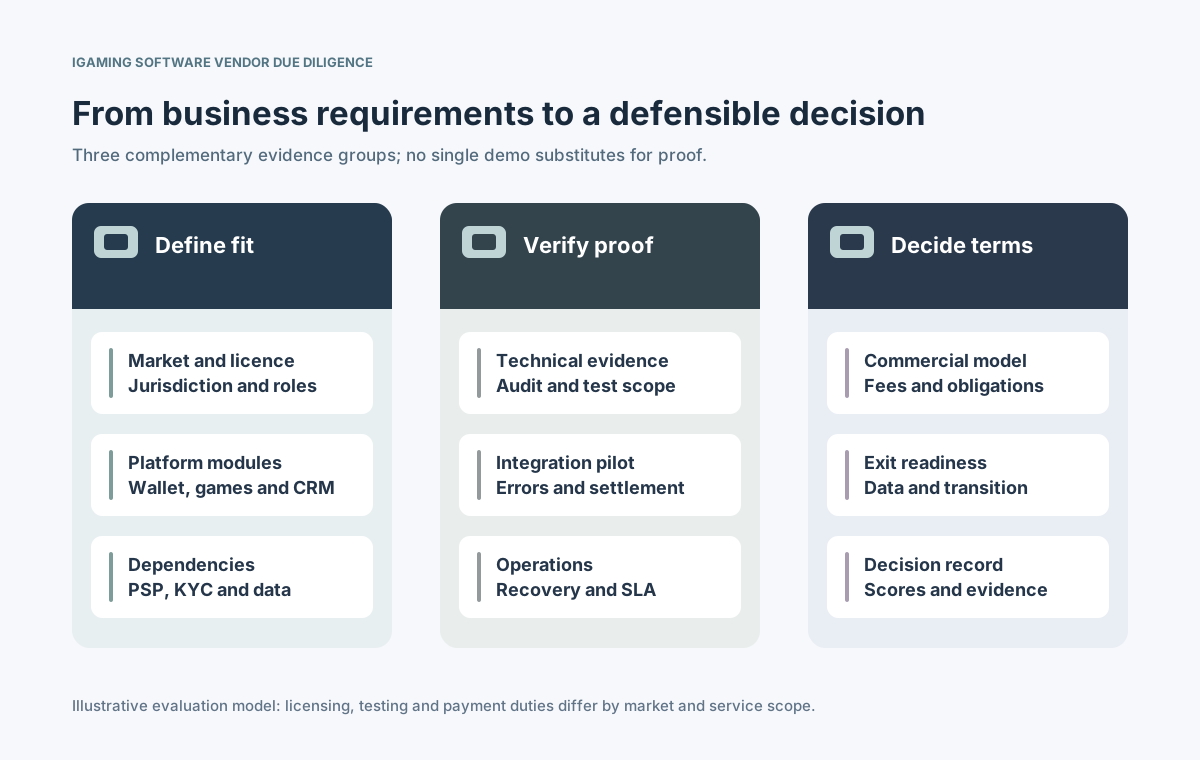
Choosing an iGaming software provider is a procurement decision with long-lasting technical, contractual and regulatory consequences. A polished demonstration cannot tell an operator whether customer balances will reconcile, outages will be handled, market-specific requirements can be met or data can be exported if the relationship ends. The right evaluation begins with a written scope, moves through evidence and a controlled integration pilot, and ends with clear ownership of each operational responsibility. This guide offers a practical framework for comparing casino platform, aggregation, managed-service and integration vendors. It does not certify or recommend individual suppliers or presume that one licence or technical standard applies in every jurisdiction.
Published
Compare candidate platforms using documented evidence, tested integrations and contractual exit rights.
On this page
What are you actually selecting from an iGaming software provider?
First define the purchase boundary. A casino operator might seek a complete platform, a white-label managed service, a game aggregation layer, individual APIs or an implementation partner. These services carry different responsibilities for player accounts, wallets, content contracts, hosting, support and legal approvals. Treat the term 'software provider' as a starting question, not a sufficient specification.
List required markets, products, launch dates, brands, traffic expectations, existing integrations and internal capabilities. Identify which functions the supplier owns, which are subcontracted and which remain with the operator. The resulting scope document should be shared with every bidder so an apparently inexpensive quote cannot omit core operations.
Which licensing, market and testing evidence should you verify?
Legal suitability is specific to the country, regulated activity and contractual supply chain. For Great Britain, Gambling Commission guidance distinguishes manufacturing, supplying, installing and adapting gambling software and explains circumstances in which a supplier licence is needed. Do not use a claimed UK permission as evidence for a different market, or assume a licence for one entity covers all affiliates. [1]
Question
Evidence to request
Reason
Target market
Jurisdiction matrix and legal entity
Avoid assumed cross-border coverage
Software licence
Number, holder and valid scope
Verify who may supply what
Game and RNG tests
Reports, versions and lab identity
Check actual certified scope
Technical standards
Applicable controls and gap register
Separate standard from approval
Change management
Major-change and retest procedure
Control post-launch releases
Subcontractors
Named critical suppliers and roles
Map the complete responsibility chain
A test certificate should identify the evaluated product and version, not merely a familiar laboratory logo. UK Gambling Commission testing guidance describes when independent evaluation is required; GLI publishes technical standards including GLI-19, but conformity to a standard is not itself an operating licence. Verify current requirements locally with qualified advisers. [2] [3]
Which platform modules and architecture decisions matter most?
Inspect the boundaries between player management, game catalogue and aggregation, wallet ledger, payments, bonus engine, CRM, responsible-gambling controls, reporting and backoffice permissions. Ask which system owns balances and transaction states, which interface is authoritative and how a missing upstream service affects play. Ownership is more important than a broad dashboard screenshot.
Request a component map identifying hosted, licensed, custom and subcontracted services.
Inspect multi-brand, multi-currency and country restrictions against the exact planned launch model.
Trace a round from game launch to wallet debit, result, rollback and final reconciliation.
Review configuration portability, release cadence and who can approve production changes.
Compare architecture on a like-for-like basis. A managed platform reduces some internal operations but increases dependence on its controls and export options. A modular stack offers flexibility yet requires the operator or integrator to coordinate contracts, event handling and incident ownership. Neither model is inherently superior for every launch.
How should you test integrations before committing?
Build a time-boxed pilot with an isolated test environment, test accounts, documented API contracts and agreed acceptance criteria. Connect at least one representative game flow, a wallet transaction path and one operational reporting export. Cover authentication, versions, error formats, rate limits and the division of responsibility between supplier, operator and payment or identity partners.
Start from documented API and callback contracts with sample payloads and identifiers.
Test repeated and out-of-order messages, timeouts, retries and settlement corrections.
Match wallet, game and provider totals and explain any reconciliation differences.
Simulate service interruption and prove how support, replay and recovery are coordinated.
⊕View largerAn integration proof links the marketed platform scope to actual wallet behavior, test reports and support ownership.
Accept a pilot only when both normal and failed outcomes are reproducible. A game launch that succeeds once does not validate financial integrity or resilience. Keep test cases, expected results, responsible parties and defects as dated evidence that can be referenced in the contract.
How do you evaluate security and supplier dependencies?
Ask for concrete evidence of secure development, identity controls, privileged access, vulnerability remediation, logging, backups and third-party management. NIST's Secure Software Development Framework provides a vocabulary for discussing supplier practices; OWASP ASVS supplies verifiable application-security requirements that can be written into testing or procurement criteria. Neither automatically certifies a particular vendor. [4] [5]
Control
Supplier evidence
Buyer verification
Identity and access
Role matrix, MFA, admin logs
Review privileged workflows
Secure delivery
Code review and remediation records
Sample release/change trail
Data protection
Encryption and retention design
Map access and deletion scope
Incident response
On-call and breach procedures
Test an escalation scenario
Payment services
PCI scope and responsibility matrix
Verify relevant TPSP obligations
If payment card account data or its security environment falls within the service, apply the relevant PCI DSS responsibility analysis. PCI SSC guidance on third-party service providers emphasizes due diligence, written responsibilities and ongoing monitoring. Do not infer that every casino platform vendor requires the same PCI assessment when payment data is fully segregated. [7]
What reliability, SLA and support evidence is meaningful?
Marketing claims of 24/7 availability are not measurable service commitments. Define the availability boundary, maintenance exclusions, monitoring source, severity categories, acknowledgement and restoration targets, escalation contacts, backup objectives and remedies. Ask for historical incident summaries and a recovery exercise showing how the supplier coordinates operators and upstream providers.
Define which APIs and player operations the availability measurement actually covers.
Separate first response, incident mitigation, recovery and financial-reconciliation completion.
Validate recovery time and recovery point objectives with documented tests.
Identify the escalation path for incidents caused by external game, KYC or payment providers.
AWS Well-Architected guidance advises designing to measurable availability targets and SLAs, supported by runbooks and operations. Use that as a review method, not proof that a vendor meets its promises. Contractual metrics require independent observation and realistic exclusions. [6]
How should commercial terms and total cost be compared?
Compare total cost over the expected contract horizon, not a single implementation quote. Separate setup, licences, revenue share, minimum commitments, content aggregation, payments, hosting, monitoring, support tiers, compliance work, change requests and exit services. Ask what happens to fees when new countries, products or brands are added.
Request a line-item price model with measurement units and example monthly invoices.
Identify pass-through charges, minimums, renewal changes and FX or tax assumptions.
Clarify source-code, configuration, integration and content rights, including subcontractor licences.
State acceptance milestones, service credits, termination triggers and post-exit assistance.
The cheapest entry price may have the highest switching cost, and an expensive proposal may include infrastructure another bid leaves outside scope. Build a comparable scenario across vendors using the same player, transaction and support assumptions. Keep projections labeled as assumptions; no universal cost-per-player benchmark fits every model.
Can you recover your data and exit the platform safely?
The exit plan belongs in procurement, not in a dispute after launch. Define ownership, lawful processing rights, export formats, frequency, identifiers, data history, secure transfer and deletion proof. Check whether the operator can reconstruct open bets, wallet balances, rewards and player support evidence without relying on undocumented vendor tools.
Exit item
Required deliverable
Acceptance check
Player identities
Scoped IDs and account history
Reconcile mappings and permissions
Wallet and ledger
Balances and transaction journal
Match closing/opening totals
Games and sessions
Contracts, keys and session mapping
Test controlled continuity
CRM and promotions
Preferences, offers and valid states
Check consent and expiry
Audit and configs
Logs, policies and configuration export
Verify readable provenance
Run a sample export before awarding the contract and retain a migration assistance schedule. Some data or licences may be legally unavailable to transfer; mark those dependencies explicitly and plan a compliant alternative. A vendor's promise that data 'belongs to the client' has limited value without a usable, tested delivery format.
How do you score suppliers without rewarding sales polish?
Make a shortlist scorecard with weighted criteria and minimum pass/fail gates. Licence fit, critical balance integrity or security deficiencies can be disqualifying regardless of the total score. For other criteria, award points only when the supplier delivers a document, demonstration, test report or reference that supports the claimed capability.
Separate mandatory controls from weighted differentiators before viewing proposals.
Give every bidder the same pilot cases and request evidence in the same format.
Track open questions, exceptions, owners and deadlines in a single evidence register.
Record the rationale behind the decision, including unresolved risks and mitigations.
Do not mix incomparable business models into one unqualified ranking. Create separate scorecards for fully managed versus self-hosted stacks if their operational burden differs materially, then compare the residual work left with the operator.
What should be signed off before choosing a provider?
A final decision package should join the requirements baseline, compliance review, architecture map, successful and failed pilot results, SLA definitions, total-cost model, supplier responsibility chart and tested exit plan. Identify who accepts residual risk in engineering, finance, legal, operations and responsible gambling. The evidence set must match the specific legal entity and software version offered.
Approve the jurisdiction-and-supplier licensing matrix, including subcontractor duties.
Sign off wallet and reconciliation tests, security findings and recovery evidence.
Confirm commercial and operational obligations in the executed agreement and schedules.
Preserve a decision log and define post-signature verification before production launch.
Provider selection is complete when business promises have become verifiable acceptance tests, enforceable responsibilities and realistic operating plans. Continue checking the delivered release against the approved scope: successful procurement does not replace commissioning, security review or jurisdiction-specific approval.