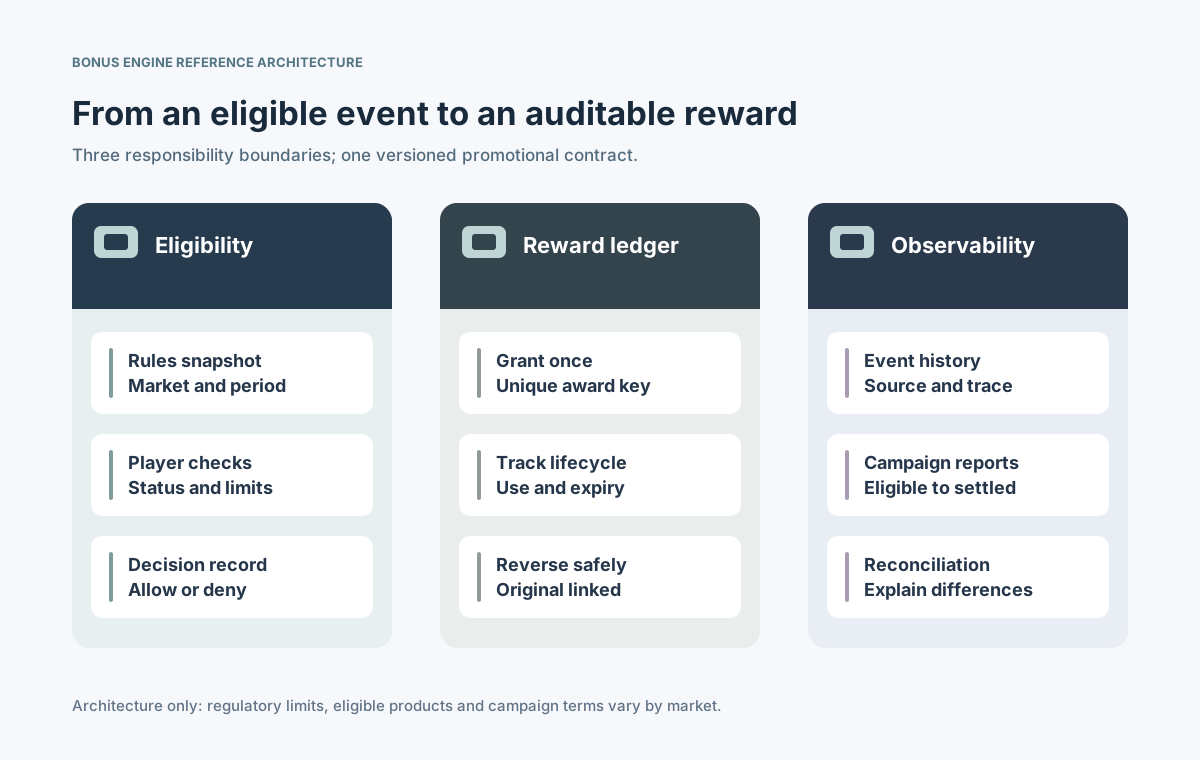
Casino Bonus Engine: Eligibility, Rewards and Tracking
A casino bonus engine is more than a coupon form or a scheduled marketing campaign. It connects player status, promotion rules, event processing, bonus balances, eligibility restrictions, reward fulfillment and reporting. A reward can fail even when the marketing screen looks correct: the player might be excluded, a qualifying event might be repeated, a grant might time out after posting, or a reversal might be delivered later. Operators need one authoritative decision record for each promotion and player, with versioned terms and a durable financial trail. This guide explains how to design that chain, where responsibility belongs, and what an integration team should test. It describes architectural controls rather than an implementation endorsed for every jurisdiction.
Published
Eligibility decisions, reward postings and tracking records must agree even when events arrive late or repeatedly.
On this page
What is a casino bonus engine responsible for?
The bonus engine translates an approved promotion into executable decisions: which event may trigger an offer, which player is eligible, what reward is allowed and how its lifecycle is recorded. It may be embedded in a casino platform or connected through APIs. Campaign creation, player restrictions, wallet accounting and customer communications remain distinct responsibilities even if one product markets them together.
A useful reference model has a campaign registry, a rule evaluator, a player eligibility gateway, a reward ledger and an event/audit pipeline. Open Loyalty's campaign API illustrates triggers, effect rules, activation periods and wallet-specific rewards; that commercial example is not a casino-specific compliance guarantee. Separate administrative promotion settings from immutable player-level award evidence. [1]
Which eligibility rules and exclusions should run first?
Eligibility is a point-in-time decision. It may depend on account verification, market or brand, campaign dates, player opt-in, product scope, previous claims, bonus concurrency and authoritative risk or responsible-gambling restrictions. The engine should read the latest controlling state and record which rule version produced the allow or deny decision. A cached audience list alone is not sufficient for awarding restricted benefits.
Rule group
Decision input
Evidence to retain
Campaign scope
Brand, country, product and dates
Campaign and version IDs
Player state
Verified account and active status
Decision-time snapshot reference
Exclusions
Self-exclusion, blocks or risk hold
Restriction source and outcome
Claim limits
Per-player cap and prior grants
Claim key and award history
Offer conflicts
Existing bonus and allowed stacking
Conflict resolution rule
Consent
Opt-in and relevant marketing permissions
Recorded basis and timestamp
A declined player must not be silently retried into a grant after a later marketing event. If account restrictions change between preview and claim, the final grant decision must be rechecked. The applicable product and marketing rules differ across jurisdictions; a rules matrix should explicitly name the market and effective date. [6] [7]
How do triggers and campaign rules evaluate events?
Typical triggers include an accepted registration, eligible deposit, verified transaction milestone or an approved manual action. The producer should emit a stable event ID with source, player scope, transaction reference and occurrence time. The rule evaluator then resolves one campaign version and evaluates conditions before any effect runs. These are conceptual examples; not every triggering behavior is appropriate or lawful in every market.
Distinguish the event that occurred from the campaign effect that might result from it.
Evaluate time windows in an agreed time zone and retain the effective campaign version.
Filter by source, event type and player scope; reject unknown or malformed event payloads.
Keep a reason-coded decision for every allowed, excluded, expired or duplicate case.
Amazon EventBridge documents matching event patterns to sources and attributes, while Open Loyalty distinguishes campaign triggers from longer-running achievement progress. They are useful architecture examples, not a substitute for testing settlement timing, refund handling and player restrictions against the actual casino provider contract. [2] [4]
How should reward issuance connect to wallet accounting?
The rule engine should produce a reward instruction with player, campaign, award ID, reason, amount or noncash entitlement, currency where applicable and expiry rules. A wallet service or entitlement ledger should commit the award with its own accounting identity. Do not treat a CRM message or a successful request acknowledgement as evidence that a balance changed.
Accept an eligible source event and load the immutable campaign rules snapshot.
Verify player restrictions, offer conflicts and the remaining campaign budget before reserving an award.
Create an idempotent award record and post its authorized wallet or entitlement effect once.
Emit a committed-award event for player visibility, analytics and subsequent status changes.
⊕View largerThe award record links rule version, originating event and financial or noncash entitlement effect.
An award can be cash-like credit, a restricted bonus balance, free spins, a loyalty entitlement or another market-approved benefit. The provider and wallet contract must define exactly how those categories are represented, spent, expired and reversed. One field named 'bonus_balance' rarely explains all of these states. [1]
What states should a bonus and wagering progress expose?
A bonus is a lifecycle, not one boolean. Depending on its terms, it can be offered, claimed, reserved, granted, active, partially used, completed, expired, cancelled or reversed. If wagering conditions are applicable in the relevant market, progress should be calculated only from explicitly qualifying settled events and should be reproducible from a durable source trail.
State or event
Accounting meaning
Player-facing result
Offered
No award posted
Terms available before claim
Claimed / pending
Eligibility recheck and reservation
Pending confirmation
Granted / active
Identified entitlement recorded
Visible usable benefit
Completed / converted
Terms met and any transfer recorded
Final outcome explained
Expired / reversed
Linked closure or compensating entry
Reason and date retained
Progress must account for voided bets, late settlement, rollbacks, eligible game contribution and currency precision only as permitted by the approved rules. Do not invent universal wagering multipliers: for example, Great Britain's Gambling Commission imposes restrictions on wagering requirements and on combining gambling products in incentives. The governing terms require local legal review. [6]
How can grants, retries and reversals remain idempotent?
An event may be delivered twice, or an API call may time out after the reward has been committed. The engine must prevent two postings from the same authorized effect. Construct a unique award identity from a scoped source operation, campaign version and player identity; enforce uniqueness in persistent storage before creating the wallet effect. In-memory flags do not protect against process restarts.
Assign one durable effect key to the grant; retries must return the stored result.
Reject a reused key carrying a conflicting amount, currency or campaign version.
Link refunds, cancellations and award reversals to the original grant and event.
Reconcile the bonus ledger against the wallet and provider outcome before manual repair.
AWS DynamoDB documents conditional writes that reject duplicate keys. The general pattern is relevant whether the actual implementation uses SQL constraints, a transactional ledger or another data store. Replaying an award should never create a second monetary or noncash benefit simply because an acknowledgement was lost. [3]
How do bonus terms and player-protection controls interact?
Compliance belongs in the authorization path, not just a legal footer. The player should see relevant conditions before participation, and the bonus system must respect active self-exclusion, account restrictions, limits and jurisdiction-specific eligibility. A promotion must not override a customer's independently enforced financial or safer-gambling controls.
Version and expose material terms: eligible product, expiry, qualifying actions, exclusions and withdrawal conditions.
Use market-level policy flags, with legal review and explicit effective dates, instead of global defaults.
Make restricted-player denial authoritative across web, app, CRM and support-granted awards.
Record who approved a rule change and whether existing claims retain their original terms.
For Great Britain, the Gambling Commission's rewards-and-bonuses code addresses clarity, conditions and particular prohibited incentive mechanics, while RTS 12 covers customer financial-limit facilities. These are jurisdiction-specific primary examples, not a statement that every country's regime is identical. [6] [7]
Which events should tracking and campaign reporting measure?
A reporting pipeline should separate campaign exposure from eligibility, claim, grant, activation, fulfillment, expiry, reversal and dispute resolution. Conversion counts derived from emails or banners can differ from confirmed awards, and neither should be used as the wallet's accounting source. Log each state transition with a correlation ID and consistent definitions so teams can explain the funnel.
Metric
Authoritative source
Common pitfall
Eligible decisions
Rule evaluator result
Using audience size as eligibility
Claims
Recorded player action
Counting button taps as grants
Issued benefits
Reward ledger commit
Double-counting retry events
Completed awards
Approved lifecycle transition
Treating activity as settlement
Expired / reversed
Linked closing entries
Hiding cancelled value from reports
Braze's custom-event documentation shows how events can support segmentation and campaign analytics. That is a downstream marketing use: a bonus engine should publish verified outcome events to CRM without letting a marketing counter become its financial source of truth. Track player identity and privacy scope consistently. [5]
How should operators audit campaigns and reconcile rewards?
Every disputed reward should be explainable from original trigger through rule evaluation, operator approval, award entry, balance effect and final status. Keep the exact rule version and player restriction decision used at grant time. Reconciliation must compare authoritative system totals rather than assume that emitted events equal committed transactions.
Retain a promotion change log with approver, effective period, market and immutable version.
Compare award ledger records with bonus-wallet postings and unused entitlements.
Alert on missing or unusually frequent grants, failed reversals and unresolved settlement differences.
Restrict manual overrides and replays; log actor, justification and linked original award.
A successful campaign dashboard does not prove player-level integrity. Support, risk, compliance and engineering need a shared evidence trail that can answer why a benefit did or did not reach a particular account.
What should a bonus-engine integration test before launch?
A realistic test plan covers configuration, event ingestion, decisioning, accounting, customer visibility and failure recovery. Test each bonus type in every intended market and product, not only a happy-path welcome promotion. Include a jurisdiction-aware legal and responsible-gambling sign-off on promotion rules before enabling live claims.
Preview both eligible and excluded players, then change a restriction between preview and grant.
Deliver a trigger twice, lose the grant acknowledgement and verify that one award exists.
Reverse an original transaction, expire an unused award and reconcile every resulting ledger state.
Compare campaign reports, CRM events, wallet totals and player-facing balances for matching identifiers.
The core procurement question is whether the platform can prove who qualified, which terms applied, what was granted once, how it was used or reversed, and how the operator detects inconsistencies. A feature list mentioning free spins, cashback or loyalty points is not enough to establish those operational guarantees. [1] [3] [6]