Casino Platform Migration: Planning and Technical Risks
Moving an online casino to another platform can affect every live customer and financial integration at once. A polished new frontend does not prove that balances, pending withdrawals, player verification, bonus obligations and provider callbacks survived the change. The migration plan must define authoritative records, data mapping, acceptable downtime, rollback limits and the people responsible for each decision. This guide describes operator-side technical controls for switching platform vendors, architectures or hosting environments. Cloud-migration references provide engineering patterns, not a guarantee that every casino vendor supports the same transfer features or that regulatory consent is automatic.
Published
A controlled platform transition validates each data domain before shifting production traffic.
On this page
What does casino platform migration actually involve?
A platform migration replaces, relocates or restructures the components that operate a casino while retaining agreed business records and player obligations. It might change a turnkey vendor, move hosting, separate the wallet from a monolith or replace integrations. A simple infrastructure move differs sharply from replacing an entire player-management and payments stack. [1]
Define the business reason, exact in-scope domains and acceptable disruption first. The operator must know which balances, account restrictions, active wagers, payment exceptions and reports will be transferred, archived or deliberately left in the old environment. A vendor statement that migration is supported is not a field-level acceptance plan.
Which systems and dependencies need an inventory?
Build a dependency map spanning the frontend, authentication, player management, wallet, bonus engine, game providers, sportsbook, payments, CRM and reporting. Record data ownership, API versions, export rights, currency precision, external identifiers, contract constraints and recovery responsibility. Missing a dependency can turn a technically successful deployment into an operational outage. [1] [3]
Domain
Data to account for
Potential migration failure
Player identity
Accounts, KYC state, access limits
Duplicate accounts or lost restrictions
Wallet and ledger
Cash, bonus, holds, open items
Missing or duplicated liabilities
Game integrations
Rounds, sessions, callback IDs
Unsettled wagers or broken launch
Payments
Deposits, withdrawals, PSP statuses
Replayed callbacks or orphan payments
Promotions
Eligibility, wagering progress, expiry
Incorrect bonus entitlement
Operations
Reports, CRM events, audit evidence
Broken reconciliation or investigations
Inventory includes secrets, certificates, domains, DNS, callback allowlists, data retention and third-party connectivity. Keep a named owner and a yes/no acceptance criterion for each interface, including services that continue running on the previous platform.
How should the migration strategy be selected?
Choose a strategy for each component, not one label for the whole project. A rehost preserves application behavior; a replatform changes infrastructure; replacing a vendor product resembles repurchase; refactoring alters architecture. AWS describes these distinct migration choices, which translate into different testing and rollback requirements for a casino stack. [1]
List components that can remain unchanged and those that must be replaced.
Confirm contractual access to source exports, schemas, media and audit histories.
Assign each interface to a source owner, target owner and integration test.
Separate must-have launch behavior from improvements that can ship after stabilization.
Do not combine a platform replacement, a payment-provider switch and a new bonus rule set in one uncontrolled release. Multiple simultaneous changes reduce the ability to explain which change caused a financial or session discrepancy.
What are the practical migration stages?
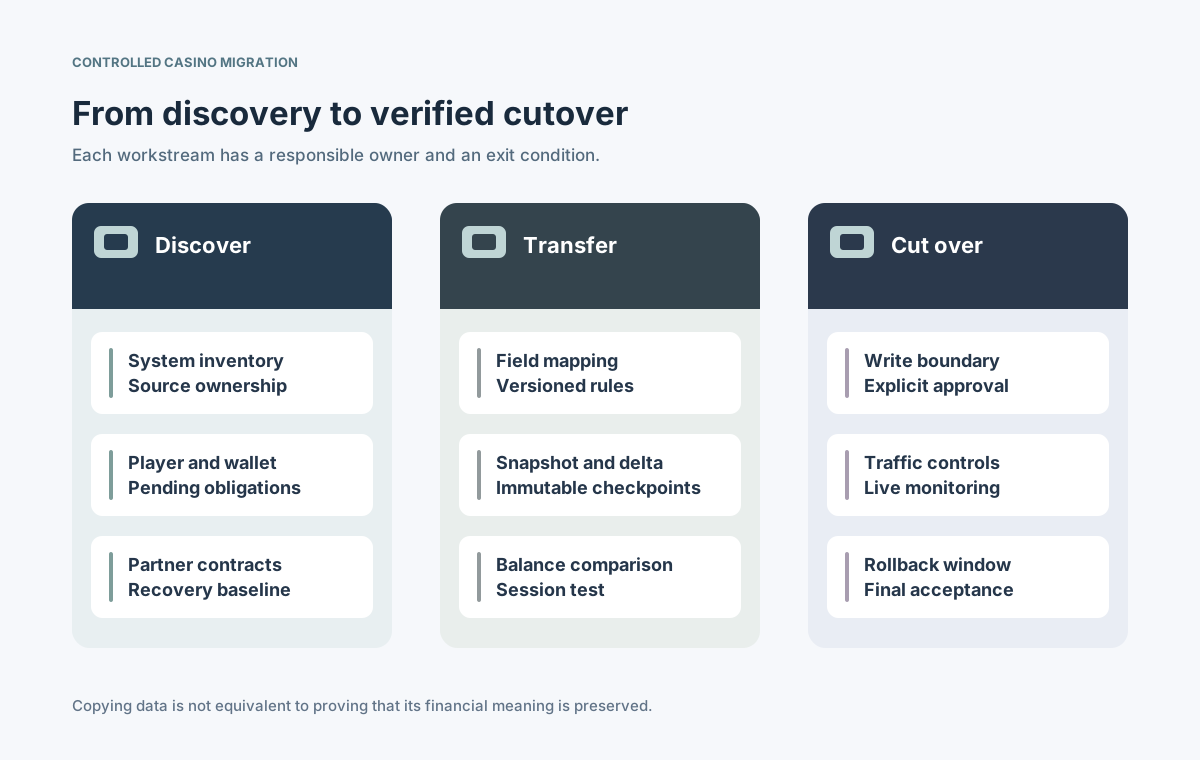
A defensible plan starts with discovery and a target model, continues through repeated test imports, and ends with an approved production write boundary. Copying historical tables is only one stage. Each stage must have inputs, reconciliation evidence, a responsible person and a failure condition. Google Cloud's migration guidance emphasizes testing failure modes and preparing rollback for each step. [3]
Freeze the migration mapping and create a timestamped, recoverable source baseline.
Load a sample and then a complete historical dataset into a segregated target environment.
Validate source-to-target identities, wallet totals and representative business journeys.
Capture final changes, stop or route conflicting writes, obtain sign-off and shift traffic.
⊕View largerDiscovery, transfer verification and production cutover each require a distinct acceptance gate.
Plan separately for long-running game rounds, payment webhooks and support workflows that cannot end precisely at a deployment minute. Define whether they finish on the old system, are migrated with explicit state or are temporarily unavailable.
How are player, wallet and transaction records validated?
Design versioned mappings for IDs, currencies, amounts, timestamps, statuses, restrictions and historical relationships. Record null handling, retired codes and incompatible schemas. Compare source and target by stable business identifiers and financial meaning, not only equal table counts. Database migration tooling can compare copied data, but application-level rules require separate tests. [2]
Record set
Validation control
Evidence required
Player accounts
Unique identity and restrictions
ID crosswalk and exception list
Wallet balances
Opening + movements = closing
Ledger-level reconciliation
Open game rounds
Single owner per unsettled round
Round and provider references
Bonus commitments
Eligibility and progress preserved
Rule version and test cases
Payment items
Pending and settled separated
PSP IDs and state comparison
Keep raw extracts, transformation version, row-level rejection reasons and comparison outputs. A target wallet balance matching a snapshot can still conceal missing withdrawals or double-counted wins. Classify exceptions and obtain financial sign-off before enabling real-money writes.
How are wallets and player sessions protected during the move?
A live casino cannot casually run two independent systems that can both debit the same wallet. Establish which platform is allowed to create financial side effects at each phase and how late supplier callbacks are routed. If events and data updates cross services, dual-write failures and duplicate delivery require explicit controls; transactional outbox patterns can help when the architecture permits them. [6]
Decide when new deposits, wagers, withdrawals and bonus grants are stopped or routed.
Reconcile pending holds and open rounds to one financial authority before cutover.
Choose whether sessions end with forced reauthentication or can be safely transferred.
Verify duplicate callbacks, login recovery and operator adjustments under delayed delivery.
Session identifiers are security credentials, not ordinary rows to copy. Reusing old tokens across a new security boundary can be unsafe; apply a deliberate reauthentication and session rotation policy that follows accepted session-security guidance. [5]
How should cutover and traffic shifts be controlled?
Cutover is the moment production authority changes. Establish an explicit go/no-go decision, a measured data-lag threshold, available rollback time and live dashboards. A canary can expose a small non-financial cohort to the target, but splitting financial writes without single ownership is not a safe experiment. Canary techniques reduce exposure only when the traffic and state model support isolation. [4]
Stage
Traffic or state
Exit condition
Dress rehearsal
Synthetic and masked test activity
Mapped records and journeys pass
Read-only validation
Target shadow reads, no wallet writes
Reconciliation within agreed limits
Write boundary
One authoritative ledger writer
Signed financial and security gate
Controlled launch
Defined channels or cohorts
No critical unmatched operations
Stabilization
Monitored production and support
Exit metrics and handover passed
Set the checkpoint at which fallback stops being a simple traffic switch. Once the target accepts new payments or wagers, returning to the source requires accounting for those new movements; a DNS rollback alone can create lost or duplicated transactions. [3]
What makes rollback and recovery credible?
A rollback plan must state which data can be restored, which new events must be replayed and who can approve irreversible actions. Test restoring backups, reconnecting old providers, reversing routing changes and verifying financial balances. The ability to create a backup is not evidence that recovery will work within the permitted interruption window. [3] [7]
Write down the last safe rollback point and what changes after that point.
Keep verified backups, original exports and checksummed transformation results.
Practice failed-import, delayed-callback, corrupt-data and broken-login scenarios.
Assign owners for player communication, payment holds and incident escalation.
If a live operation ran only in the new environment, an old snapshot is incomplete. Recovery may need a forward-repair plan or controlled replay rather than reverting the entire wallet database. Do not promise zero downtime or zero loss without evidence from the exact architecture.
Which security, regulatory and vendor risks remain?
Review data-export rights, controller/processor obligations, encryption, access logging, secret rotation, vendor end dates and incident support before changing providers. Verify that any jurisdiction-specific reporting, responsible-gambling limits, identity checks and audit retention remain operable. Requirements vary by market, license and contract; a successful technical import does not establish legal permission to operate.
Keep production personal and payment data out of unrestricted test environments.
Rotate or revoke credentials and callbacks as responsibilities move between vendors.
Confirm provider contracts, IP allowlists, certificates and escalation contacts.
Retain traceable evidence for financial corrections and player-access decisions.
Document which party owns open incidents, unresolved withdrawals and historical data access during the overlap period. The old platform should be retired only when those responsibilities are demonstrably covered by the new operating model. [3]
What must be signed off before the final switch?
A release-ready migration has more than a green deployment dashboard. It has an accepted data inventory, signed financial comparison, successful payment and game round tests, secure customer access, current vendor contacts and a rehearsed incident response. Repeat the most important checks against the final production snapshot rather than relying on an earlier staging import.
Approve source and target data maps, exclusions, owners and recovery checkpoints.
Verify player balances, restrictions, open rounds, PSP statuses and bonus obligations.
Exercise login, deposits, wins, cancellations, withdrawals and delayed callbacks end-to-end.
Record go/no-go authority, rollback limits, monitoring thresholds and post-launch owners.
The migration is finished only when the operator can explain every remaining exception, support affected players, reconcile money movements and safely retire the old dependencies. Migration strategy guidance and controlled rollout principles offer useful patterns, but acceptance must be demonstrated for the actual casino system and contracts. [1] [3] [4]