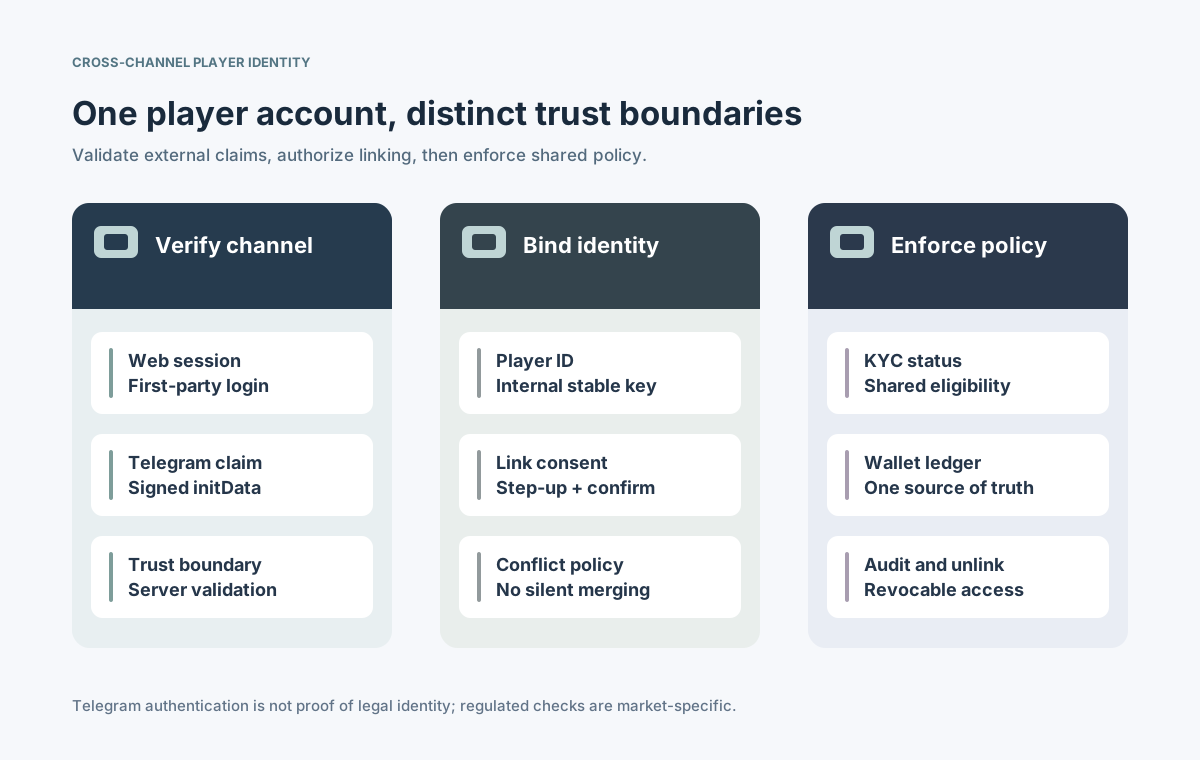
A customer who visits an online casino website and later opens its Telegram Mini App should not accidentally become two separate financial accounts. Yet Telegram login data, an application session, a verified customer identity and the operator's permanent player record represent different facts. Secure omnichannel design uses one authoritative internal player ID, verifies the external authentication evidence on the server and requires a deliberate link before connecting an existing account. This guide explains the identity boundary, consent, recovery, responsible-gambling restrictions, wallets and audit trail. It is architectural guidance, not a claim that Telegram authentication alone fulfils regulated identity or age-verification requirements.
Published
One authoritative player record serves both interfaces while authentication and verification remain distinct controls.
On this page
What does one player identity mean across two channels?
Start by separating four concepts: Telegram account, proof that a channel request originated from Telegram, a casino login session and the operator's durable player record. None is interchangeable. A Telegram username may change; even a stable platform-specific numeric ID is only a handle for a Telegram account, not proof of the account holder's legal identity.
The operator should maintain its own immutable player key and place channel-specific identities in a separate mapping table. Website and Mini App traffic can then resolve to that key after the required authentication and linking checks. Player state, wallet balance, customer verification and restrictions remain on the authoritative backend, not inside a messenger profile.
How should Telegram Mini App and website login be verified?
Telegram Mini Apps provide signed initialization data; the backend must validate the raw initData according to Telegram's documented algorithm and reject stale or invalid claims. The client-side convenience object initDataUnsafe must not be the authority for creating a session. Website login can use Telegram's documented OIDC integration, with its own redirect and token-verification requirements. [1] [2]
Channel evidence
Server-side check
Unsafe shortcut
Mini App initData
Verify signature, bot identity and age
Trust initDataUnsafe
Telegram OIDC login
Validate token, issuer, audience and flow
Trust a profile callback
External user ID
Bind to correct provider and tenant
Match by display name
Website session
Check own session and CSRF protection
Reuse external proof as cookie
Fresh authentication
Apply freshness and replay policy
Accept an old launch payload
Sensitive action
Require recent account proof
Treat channel login as KYC
For redirect-based OAuth/OIDC authentication, use transaction-bound state or equivalent protections, PKCE as applicable and exact redirect URI checks. RFC 9700 describes current OAuth security guidance. Telegram Mini App HMAC validation and an OIDC login response use distinct verification methods; do not apply one protocol's hash recipe to the other. [6]
How do you map Telegram users to an internal player ID?
Use a mapping record containing provider='telegram', the validated numeric provider subject, operator tenant and internal_player_id, with a unique constraint on the provider subject inside the intended account scope. Treat Telegram usernames, phone numbers, photos and language labels as optional mutable profile attributes. They must never trigger automatic wallet merges.
Issue an internal, non-recycled player identifier independently of Telegram and website sessions.
Store provider and subject together so numeric IDs from different identity systems cannot collide.
Enforce uniqueness, ownership and tenant boundaries transactionally when adding or changing a link.
Keep a dated mapping history for support and fraud review without exposing raw credentials.
A single Telegram identity may already point to another player record. In that situation stop the link and send the user through a documented conflict-recovery process. Never select an account using only a matching alias, a chat ID pasted into a form or a device fingerprint.
How can players securely link an existing casino account?
Account linking is an authorization ceremony, not a silent side effect of opening a Mini App. The player first authenticates to the existing casino account, starts a short-lived linking request, authenticates the external Telegram identity and explicitly confirms that both represent the account they intend to connect. Reauthentication or stronger proof is appropriate before changing recovery or financial access. [3]
Begin with a currently authenticated casino session and a one-time, expiring link intent.
Validate the Telegram response on the server and bind it to that specific link intent.
Show the intended casino account and external channel; request explicit confirmation.
Atomically reject duplicate links, record consent and rotate the account session as needed.
⊕View largerA valid Telegram claim can authorize a channel only after a deliberate link to the operator's existing player identity.
Never accept a link token sent as an unrestricted chat message or allow a new Telegram login to take over an existing balance. Record the initiating session, verification method, timestamp and final decision for disputed merges and support investigations.
What session and step-up protections are required?
Once identity is linked, create an application-owned session for each device and channel. Session tokens need secure transport, limited lifetime, server-side revocation and rotation at relevant privilege changes. Separate authentication from authorization: a valid session must still pass current access rules for every requested operation. OWASP and NIST provide relevant session and authenticator lifecycle guidance. [4] [5]
Event
Required control
Expected outcome
New Mini App session
Verify signed launch and create own token
Bound to linked player
Wallet or payout change
Recent high-assurance proof
Step-up or reject
Link or unlink
Reauthenticate and confirm
No silent takeover
Lost device
Revoke channel sessions
Other channels protected
Suspicious activity
Rate limits and risk review
Restrict high-risk actions
Set explicit idle and absolute timeouts. Do not embed long-lived bot tokens, KYC documents or payment secrets in Mini App JavaScript or Telegram messages. A bot's access token is a backend secret; leaking it can compromise the signed-data trust boundary.
How do KYC, age checks and market restrictions cross channels?
The operator's identity-verification service must remain independent of the login provider. The same internal player ID should carry age/KYC status, geographic permissions, sanctions or AML holds, responsible-gambling limits and self-exclusion decisions. A Telegram account connection does not remove any incomplete verification or restricted status. For Great Britain, Gambling Commission licence condition 17.1.1 requires applicable remote licensees to obtain and verify customer identity before gambling; other markets have different rules. [7]
Check eligibility and exclusion centrally before each regulated or financial action.
Apply one account's limits and cooling-off status on every approved client surface.
Show only the information necessary for the permitted customer journey in each channel.
Re-evaluate access if verification, jurisdiction or restriction status changes mid-session.
Do not assume a Telegram handle, phone number, profile photo or paid Telegram status establishes age or real-world identity. Likewise, a completed identity check does not grant unlimited geographic access. Document applicable market rules separately from the technical login protocol.
How are wallet, bonuses and account state kept consistent?
Both interfaces should call the same authoritative player, wallet and bonus services. Telegram must not maintain an independent 'shadow balance' or a separate KYC flag. Use stable transaction IDs, idempotent wallet commands and a ledger or equivalent auditable source to avoid double debits when a user changes channels or retries requests.
Resolve the channel session to the same canonical player ID before any wallet operation.
Enforce one set of limits, balances and promotion eligibility in backend business rules.
Reconcile asynchronous settlement and callback results by immutable transaction references.
Test rapid channel switching, stale screens, duplicate requests and account blocks.
An account link must never imply two existing ledgers should be summed. If an operator needs a formal account-consolidation procedure, treat it as a separate, reviewed financial migration with reconciliation and restrictions, not an automatic identity match.
What happens when a player unlinks Telegram or loses access?
Provide a visible unlink and recovery flow from an independently authenticated casino account. Revoking the Telegram channel should invalidate its sessions and future automatic mapping while preserving the player's wallet, verified identity, legitimate records and other linked channels. Recovery must not depend exclusively on the compromised or lost Telegram account.
Scenario
Safe handling
Verification
Voluntary unlink
Step-up, revoke channel access
Audit owner confirmation
Lost Telegram access
Independent account recovery
No balance reset
Conflicting link
Block and review ownership
No automatic merge
Privacy request
Review lawful retention and rights
Scope data per system
Account closure
Deactivate access across channels
Retain only lawful records
Publish recovery expectations before launch. Distinguish deleting a channel connection from erasing every operational or legally required record. Regulatory retention and data-protection duties depend on jurisdiction and purpose, so document what can be erased, retained or exported.
Which identity events should be audited and monitored?
Make account association observable without overcollecting personal information. Log a structured event when Telegram evidence is accepted or rejected, a player link is requested, confirmed or revoked, a session is rotated, or an access restriction blocks an operation. Use server timestamps and internal event IDs. Avoid storing full signed initData or bearer tokens in routine logs.
Track verified provider subject, internal player ID, tenant, link action and security result.
Alert on high-volume failed links, repeated account conflicts and suspicious recovery attempts.
Keep auditable decisions for financial or eligibility state changes across channels.
Define access control, retention windows, deletion rules and evidence ownership for logs.
Review support tools as carefully as customer interfaces: privileged manual re-linking or account overrides can bypass the safest public flow if not separately controlled. Keep approval trails for exceptional merges and changes.
What should be checked before enabling both channels?
Before launch, the team should demonstrate the complete lifecycle: an unlinked customer logs in, verifies Telegram evidence, links safely, opens either interface, sees the same restrictions and balance, and can unlink without losing the underlying account. Repeat with conflicts, expiry, altered signatures, replay attempts and blocked players. Store results as release evidence.
Validate Mini App and OIDC variants against their distinct official contracts and negative cases.
Prove unique player mappings, consent, step-up, conflict handling and revocation.
Verify KYC, limits, exclusions, wallet debits and audit events across both channels.
Sign off recovery, monitoring, retention, market requirements and ownership of each control.
A trustworthy cross-channel journey depends on identity continuity without weakening financial, privacy or age-verification safeguards. Preserve the operator-controlled player record as the source of truth and treat Telegram as a separately verified entry channel, not an alternative compliance system.