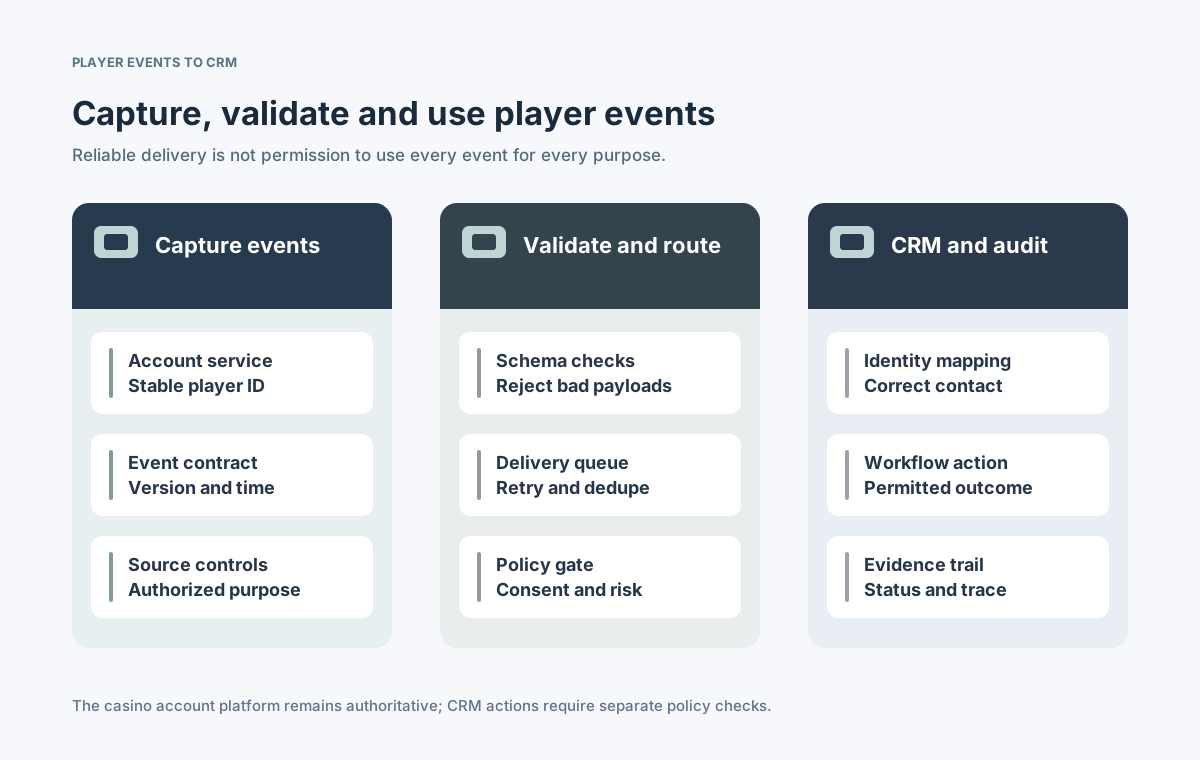
Casino customer relationship management is only as reliable as the events connecting it to the player account system, wallet, games and support channels. Registration, verification, session status and service requests may be useful to a CRM, but sending every database change creates inconsistent profiles, duplicate actions and privacy risk. A robust integration defines event purpose, identity, schema, permissions, delivery guarantees and failure recovery before enabling automated workflows. Commercial messaging must remain separate from responsible-gambling or account-safety communications, and each market requires its own compliance review. This guide describes a controlled, auditable architecture rather than claiming that one CRM product automatically solves these obligations. [1] [2] [5] [6]
Published
A controlled event stream connects the casino platform to CRM without making the CRM the source of truth for player identity or balances.
On this page
What does a casino CRM integration actually connect?
A casino CRM consumes selected facts and actions from the player account management system (PAM), wallet, game services, payment and customer-support tools. The PAM remains authoritative for player identity, access restrictions and account status; the wallet remains authoritative for balances and transactions. CRM copies are projections used for permitted service workflows and analytics, not substitutes for those systems.
Integration patterns include API requests, event subscriptions and batch reconciliation. Salesforce platform events and HubSpot custom events illustrate two different vendor-specific ways to ingest or expose activity; neither should be treated as a universal schema for casino operations. Decide which system owns each field and what happens when it disagrees with a CRM record. [2] [3]
Which player events should the CRM receive?
Start with a governed event inventory: name, producing service, meaning, permitted consumers, data classification, retention expectation and operational owner. Events such as registration completed or support case opened have different consequences from bonus granted or a responsible-gambling restriction. A timestamped event is not automatically a request to contact the player. [1] [5] [6]
Event family
Example event
Typical permitted use
Account lifecycle
player.registered
Onboarding status
Verification
player.verification_changed
Service queue
Session and activity
player.session_closed
Operational analytics
Support
support.case_opened
Case handling
Wallet
wallet.transaction_finalized
Reconciliation signal
Safety and preferences
player.marketing_opted_out
Suppression enforcement
Record events as state transitions with stable identifiers, not as vague labels such as active player. Where a CRM only needs an aggregate, publish the aggregate instead of detailed gameplay or financial history. Any marketing trigger must pass a separate eligibility gate before a message is issued. [5] [6]
How should player IDs and event schemas be mapped?
Use a stable tenant or operator ID plus an internal player ID as the primary join key. CRM contact IDs are external mapping records, not the sole identity of a player. A cross-brand group must define explicit identity boundaries so that one brand's permissions, restrictions and contact preferences are not silently applied to another. CloudEvents describes useful envelope attributes including source, type, ID and time. [1]
Define event_id, event_type, occurred_at, source, schema_version, tenant_id and player_id in every approved envelope.
Maintain a scoped mapping between internal player_id and CRM contact_id; track merges, splits and deleted contacts.
Publish additive schema changes carefully and require a migration plan for renamed or removed fields.
Classify each attribute by purpose and sensitivity; do not place raw identity documents or secrets in the event.
Protect identifiers in transit, use scoped service credentials and restrict logging of player attributes. A contact merge or account closure must have a defined replay and deletion policy; otherwise subsequent events can revive an obsolete CRM profile. [1] [5]
What is a safe end-to-end player-event delivery flow?
The producer writes an event after its authoritative business transition is committed, ideally through a transactional outbox or another demonstrably consistent publication path. An event router validates the schema, checks tenant boundaries and forwards an authorized projection to a CRM adapter. Salesforce and HubSpot require integration-specific mapping and authentication rather than a generic fire-and-forget webhook. [2] [3] [4]
Commit the player-account change and record a durable, uniquely identified event for publication.
Validate the event against the expected schema and the destination's permitted data fields.
Deliver through a retry-capable queue or adapter with deduplication and per-tenant routing.
Confirm the CRM outcome, record the response and reconcile uncertain or rejected events.
⊕View largerA CRM receives a verified, purpose-limited event projection and records delivery separately from the casino source of truth.
Do not claim end-to-end exactly-once behavior merely because a broker supports transactional features. Network failures can leave CRM outcomes unknown, so design for idempotent destination operations and explicit reconciliation. [4]
How do different CRM platforms consume player activity?
Different CRMs represent activity through contact properties, timeline events, platform events or custom objects. Map the internal event catalog onto each vendor's supported entities, quotas, authentication and workflows. For example, HubSpot custom events require event definitions and properties; Salesforce provides an event bus with subscriber-specific behavior. [2] [3]
Integration choice
Useful for
Risk to control
Contact property update
Current account stage
Overwriting newer state
Custom activity event
Historical service milestones
Duplicate timeline entries
CRM automation trigger
Approved follow-up workflow
Unwanted repeat messages
Support case integration
Agent-visible issue status
PII overexposure
Periodic reconciliation
Repairing missed updates
Stale or mismatched identity
Keep adapters replaceable: the casino event contract is a stable internal API, while the vendor-specific fields belong to an adapter version. Test behavior when a CRM rejects a property, rate-limits requests, merges contacts or temporarily becomes unavailable. [2] [3]
How should duplicate, delayed and reordered events be handled?
A consumer may receive the same event more than once after timeouts and retries. Ordering can also differ across players, partitions and external destinations. Kafka documents at-least-once delivery and the limits of exactly-once claims. Treat the event ID as a deduplication key, and use entity versions or effective timestamps when updating state in a CRM. [1] [4]
Store a processed-event key scoped by source, tenant and destination with a retention policy.
Make workflow actions idempotent, including outbound messages, case creation and loyalty changes.
Reject stale state replacements using authoritative entity_version rather than arrival order alone.
Route poison messages to a controlled dead-letter queue with replay and redaction procedures.
Do not blindly replay every failed event into marketing automation: the player's current eligibility and preferences may have changed since the event occurred. Recheck them at action time. [5]
Why must service, safety and marketing signals stay separate?
A single player event may matter to operations without being suitable for sales targeting. A support incident should create a service task; a verified exclusion or harm indicator may require a restricted safety process; a promotional campaign requires its own legal and preference checks. UK Gambling Commission guidance addresses customer interactions, while ICO guidance distinguishes rights involving direct marketing. Applicability depends on jurisdiction. [5] [6]
Signal class
Destination policy
Forbidden shortcut
Service
Authorized support queue
Treating every ticket as a sales lead
Account security
Restricted risk workflow
Exposing sensitive alerts to marketers
Responsible gambling
Protected customer-interaction process
Turning risk into an offer trigger
Marketing
Consent or lawful-basis and suppression checks
Assuming CRM membership is permission
Financial status
Finance or support projection
Sending full balances to campaigns
Enforce this separation in routing permissions and CRM roles, not only in written policy. Marketing systems should never be able to override an account exclusion, a do-not-contact preference or a mandatory safety restriction. [5] [6]
How should consent, suppression and data minimization be governed?
Treat marketing preferences as versioned, authoritative state rather than an optional CRM tag. The right to object to direct marketing and the need for suppression are explicit in ICO guidance for relevant UK processing. Other markets require separate legal assessment. Capture the provenance and time of changes, and apply the latest effective restriction before any communication. [5]
Maintain a canonical preference or restriction service with market, brand, channel and purpose scope.
Send only data fields required by the approved CRM use case; exclude passwords, raw KYC and payment secrets.
Propagate opt-outs, exclusions and account closures promptly, and verify suppression at message dispatch.
Define retention, access logging, subject-request handling and safe deletion of vendor-side copies.
If a safety or regulatory service needs an interaction record, keep its required evidence in the appropriate protected system. Do not repurpose that record for promotional profiling. The CRM's technical ability to store a field does not establish a lawful purpose. [5] [6]
How should the integration be monitored and recovered?
Measure event production, validation, queue age, destination acceptance, rejected mappings, lag and replay outcomes per operator. Correlation IDs and trace context help investigate a player-account transition through the adapter without recording unnecessary sensitive content. OpenTelemetry documents context propagation across service boundaries. [4] [7]
Track produced, accepted, rejected and deduplicated event counts by event type and tenant.
Alert on queue age, failed destination calls, missing acknowledgements and unusual suppression failures.
Maintain dead-letter triage with redacted payload samples, operator access controls and audit logs.
Test restoration after CRM downtime, contact merges, schema rollout and broker failover.
Reconcile an authoritative sample of player states and CRM projections after recovery.
Set recovery objectives around missing service updates and unsafe repeated actions, not merely the throughput of the event broker. Use synthetic test tenants and non-sensitive fixtures where possible. [4] [7]
What acceptance tests are needed before a casino CRM rollout?
Validate the full chain in a sandbox across every relevant brand, locale and approved market. Test positive and negative cases: the same registration event should update the correct contact once, while a suspended or opted-out player should not receive marketing because an old workflow was replayed. Separate operational and legal sign-offs for each destination and purpose. [2] [3] [5] [6]
Verify event schemas, source timestamps and ID mapping for new, merged and closed player accounts.
Inject duplicate, delayed, missing and reordered messages; confirm idempotency and safe reconciliation.
Check opt-outs, exclusions, channel preferences, role access and minimization at dispatch time.
Compare source records, CRM projections, audit traces and message outcomes before controlled release.
Publish a versioned test report with expected and actual CRM behavior, responsible owners, market scope and rollback steps. A successful connector deployment is only the start; correct identity, event semantics and permitted downstream action are the acceptance criteria.