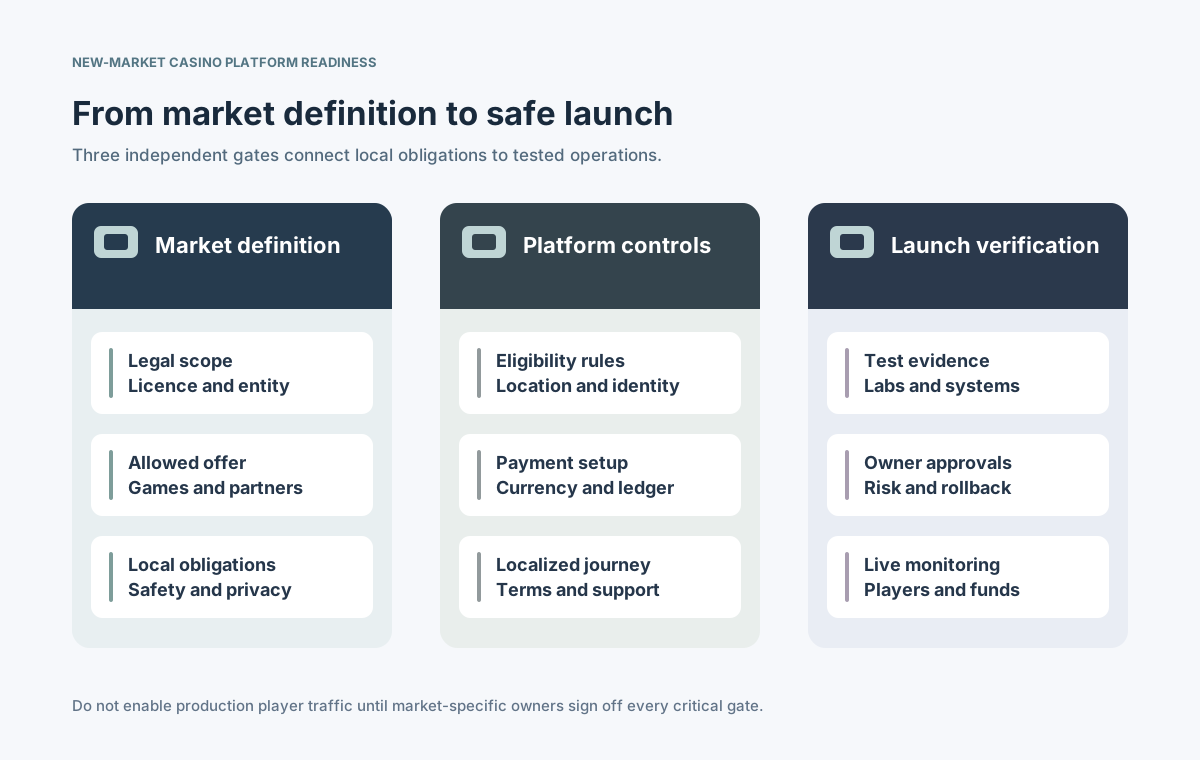
A casino platform that works in one territory is not automatically ready to operate in another. Regulatory permissions, game availability, player eligibility, financial rails, disclosures, privacy controls and test evidence depend on the target market and operator structure. The practical starting point is an approved requirements matrix, not a translated homepage or an assumed licence passport. This guide connects commercial market selection to platform configuration and verifiable launch controls. It is a technical planning framework, not a substitute for jurisdiction-specific legal and regulatory advice. [1] [2] [3] [4] [5] [6] [7]
Published
Each market requires its own regulatory decisions, platform configuration and tested release evidence.
On this page
What does new-market casino readiness actually mean?
Readiness is the ability to demonstrate that a specified operator, entity, product and technology stack can serve eligible users in one defined jurisdiction. It combines permission to offer the service with controls that actually enforce those permissions. A jurisdiction label alone cannot determine every duty: customer location, products and contractual roles can change the scope. [1] [3]
Create a market profile with the legal entity, regulatory owner, proposed brands, permitted products, technical suppliers, target player group and responsible teams. Separate blocking requirements from optional commercial improvements. A green design review does not replace a regulator's decision or required independent assessment. [2] [3]
Which regulatory requirements must be mapped first?
Regulatory discovery belongs before development. Legal and compliance owners should map the exact regime, application status, operating entity, permitted audience, disclosures, player safeguards, records, reporting and required technical assessments. For example, the UK Gambling Commission publishes market-specific Remote Gambling and Software Technical Standards; they are not a universal rulebook. [1] [2]
Requirement
Decision to document
Accountable owner
Jurisdiction and scope
Where and to whom service is lawful
Legal
Operator authorisation
Entity, brand and licence status
Compliance
Products and limits
Allowed verticals and restrictions
Product and legal
Player safeguards
Age, limits and exclusions
Player safety
Records and reporting
Evidence, retention and submissions
Compliance and data
Technical assessment
Standards, test lab and approval gate
Engineering and QA
Record each requirement with its source, version, effective date, jurisdiction, owner, implementation control and evidence link. Mark unresolved questions HOLD rather than silently applying the most permissive rule. The Malta Gaming Authority's B2C framework illustrates why licence scope and approved game types must be examined together. [3]
How are licences, games and provider permissions checked?
Operator authorization, software supply, game content and payment partnerships are separate approval questions. Verify contracting entities, territories, permitted gaming verticals, certification constraints, branded content rights and each supplier's obligations. An aggregator catalog is not proof that a particular title can legally launch everywhere. [1] [3]
Build an allowlist of approved providers, games, betting features and brands for this jurisdiction.
Check each contract and game certificate against the actual operator entity, domain and launch configuration.
Implement server-enforced country, eligibility, language and product restrictions; document exceptions.
Block unknown titles or disputed licence coverage until the responsible reviewer resolves them.
Test restrictions at the wallet, game-launch and back-office layers, not merely by hiding tiles in the lobby. Where geolocation signals disagree or a player moves between countries, deny unsupported play until eligibility can be determined under the market's requirements.
What configuration flow prepares the platform for a country?
Treat market enablement as versioned configuration with traceable approvals. Keep product flags, player eligibility, payments, limits, terms and integrations in one market release manifest. Changes should be auditable and reversible without corrupting active sessions or financial transactions. [1] [6]
Approve a market profile and classify every requirement as mandatory, conditional or out of scope.
Bind the operator, brand, environment, allowed products and supplier credentials to that profile.
Configure identity, wallet, limits, content rules, consent and customer communication per locale.
Verify the effective settings in staging, capture evidence and freeze the exact release candidate.
⊕View largerThe market profile drives enforcement; the release gate validates the actual configured system.
Do not let a frontend language selector act as a jurisdiction switch. Persist the market decision at account and transaction boundaries, and reject contradictory configuration before enabling deposits or game sessions.
Which payment, currency and settlement tests matter?
A new currency or local payment method changes more than labels. Validate permitted payment instruments, PSP merchant onboarding, deposit and withdrawal eligibility, payout timelines, transaction limits, fees, reversals and settlement-bank arrangements. PCI DSS scope depends on whether and how cardholder data is handled; a payment provider integration does not by itself settle compliance. [5]
Payment control
Market-specific question
Acceptance evidence
Payment method
Is the method allowed and contracted?
PSP approval and test
Currency and FX
Who converts and rounds amounts?
Ledger reconciliation
Withdrawals
Who verifies identity and release rules?
Approved payout cases
Reversals
How are retries and chargebacks booked?
Idempotency tests
Card data
Where does regulated payment data flow?
PCI scope record
Use ISO currency identifiers and locale-aware display separately. Unicode CLDR informs formatting, not FX prices or settlement rules. Test decimal precision, currency conversion, deposit-to-balance mapping, failed payouts and daily reconciliation against independent provider statements. [7]
How are identity, AML and player safety localized?
Age and identity checks, sanctions screening, AML monitoring, account exclusions and safer-gambling features must match the market's actual obligations and operator risk model. FATF's 2026 analysis describes money-laundering risks in gaming and gambling; it is risk guidance, not a uniform licence requirement. [4]
Define when age, identity, address or source-of-funds evidence is required and when access must stop.
Configure market-specific deposit, loss, session and self-exclusion controls with authoritative enforcement.
Test suspicious activity alerts, manual review permissions and customer-support escalation.
Preserve an auditable reason for approvals, rejections and overrides without exposing sensitive documents.
Do not transfer an existing player's verification or restrictions across brands and countries without an approved legal and operational basis. Validate that pending KYC, exclusion or AML review blocks every affected product path, including API-initiated actions.
What changes in localization, privacy and data handling?
Localization covers contracts, promotions, support language, currency displays, accessibility, customer notifications and dispute handling. A browser locale is not reliable evidence of physical eligibility. Assess personal-data purposes, processors, international transfers and retention with qualified privacy owners; EU data-protection-by-design guidance applies within its relevant legal scope. [6]
Area
Implementation question
Verification
Language
Are terms and help understandable?
Native editorial review
Numbers and dates
Are formats unambiguous?
Locale and currency tests
Privacy
Are purposes and roles documented?
Data-flow approval
Data location
Are hosting and transfer duties met?
Supplier assessment
Player notices
Are local rights and contacts clear?
End-to-end journey test
Keep language preference, market eligibility and settlement currency as distinct fields. Test right-to-left or regional variants if supported, and confirm that content updates propagate to email, mobile, support and the back office, not only the homepage. [7]
Which testing and certifications should precede launch?
Testing is a jurisdiction-specific evidence process. Depending on the market, the operator may need approved laboratory reports, security assessments, game certifications, internal controls or regulator acceptance. The UKGC Testing Strategy shows how testing and reporting obligations can attach to particular technical standards and operators. [1] [2]
Verify production-equivalent versions of games, RNG-dependent integrations, accounting and access controls.
Run negative tests for excluded locations, age failures, blocked products, missing consent and unsafe payments.
Reconcile deposits, withdrawals, bonuses and game settlements across provider failures and retries.
Collect signed requirements coverage, test results, independent approvals and unresolved exceptions.
Do not treat a past certification for a different build, supplier entity or territory as blanket approval. Track certificate identifiers and expiry, test-lab scope, exact software versions, known gaps and the owner who accepts or rejects the residual risk.
Who owns rollout, rollback and market monitoring?
Market go-live should be a controlled change with an operator decision record. Legal confirms permission, compliance and player safety approve control effectiveness, finance signs off payment reconciliation, engineering verifies capacity and security, and operations confirms staffing and response. No team should infer collective approval from silence.
Freeze the market configuration and assign a named final go/no-go owner with escalation contacts.
Open a narrow monitored cohort only if this is permissible and representative for the licensed operation.
Track rejected eligibility checks, game errors, deposits, payouts, exclusions and complaint signals by market.
Predefine stop conditions, reversible feature flags and a wallet-safe response to partial outages.
Reconcile provider balances and pending transactions before widening traffic or rolling back.
Run a staffed launch review and daily post-launch checkpoints until critical controls and transaction outcomes are stable. Any unresolved licensing or player-harm issue remains a stop condition, even when commercial metrics are positive.
What belongs in the final market-readiness checklist?
The final checklist should be an evidence index, not a decorative list of green ticks. Record the operating entity, target jurisdiction, permissions and exact release candidate alongside each control owner, approving document and test environment. Keep a separate exception register with remediation dates and explicit hold rules.
Legal and supplier scope approved: operator licence, games, locations, contracts and third-party permissions.
Player controls verified: eligibility, KYC/AML, exclusions, limits, privacy notices and local support.
Launch governance signed: owners, support coverage, incident path, rollback criteria and post-launch review.
Release only when every blocking item has verified evidence or an expressly permitted documented treatment. Store the decision with configuration hashes, approvals and the date of review. When law, product supply or the platform changes, repeat the relevant parts of this gate before expanding the offer.