Casino Software Costs: Initial Development vs Ongoing Expenses
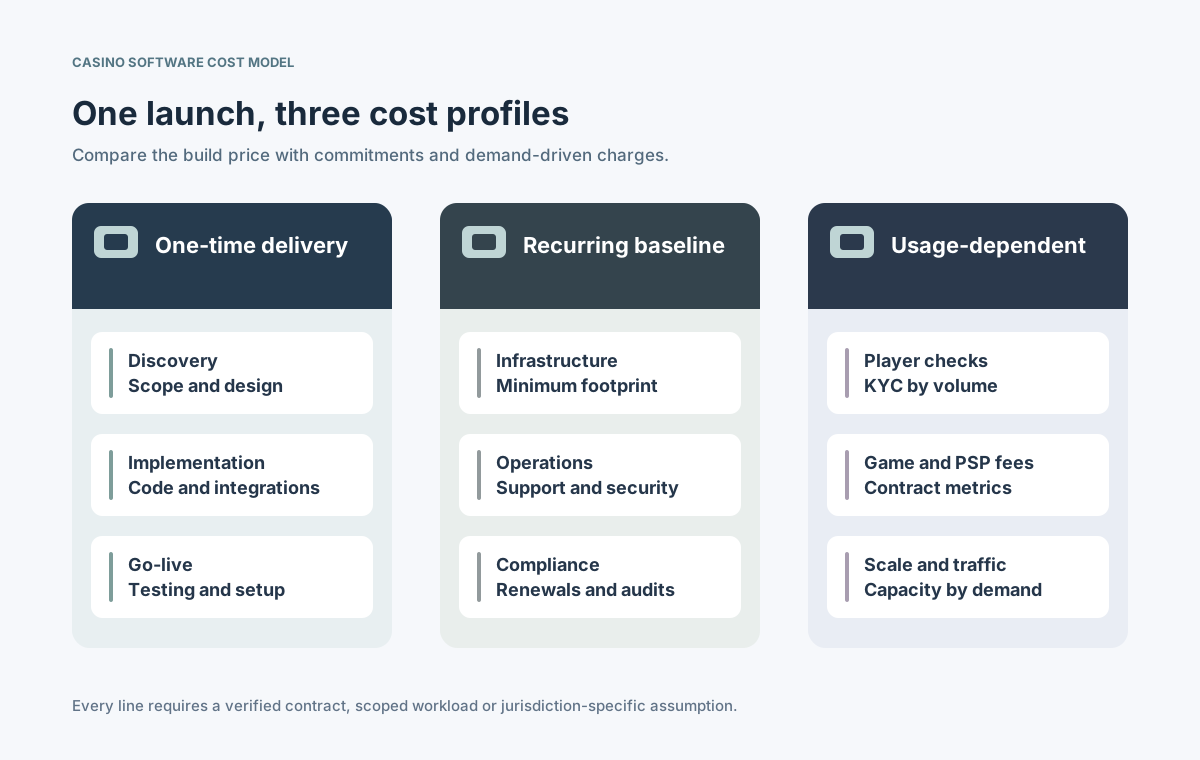
A casino platform quote can look affordable until the operator adds gaming content agreements, payment integrations, identity checks, licensing, production hosting, monitoring, incident support and future change requests. These costs do not behave alike: some are incurred once, some recur at fixed intervals, and others rise with players, transactions or markets. A reliable budget must therefore model a complete operating system rather than one development invoice. No defensible universal dollar amount exists for every white-label, turnkey or custom build; architecture, jurisdiction, service levels and negotiated contracts change the result. This guide provides a practical cost breakdown, a three-part total-cost-of-ownership model and questions that expose missing assumptions before purchase. [1] [2] [3]
Published
The launch build is a starting cost; reliable operations create an ongoing cost profile.
On this page
What counts as initial casino software cost versus ongoing expense?
Initial spending covers the work needed to design, integrate, test and launch the agreed scope. Ongoing spending keeps that platform available, secure, compliant and supported after the first release. Usage-based charges may appear from day one and increase even if the software team adds no new features. [1] [2]
Treat cost and cash timing separately. A prepaid annual contract is still an ongoing service commitment; a one-off integration paid in installments is still implementation work. Define the time horizon, currency, tax treatment and whether every quoted line includes vendor support and production environments. [3] [4]
Which budget items belong in each cost category?
Create a line-item inventory before comparing offers. Classify each expense by why it exists and when payment is triggered. Some services have both a one-time onboarding fee and a continuing minimum or unit charge, so one supplier can appear in more than one row. [1] [7]
Workstream
Initial cost example
Ongoing or variable example
Platform software
Design, setup, custom modules
Licence, updates, feature work
Game content
Aggregator and provider integration
Revenue share or usage terms
Payments
PSP onboarding and integration
Processing, disputes, reserves
Player identity
KYC workflow and rules setup
Checks, screenings, rechecks
Infrastructure
Provisioning, load tests, migration
Compute, storage, traffic, backups
Governance
Legal review, audit preparation
Renewals, reporting, support
This is an allocation framework, not a price list. Legal requirements, revenue-sharing formulas, minimum commitments and supported markets must come from current contracts and the correct regulator, never from a generic template. [3] [4]
How does the platform delivery model change the cost structure?
White-label, turnkey and custom platform proposals allocate ownership and work differently. A smaller setup bill can transfer costs to recurring licences, supplier-controlled changes or per-brand fees. A custom build may require more engineering before launch but permit a different long-term hosting and integration model. Neither is universally cheaper. [1] [2]
List code, data, domains, source assets, configurations and operational credentials that the buyer will actually control.
Separate included modules from paid extensions, provider connectors, jurisdictions and additional brands.
Confirm launch acceptance criteria, source-code access, documentation, upgrade path and support availability.
Price an exit scenario: data export, replacement integrations, transition support and contractual termination.
Compare all delivery models against the same defined scope and period. A proposal that excludes wallet reconciliation, fraud controls or a production disaster-recovery test is not directly comparable with one that includes them. [2] [6]
How can a casino budget connect build, operations and growth?
Start with a scope baseline: markets, brands, expected concurrent sessions, payment methods, game suppliers, player-verification workflows and availability target. Translate the design into a delivery budget, a minimum monthly run rate and a separately modeled usage curve. Cloud pricing tools can help estimate infrastructure from workloads, but they do not include every commercial or regulatory contract. [1] [2]
Freeze launch scope and list one-time delivery milestones, dependencies and acceptance evidence.
Estimate the recurring baseline for production, staging, monitoring, security, staffing and renewals.
Add per-transaction, per-verification, provider, storage and bandwidth formulas using actual contract units.
Run low, expected and high usage cases; review cash timing, reserve requirements and contingency separately.
⊕View largerOne cost category does not replace another: the budget combines delivery, baseline and demand.
Use a consistent forecast window, such as the first year plus later growth periods, and show assumptions explicitly. A lower monthly price is not comparable if one quote omits traffic, 24/7 response or minimum game-content commitments. [1] [7]
What do game, payment and identity providers add to the bill?
Third-party services may combine implementation charges, minimum commitments, volume tiers, revenue participation and fees for exceptions. The basis of each fee matters more than its marketing label. Ask whether transaction counts include failed attempts, reversals, manual reviews, multi-currency settlements and extra brands. Sumsub, for example, documents usage-, volume- and tier-based identity-check billing structures. [7]
Provider relationship
Contract unit to verify
Often overlooked question
Game aggregation
Minimum, content or revenue terms
Which studios and markets are included?
Payment service
Successful payment, refund, dispute
What happens with reserves and FX?
KYC and screening
Per check, tier, monthly minimum
Do rechecks or retries incur charges?
Communication
Message, delivery or verification
What do failed and cross-border sends cost?
Support and SLA
Plan, seats, incidents or hours
Is emergency coverage included?
Avoid assuming that one payment processor or content provider serves every licensed jurisdiction. Commercial eligibility, risk approval, provider availability and settlement rules must be checked before putting the rate into an investment model. [3] [4]
Where do licensing, testing and security costs enter the timeline?
Regulatory costs depend on the actual jurisdiction, activity and legal entity. The UK Gambling Commission distinguishes application and annual operating-licence fees, while the Malta Gaming Authority publishes its own application, annual-licence and compliance structures. Those frameworks are examples, not interchangeable worldwide rates. [3] [4]
Identify the intended market and licence type before assigning legal, regulatory and reporting costs.
Budget for required system documentation, independent testing and the evidence collection needed before approval.
Define payment-data exposure and assess applicable PCI DSS responsibilities with qualified specialists.
Include ongoing security testing, incident response, policy maintenance and secure-development practices.
A hosted payment page does not by itself prove that no PCI obligations remain; scope must be confirmed. NIST's SSDF offers a framework for budgeting security throughout development, not as a final one-time checklist. Reconfirm fee schedules and audit requirements at the point of application. [5] [6]
Which infrastructure and operational costs continue after go-live?
Production requires more than one web server. Include databases, queues, encrypted backups, logs, monitoring, incident communications, network transfer, disaster recovery and staging. High availability and resilience can increase the baseline footprint, while traffic and retention drive variable consumption. Estimate by workload, region and deployment topology. [1] [2]
Operating layer
Cost driver
Control or evidence
Application and DB
Capacity and redundancy
Peak tests, service SLOs
Storage and backups
Retention and restore copies
Restore drill results
Network and CDN
Transfers and geographic demand
Traffic forecast, unit metrics
Monitoring and security
Events, scans, logs, response
Retention policy, alert ownership
People and support
On-call, fixes, vendor SLA
Escalation and coverage matrix
Treat cloud estimates as adjustable models, not guaranteed invoices. Measure actual resource and vendor spend after go-live and revise usage forecasts. A budget without an owner for cost alerts, capacity planning and reconciliation will age quickly. [1] [2]
How should usage scenarios and financial sensitivity be tested?
A budget for an average month hides risks around launch peaks, promotions, extra jurisdictions and new payment methods. Model the number of active players, verification attempts, gaming sessions, financial movements, data volume and support cases. Each driver should map to a contracted cost unit or a measured resource. [1] [7]
Base case: committed minimum costs plus realistic activity and staffing requirements.
Peak case: temporary capacity, higher verification volume and traffic-related expenses.
Expansion case: added brand or market, new content contracts and regulatory work.
Stress case: outages, disputes, refund processing, restoration and transition reserves.
Do not infer profitability from software cost alone. Revenue, responsible-gaming limits, payment acceptance, tax, fraud loss and acquisition economics form separate financial assumptions. The purpose here is to reveal cost sensitivity and contractual breakpoints, not promise returns. [3] [4]
What expenses are commonly missing from an attractive quotation?
The omissions often sit outside the application feature list: a separate staging environment, test automation, operational handover, game-catalog updates, round-the-clock support, security verification, monitoring retention, settlement reconciliation and emergency supplier assistance. The buyer should assign an accountable owner to each line. [2] [6]
Provider integration certification and repeated testing after API changes.
Additional languages, jurisdictions, brands and regulatory reporting formats.
Data migration, rollback plan, export rights and termination assistance.
Provider minimums, verification rechecks, chargebacks and unexpected traffic.
Maintenance windows, incident coverage, disaster recovery and vulnerability remediation.
Distinguish a contingency allowance from a known recurring obligation. The former covers uncertainty; the latter belongs in the base forecast. Audit trails and operational responsibilities should be designed before launch to avoid expensive retrofits. [5] [6]
How should buyers compare proposals and approve a budget?
Ask all bidders for the same scope, currencies, assumptions and forecast horizon. Separate implementation milestones, monthly minimums, unit-based formulas, renewals, support levels and exit conditions. Validate the model with engineering, finance, operations and market-specific compliance owners rather than approving a headline total. [1] [2]
Publish a requirements matrix with ownership, included modules and explicit exclusions.
Request line-item pricing and formulas for base, peak and expansion workloads.
Verify provider approvals, licensing dependencies, data rights, SLAs and escalation coverage.
Run acceptance, security, load, recovery and financial-reconciliation tests before final sign-off.
Assign monthly budget reviews, invoice reconciliation and change-control authority after launch.
The outcome should be a traceable total-cost-of-ownership model and a contract schedule, not a single unsupported estimate. Revisit figures when vendors, regulation, geography or scale change. All jurisdiction-specific fees must be independently confirmed at the time of procurement. [3] [4] [7]