Wallet and Game Session Synchronization Across Channels
A casino player may open an account in a web browser, continue in a Telegram Mini App and then return to the original channel while a game round or withdrawal remains pending. The visual interfaces can be different, but the financial obligations must not split into two contradictory versions. Synchronization therefore concerns server-side identity, wallet authority, round ownership and event processing rather than copying a number between screens. This guide explains how to design those boundaries, how to handle retries and reconnects, and what to test before promising seamless play. Vendor game and payment contracts, jurisdictional rules and available platform APIs determine which continuity features are actually possible.
Published
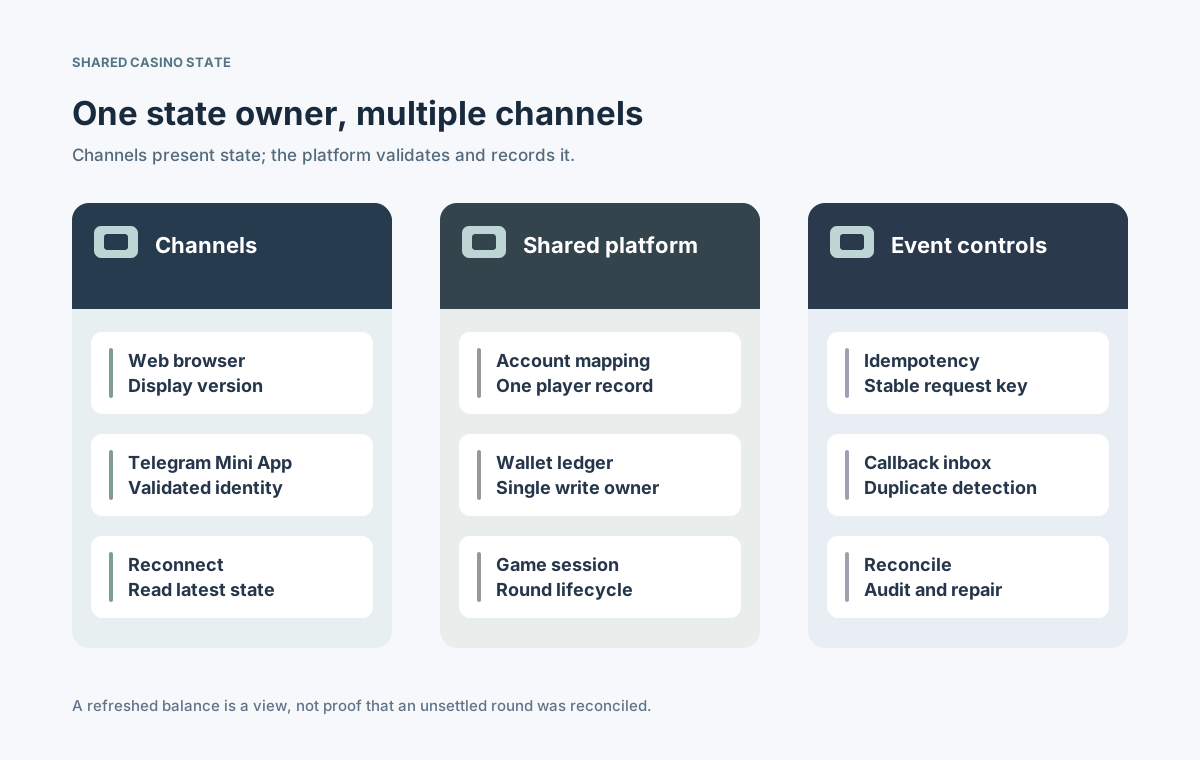
Two client channels read shared platform state; neither is an independent financial ledger.
On this page
What does cross-channel synchronization actually mean?
Cross-channel synchronization means that web and Telegram surfaces refer to the same verified player, wallet obligations and relevant game-round lifecycle. Each interface can render a locally cached view, but the backend decides what can be debited, credited, resumed or settled. The goal is consistent business meaning, not simultaneous animations or an identical interface on every device.
A synchronized account does not automatically provide transferable provider sessions. One game supplier may allow a round to resume on a different client, while another requires the previous session to finish or expire. Document those capabilities per integration, including pending wins, round identifiers and supplier callback timing.
Which states must be shared, and which can remain local?
Separate durable business state from short-lived presentation state. Identity mapping, restrictions, ledger movements and unsettled game results require an authoritative backend. A selected tab, an open modal or scroll position usually belongs to the client. Treat cached amounts as display hints until a fresh, versioned server response confirms them.
State
System of record
Channel rule
Player identity
Operator player account
Map verified channel identities
Cash and bonus wallet
Ledger with holds and versions
Show server-confirmed amounts
Unsettled game round
Round service and provider reference
Resume only when supported
Wager and settlement
Idempotent transaction records
Never replay a debit blindly
Deposit or withdrawal
PSP state plus operator ledger
Display pending status honestly
UI preferences
Client or optional profile storage
Can differ across channels
An operator should be able to trace any amount shown in either channel to an account, currency, wallet type, ledger version and relevant pending operation. The display may lag briefly, but it must not imply a completed settlement when the authoritative record remains pending.
How should a web account link to a Telegram user?
Telegram Mini Apps deliver signed initialization data that the backend must validate before trusting the embedded user fields. The raw initData is intended for server-side verification; initDataUnsafe is not trusted identity proof. Check the signature and freshness, then map the Telegram user to the correct operator account through an authorized linking process. [1]
Validate Telegram-origin data on the server and enforce an appropriate freshness window.
Require account ownership proof before merging a Telegram identity with a web player account.
Preserve existing KYC, age, exclusion and account restrictions across the linked views.
Offer revocation and audit trails for account links and sensitive changes.
Telegram Login is another documented integration surface, but it does not replace the operator's account, permissions or verification process. A Telegram identifier is not itself permission to access another wallet. Avoid silent account merges based only on matching usernames or contact details. [3]
What architecture keeps both channels consistent?
Use the browser frontend and the Telegram Mini App as clients of shared identity, wallet and game-session services. Financial commands should pass through one authorization and ledger boundary. Publish relevant state changes after durable commits; a transactional outbox is one pattern for avoiding a database update that succeeds while its event publication fails. [4]
Authenticate the channel and resolve the verified operator player ID.
Read current wallet and game-session versions from the authoritative services.
Submit a uniquely identified command, applying validation and a single durable state transition.
Publish or poll the resulting state and refresh all active channel views from the server.
⊕View largerClients share an operator account, one ledger owner and a controlled event pipeline; they do not settle funds with each other.
Do not confuse event notifications with the ledger itself. A notification may arrive late or twice, and a connection may disappear. The next authoritative read must still return the correct state even if no real-time update reached a particular device.
How can wallet debits and credits remain safe?
Every balance-changing command needs an immutable business reference, a clear currency and wallet type, authorization, and an idempotency policy. A repeated request with the same key should not create a second debit. Stripe's engineering discussion illustrates idempotency keys for safe retries, but casino wallet rules must be implemented and verified in the actual operator and supplier contracts. [7]
Operation
Required invariant
Failure to test
Wager debit
One debit per accepted wager ID
Browser and Mini App retry together
Win credit
One settlement per provider event
Duplicate or delayed win callback
Withdrawal hold
Pending amount not spendable
Switch channels before completion
Bonus movement
Separate cash and bonus rules
Eligibility changes mid-session
Balance view
Version and pending states shown
Stale cache after reconnect
A single visible balance may be derived from multiple ledger buckets and obligations. Avoid reconstructing spendable funds from independent client deltas. Reconcile opening balance, accepted transactions, holds and closing balance against server-side entries before treating a channel discrepancy as resolved.
Can a game round continue after switching channels?
A game round is not the same as a browser tab or Mini App session. The provider may own launch tokens, session expiry, round state and settlement references. The platform needs a server-side round record that identifies the player, supplier, game, currency, wager and current lifecycle. Channel switching must respect supplier rules instead of assuming an iframe can simply be reopened elsewhere.
Identify whether the previous round is open, settling, completed or disputed.
Ask the supplier integration for a supported resume or recovery mechanism before issuing a new launch.
Keep one owner for unsettled wagers, wins and refund callbacks regardless of the active channel.
If resume is unavailable, show a transparent pending status and a safe return path rather than manufacturing a new round.
Reusing a client launch token across trust boundaries may create security and session-lifecycle problems. Apply server-side session controls and regenerate credentials when authentication state changes. Supplier-specific behavior must be tested, not inferred from a generic game API. [6]
How should delayed callbacks and repeated events be handled?
Webhook or message delivery should be treated as potentially repeated and out of order. Telegram Bot API update_id helps detect repeated or misordered updates; standard distributed queues can also deliver duplicates. Neither mechanism guarantees an operator wallet will apply a supplier callback exactly once without application-level deduplication and durable transaction rules. [2] [5]
Event case
Server-side safeguard
Visible result
Duplicate supplier callback
Unique provider event and round key
No duplicate credit or debit
Out-of-order settlement
State machine and version guard
Pending until prerequisites arrive
Telegram update retry
Deduplicate by bot and update ID
No repeated business command
Publish failure after commit
Durable outbox and retry worker
Later channel refresh catches up
Conflicting channel actions
Atomic validation and one writer
One accepted result, one rejection
Record what was received, what was ignored as a duplicate, and what was left pending for investigation. Deduplication windows and keys must match business lifetimes; discarding a legitimate late settlement as an old duplicate can be as damaging as applying it twice. [4]
What happens when a device disconnects or a player returns?
Mobile clients lose connectivity, browsers sleep and Mini Apps may be relaunched. On reconnection, authenticate again as needed, obtain a server snapshot with a version or cursor, and reconcile subsequent events. An in-memory counter on the phone is not a reliable recovery source. Keep the current game-round status distinct from a newly started session.
Show that a wallet amount is updating rather than silently presenting old spendable funds.
Recheck pending payments, unsettled rounds and restrictions before allowing another wager.
Use server-issued versions or cursors to detect missing notifications after reconnect.
Expire abandoned launch tokens and allow safe recovery or an explicit restart when supported.
Avoid promising instantaneous consistency across every screen. A short propagation delay is manageable when backend decisions use fresh authoritative data and the interface accurately labels pending states. The risky failure is accepting a spend based on an outdated display.
Which security and operational boundaries matter?
Shared identity increases the importance of authentication, account linking and session revocation. Validate Telegram data as specified, enforce server-side authorization and limit the lifetime of privileged sessions. A valid Telegram launch proves neither ownership of a different casino account nor permission to bypass restrictions or local requirements. [1] [6]
Protect bot credentials, signing secrets and webhook endpoints; rotate them through controlled procedures.
Do not log sensitive session tokens, full financial credentials or unrestricted personal data.
Preserve KYC, self-exclusion, limits and operator audit trails regardless of channel.
Confirm vendor, payment and game-provider permissions for cross-channel launches and state sharing.
Jurisdiction-specific gaming rules, app-platform policies, data handling and player protection obligations vary. Review them with responsible specialists; a technical architecture is not evidence of licensing, certification or contractual access.
What should the acceptance test cover before launch?
Test real transition points, not only that a balance label looks equal in both interfaces. Use controlled test accounts and supplier-supported test environments to verify ledger entries, round lifecycles, login boundaries and recovery. Capture trace IDs and expected outcomes so engineering, finance and support can reconcile a discrepancy without guessing.
Start on the web, switch to Telegram during an open round, and verify the supported resume or pending path.
Simulate simultaneous wager attempts from both channels against one wallet balance.
Replay a delayed win, payment callback and Telegram update; confirm each business effect occurs once.
Disconnect both clients, restore sessions safely and compare wallet, hold, game and audit states.
Do not sign off on cross-channel continuity until the same account restrictions, money movements and unresolved operations remain explainable through failure and recovery. The practical goal is traceable, correct shared state; smooth UI transitions come after financial and session integrity. [4] [5] [6]