Managing Game Availability Across Markets and Currencies
A multi-market casino catalog is not a single global list translated into different languages. Game availability can depend on the operator's authorized market, local product rules, a supplier's permissions, the exact game version, the player's verified eligibility, supported wallet currency and a temporary provider outage. A currency displayed in the lobby is not a licence to offer games, and a language or IP address alone cannot establish a player's lawful eligibility. Operators therefore need a controlled availability decision that governs both discovery and the server-side game-launch request. This guide explains how to model the decision, reconcile changing supplier catalogs, handle caches and existing sessions, and test evidence before a new market goes live. Regulatory references illustrate that requirements differ by jurisdiction; they are not a legal determination for any operator or market. [1] [2] [3] [4]
Published
One supplier catalog can produce different lawful and operational game assortments for different markets and wallets.
On this page
What does game availability mean in a multi-market casino?
Game availability is the decision that a specific operator may offer a specific game version to an eligible player in a defined market at a given time. It involves more than a provider's catalog feed: the provider may expose an entry that the operator cannot lawfully or operationally launch. Regulatory and testing requirements differ by jurisdiction, so an approved market-product combination must be documented rather than inferred. [1] [2]
Separate three concepts: discoverability in the lobby, eligibility for an actual game session, and technical reachability of the supplier. A game may be licensed but temporarily offline, or technically reachable while prohibited for a particular account. Each state needs a clear user message and an authoritative reason in the back office. [1] [6]
Which rules determine whether a player sees a game?
A reliable policy engine combines regulator and operator scope, supplier agreements, tested game/version coverage, player restrictions, currency configuration and runtime status. Each condition should have an owner, authoritative source, effective date and failure behavior. The UK Gambling Commission, for example, distinguishes software supplied into different jurisdictions and the technical obligations applicable to its licensees. [1] [2]
Eligibility dimension
Example question
Control owner
Jurisdiction and licence
May this operator offer this product here?
Compliance and market team
Provider and game approval
Is this exact game version permitted?
Supplier operations
Player status
Are verification and account limits satisfied?
PAM and compliance
Wallet currency
Does the configured game session support it?
Wallet and integration team
Device or channel
Is this game supported in this client context?
Product and QA
Runtime availability
Is the supplier presently accepting launches?
Monitoring and operations
A useful policy responds with an explicit outcome such as ALLOW, HIDE, BLOCK_LAUNCH or TEMPORARILY_UNAVAILABLE and a machine-readable reason. A supplier response should not silently override a regulator- or account-level block. [1] [6]
How should the market and currency eligibility matrix work?
Model availability using stable operator, jurisdiction, supplier, game ID, game version and currency identifiers. Separate base permission from transient service health. This permits precise overrides without maintaining an entirely different handwritten catalog for every language and storefront. Currency codes should follow a maintained authoritative reference such as ISO 4217; the code itself does not imply game or payment support. [3]
Maintain explicit allow or deny entries by operator, market, provider, game and effective period.
Record the supplier's external game ID and a stable internal canonical ID, including version changes.
Store supported wallet/settlement currencies and any provider-side configuration separately from market permission.
Give every restriction a provenance record, approval owner, timestamp and review deadline.
When a rule is missing or conflicting, deny the launch and route the case for review. A default-global-allow shortcut may make a lobby look complete but creates unexplained access across markets. [1] [2]
Where must the platform enforce availability during game launch?
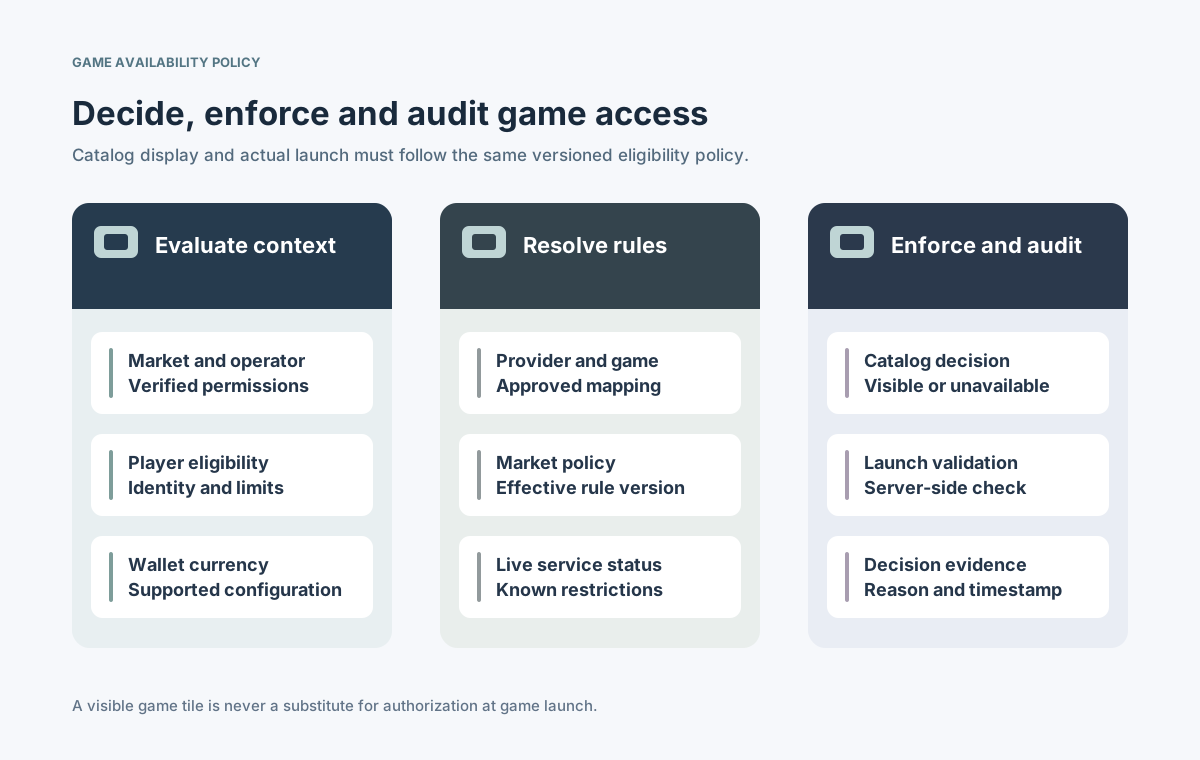
Eligibility cannot live only in front-end filters. The game-launch API must independently resolve the current account, intended market, game ID, wallet currency and approved provider configuration before issuing a launch token or redirect. A copied deep link, stale lobby cache or direct API call must not bypass this gate. [1] [6]
Resolve the authenticated player, operator and trusted market context; refuse ambiguous eligibility.
Fetch or validate the effective policy version and account restrictions for the exact game and currency.
Check current provider status, then request a short-lived launch session using the approved mapping.
Record the decision code and correlation ID; return a localized unavailable reason without exposing sensitive rules.
⊕View largerThe same policy determines the visible catalog and the final server-side launch decision.
The lobby may show a cached availability snapshot for performance, but launch must revalidate against the authoritative rule. Use explicit response codes for denied, temporarily unavailable and provider-error outcomes to avoid confusing players and support staff. [5] [6]
How do currencies affect game configuration and settlement?
A game provider can support a market without supporting every wallet currency, denomination, stake range or settlement path. Maintain exact integration capabilities and test currency changes end to end; ISO 4217 provides currency identifiers, not conversion rates or gaming permissions. Avoid silently converting balances or assuming every game accepts the displayed currency. [3]
Currency layer
Required mapping
Typical failure
Player wallet
Authoritative balance currency
Displayed balance is misleading
Game configuration
Currency and denomination support
Game refuses to launch
Stake and payout
Validated units and precision
Amounts are misinterpreted
Provider settlement
Transaction and reconciliation currency
Ledger mismatch
Lobby display
Localized presentation and formatting
Symbol suggests wrong currency
If conversion is an allowed part of the product, document the rate source, rounding policy, exchange timing and ledger entries. An unsupported currency should yield a clear unavailable status, not an unapproved fallback to another currency. [3]
How should supplier catalog changes be synchronized?
Aggregators receive additions, retirements, renamed entries, game-version changes and temporary provider restrictions. Ingestion should stage each supplier snapshot, reconcile it with known IDs and compare it with the last approved operator-market matrix before publication. A newly supplied game is a candidate, not automatically an authorized live offering. [1] [2]
Ingest provider metadata into a versioned staging catalog without making it immediately playable.
Detect additions, withdrawals, changed game IDs, altered currency capabilities and conflicting mappings.
Review jurisdiction and supplier approvals, then approve a bounded catalog version for rollout.
Reconcile the published lobby, launch API, caches and provider health against that approved version.
Keep tombstones and historical mappings for withdrawn games so previously recorded sessions and settlements remain explainable. Reject duplicate supplier identifiers or ambiguous canonical mapping instead of guessing the right game. [6]
How do caching and rollouts prevent stale game availability?
Caching improves lobby performance but introduces a dangerous interval between a rule change and its visible effect. HTTP caching standards explain freshness, expiry and revalidation; operators must additionally design application-level cache keys and invalidation around market, operator, account segment and currency. A catalog response for one context must never leak into another. [5]
Change or event
Cache treatment
Required safeguard
Game or supplier withdrawal
Invalidate affected entries
Launch blocks immediately
New market rule
Publish new policy version
Atomic rule activation
Currency support change
Refresh currency-scoped views
Exact launch validation
Provider outage
Short health-state expiry
Temporary error state
Configuration rollout
Staged exposure and rollback
Decision metrics and audits
Feature-flag systems illustrate staged configuration and rollback controls, but a flag is not itself legal authorization. Keep deny rules authoritative and make server-side launch validation independent of stale edge or mobile caches. [5] [6]
What role do location, language and account context play?
Geolocation is one input, not proof of a player's permitted jurisdiction. MaxMind states that IP geolocation cannot be perfectly accurate and may identify a VPN or network endpoint rather than the user. Combine location signals with the operator's approved verification and location-control process, applying the requirements of the actual jurisdiction. [1] [4]
Keep account residence, verified physical presence, IP signal and market assignment as separate fields.
Recheck eligibility after travel, account changes, session renewal or conflicting location information.
Use locale tags for content presentation, not as a substitute for market permission.
Apply the strictest unresolved block until the relevant eligibility evidence is verified.
IANA maintains language subtags for language identification; a language choice is not a territory code or licence. Likewise, wallet currency is a payment characteristic, not a reliable proxy for where a player is located. [3] [7]
What happens if availability changes during an active game session?
A game may become unavailable after the player launches it because of a provider outage, a policy change, loss of eligibility or a removed game version. The platform needs separate rules for starting new rounds, handling in-flight transactions and displaying the session state. Never silently drop a completed wager or discard a pending settlement because a lobby tile was hidden. [1] [2]
Block new launches or new rounds as soon as an effective restriction requires it.
Preserve provider correlation IDs, transaction references and the policy version used at launch.
Route unsettled wagers through the approved reconciliation and incident process.
Show a truthful status such as unavailable, temporarily interrupted or settlement pending.
Keep support and audit teams able to trace why the catalog or launch decision changed.
A documented transition plan should cover provider callback delays, re-entry attempts, disputed results and a future restoration of access. User communication must reflect the actual state of the game and wallet. [1] [6]
What should teams test before opening another market?
Before release, run a decision matrix across permitted and prohibited markets, supported and unsupported currencies, verified and restricted players, game versions and supplier outages. Have compliance approve jurisdiction-specific assumptions while engineering verifies catalog filtering, direct launch calls and reconciliation outcomes. A generic worldwide catalogue demo is not evidence of multi-market readiness. [1] [2]
Test valid and invalid operator-market-game-currency combinations with recorded policy versions.
Attempt direct launch against hidden, retired, restricted and temporarily offline games.
Force cache staleness, provider catalog changes, feature-flag rollback and currency mapping errors.
Verify location ambiguities, account restrictions, language variants and active-session transitions.
Capture decision logs, approval records, settlement outcomes and rollback evidence for sign-off.
The measurable goal is a catalog where discovery, launch and financial records agree on a controlled decision. Confirmed market permissions, provider contracts, currency mappings and test results must be reviewed as the platform expands—not inferred from a game tile appearing on screen. [1] [3] [5]